The Markup: Courts, governors protect voters
Welcome to the Markup, Voting Rights Lab’s weekly digest of election law and policy updates. We’re tracking 1,670 bills this session across 44 states and D.C. This week, we take a look at the breaking Supreme Court decision in Watson v. RNC, a series of legal setbacks for the Trump administration, and noteworthy vetoes out of Arizona and Ohio. Let’s dig in.
The Good News
U.S. Supreme Court upholds state mail voting deadlines.
In Watson v. RNC, the Supreme Court rejected a challenge by the Republican National Committee (RNC). The RNC challenged laws of 14 states and D.C. that accept mail ballots after Election Day, so long as they are postmarked by Election Day. The decision upholds laws in these states and another 16 states that accept ballots from overseas and military ballots based on postmark dates.
Trump administration faces setbacks in court as judges block executive orders, citizen database, and DOJ attempts to obtain state voter rolls.
In Massachusetts district court, judges in two cases issued rulings blocking President Donald Trump’s election-related executive orders. One ruling was the first in the nation to block the president’s 2026 executive order seeking to block the U.S. Postal Service from delivering ballots to voters who are not on approved lists. The other decision was a permanent injunction against Trump’s 2025 executive order, which would have imposed a proof-of-citizenship requirement for voter registration.
A Washington, D.C., district court judge ruled that the Department of Homeland Security’s reforms to the SAVE (Systematic Alien Verification for Entitlements) system violated multiple federal laws. These flawed reforms led to citizens having their registrations erroneously flagged.
The Sixth Circuit Court of Appeals affirmed the dismissal of a lawsuit brought by the U.S. Department of Justice (DOJ) against Michigan seeking access to its voter rolls. This was the first appeals court to weigh in on the DOJ’s attempts. Meanwhile, district courts in Maryland and Pennsylvania dismissed similar DOJ attempts, giving the department its 9th and 10th losses in district court on this issue.
Georgia governor signs bill delaying ban on ballots that use QR codes for vote tabulation.
Gov. Brian Kemp signed S.B. 3EX, which gives officials until 2028 to transition to new voting equipment. S.B. 189 — enacted in 2024 — required counties to stop using ballots tabulated with QR codes or barcodes by July 1 of this year. The legislature did not fund new equipment purchases for counties, and it was unclear how the midterm elections would be conducted if this deadline were not delayed. The bill also revises recount requirements, creates an election equipment selection committee, and temporarily modifies the secretary of state’s oversight of election equipment.
Delaware House passes Voting Rights Act and voting rights restoration constitutional amendment.
The Delaware John Lewis Voting Rights Act (H.B. 444) would establish protections against voter suppression and vote dilution; improve access for language minorities; and require courts to interpret laws in favor of the right to vote. H.B. 180 would amend the state constitution to restore voting rights to individuals with past felony convictions immediately upon release from incarceration. Under current law, felony convictions result in loss of voting rights until completion of probation and parole, and some convictions disenfranchise people permanently. Both bills next go to the Senate for consideration. For the constitutional amendment to go into effect, it must be passed by a two-thirds majority in a second consecutive legislative session. Another pro-voter constitutional amendment, which would have created same-day registration, failed in the House.
Michigan Senate advances package of voter protection and assistance bills.
The Senate passed several measures: S.B. 961 (establishes a State Voting Rights Act); S.B. 962 (creates a statewide elections data institute and database); S.B. 963 (requires language assistance for voters in qualifying jurisdictions); and S.B. 964 (establishes statewide curbside voting and permits food, water, and other necessities to be provided to voters waiting in line). Several of the measures are interdependent and would only take effect if companion bills in the package are also enacted. The bills now move to the House for consideration.
Ohio governor vetoes restrictive voter ID bill.
Gov. Mike DeWine vetoed H.B. 472, a bill that would have required mail voters to provide a photo ID when applying for a mail ballot and again when returning their voted ballot. In his veto message, the governor said the bill would impose unnecessary burdens on absentee voters while not improving election security. Some legislators are considering attempting to override the veto.
Arizona governor vetoes bills curtailing voter access, privacy, and more.
Gov. Katie Hobbs vetoed S.B. 1060 (strips voting rights from children of U.S. citizens born abroad with a parent who last resided in Arizona), S.B. 1040 (makes voter registration lists free and public and allows the release of voters’ private information), and S.B. 1037 (establishes burdensome and costly security provisions).
On Our Radar
U.S. Supreme Court takes up Arizona proof-of-citizenship case, lets stand ruling further limiting the Voting Rights Act.
The Supreme Court this morning agreed to hear RNC v. Mi Familia Vota next term. In this case, advocates challenged Arizona laws that prohibited citizens from voting for president or voting by mail unless they showed a passport or birth certificate; required officials to throw out all state registration forms that did not include proof of citizenship (even though these voters would still qualify for some federal elections); and required county recorders to cancel voter registrations if they “have reason to believe” someone is not a citizen.
The Supreme Court declined to take up Arkansas United v. Thurston. In this case, the Eighth Circuit Court of Appeals held that cases to enforce the Voting Rights Act can only be brought by the U.S. Department of Justice – not impacted individuals. By declining to take up the case, the Supreme Court left this ruling in place, affecting residents of Arkansas, Iowa, Minnesota, Missouri, Nebraska, North Dakota, and South Dakota. Voters in those states will no longer be able to sue state or local governments over discriminatory voting policies.
Texas lawmakers voice concerns about the state’s voter registration system.
During an interim Senate State Affairs Committee hearing, legislators questioned the secretary of state’s office about ongoing issues with the state’s voter registration system, known as TEAM. That system has faced criticism since an update last summer created functionality issues — made worse when a third-party voter-registration vendor used by Texas’s largest counties went out of business.
Arizona election officials continue to spar over duties; court orders mediation.
The Maricopa County Board of Supervisors and County Recorder Justin Heap will be compelled to enter mediation under a recent order from the Arizona Supreme Court. Since 2025, the board and the recorder have fought for control over various elements of election administration that are divided between the two offices. In June, an appeals court issued a stay to preserve the status quo, meaning IT staff and systems will remain under the board’s purview as mediation and the overall appeals process continue.
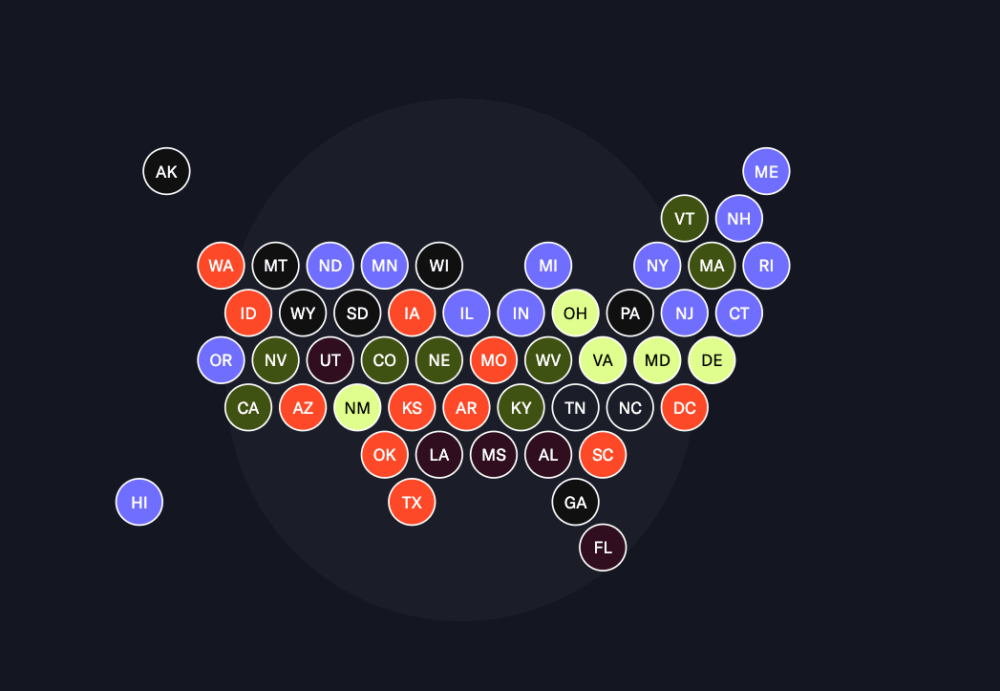
Election Policy Tracker
Explore our Election Policy Tracker for real-time updates and analysis.
Want weekly updates?
Subscribe to The Markup.