The Markup: USPS moves to implement Trump EO; NH proof-of-citizenship mandate blocked by court
Welcome to the Markup, Voting Rights Lab’s weekly digest of election law and policy updates.
We’re tracking 1,644 bills this session across 44 states and D.C. This week, all eyes are on the U.S. Postal Service, which just proposed new rules that could restrict access to mail voting ahead of the midterms. Meanwhile, a federal court blocked New Hampshire’s extreme proof-of-citizenship mandate, and high-stakes redistricting battles continue to play out in the South. Read on for more.
Good News
New Hampshire federal court blocks proof-of-citizenship mandate; legislature moves bills to lessen mandate’s burden.
The federal district court in New Hampshire blocked provisions of a 2024 law that required voters to provide proof of citizenship, such as a passport or birth certificate, to register to vote. This ruling restores voters’ ability to confirm citizenship by signing an affidavit under penalty of perjury. The attorney general’s office announced the state would appeal. New Hampshire’s law was the closest in the country to President Donald Trump’s vision of a nationwide proof-of-citizenship mandate.
Meanwhile, the state advanced new legislation to make it easier for voters to comply with the proof-of-citizenship requirement. Gov. Kelly Ayotte signed H.B. 365, directing the secretary of state to try confirming the citizenship of voters who cannot provide proof by checking available databases. The law also creates a voucher program to help voters afford to obtain birth certificates or other necessary documents. Additionally, lawmakers sent S.B. 438 to the governor’s desk. S.B. 438 requires the secretary of state to develop and maintain a centralized voter registration database linked to state driver’s license data. This database will help election officials confirm voters’ citizenship status at polling places.
California enacts law to protect against federal election interference; legislature advances pro-voter bills.
Gov. Gavin Newsom signed S.B. 73 into law, a bill intended to protect election materials and systems from unauthorized access and interference. The state legislature also passed a series of pro-voter bills. The Senate passed bills that would establish a secure ballot return method for military and overseas voters (S.B. 970), expand drop box availability (S.B. 884), and expand voter education initiatives (S.B. 1420). The Assembly passed a bill to establish a process for voters to correct mail ballot errors via text message (A.B. 2604) and another requiring local officials to notify the secretary of state and attorney general of any subpoena, warrant, or investigation, and authorize the attorney general to intervene (A.B. 1664). These bills are now headed to the opposite chamber for consideration.
New York Senate passes bills to protect voter access and recruit poll workers.
The Senate advanced legislation that would protect voters against mass, unsubstantiated challenges (S.B. 3233) and improve the process for military and overseas voters by eliminating the requirement that military and overseas voters submit duplicative paper applications and moving the application deadline from 35 days before an election to 10 days before an election (S.B. 7689). They also advanced legislation that would exempt poll worker compensation from state income tax and from benefits-eligibility calculations (S.B. 5142).
The Bad News
USPS proposes rule to implement Trump executive order on mail voting, as court rules legal challenge is premature.
The U.S. Postal Service (USPS) issued a proposed rule to implement President Donald Trump’s March 2026 executive order on elections. The proposal would grant the postal service an unprecedented new role in election administration. The rule would require state officials to submit lists of voters who have requested mail ballots at least 30 days before ballots are mailed out and direct USPS to refuse delivery of ballots to voters not on those lists.
Just a day before the USPS published its new rule, a federal district court judge in D.C. denied motions seeking preliminary injunctions against parts of the same executive order that directs federal officials to prepare “state citizenship lists” and send them to state officials. The order also directs the U.S. Postal Service to implement certain rules about mail ballot envelope design and processing. The judge found that, because the policies were not yet being implemented, the plaintiffs could not demonstrate a risk of immediate harm. Tomorrow, a federal court in Massachusetts will hold a hearing on a case challenging the executive order brought by 23 states and D.C.
On Our Radar
Arizona county battles over authority to set drop box locations.
After the Maricopa County Board of Supervisors unanimously approved voting and drop box locations for the state’s July 21 primary, Maricopa County Recorder Justin Heap threatened criminal charges against election workers who collect ballots from those drop boxes. Heap argues that only his office can set early voting locations. However, the Election Procedures Manual, which has the force of law, directs county boards of supervisors to approve all ballot drop-off locations. This dispute has the potential to disenfranchise voters and create unnecessary confusion ahead of the primary.
Arizona governor vetoes bill that would insert legislators into election rulemaking.
Gov. Katie Hobbs vetoed S.B. 1237, which would have required the secretary of state to consult with legislators when drafting the Election Procedures Manual. Current law requires the secretary of state to consult with county boards of supervisors or other officials responsible for elections.
Wisconsin lawsuit seeks to establish uniform cure process.
The League of Women Voters of Wisconsin filed a lawsuit seeking to establish a statewide system for voters to correct errors or provide missing information from mail ballot envelopes. Under current law, these processes exist at the discretion of local clerks. Wisconsin is among a minority of states without a statewide cure process.
DOJ loses lawsuits over access to state voter rolls in Maine and Wisconsin.
Federal courts in Maine and Wisconsin dismissed lawsuits filed by the U.S. Department of Justice (DOJ) seeking access to state voter rolls, including voters’ sensitive personal information. The DOJ has now lost eight similar lawsuits. Similar suits are still pending in roughly 20 other states.
Supreme Court sends Voting Rights Act cases back to lower courts following Callais decision.
The U.S. Supreme Court vacated decisions in two cases and remanded them to lower federal courts for reconsideration in light of its recent ruling in Louisiana v. Callais. Both cases challenge the right of private (non-government) plaintiffs to challenge legislative maps under Section 2 of the federal Voting Rights Act. Federal appellate courts will now determine whether the Callais decision impacts their prior decisions.
Florida and Tennessee redistricting efforts upheld by courts as Alabama’s map is blocked; Louisiana adopts new maps, while South Carolina effort stalls.
State courts in Florida and Tennessee upheld those states’ recent congressional redistricting, setting them up for use in this year’s midterms. Meanwhile, the three-judge federal panel overseeing litigation over Alabama’s congressional map issued a new preliminary injunction, reiterating its finding that the map was intentionally discriminatory. The U.S. Supreme Court had directed the panel to review its findings in light of Louisiana v. Callais. The state has asked the Supreme Court to weigh in again.
Louisiana Gov. Jeff Landry signed a new congressional map, reducing the number of majority-Black districts from two to one. The state’s prior map was blocked by the U.S. Supreme Court last month in Louisiana v. Callais. In South Carolina, the Senate adjourned a special session without passing a new congressional map. This likely leaves the current map in place for the midterm elections; the state’s primary is on June 9.
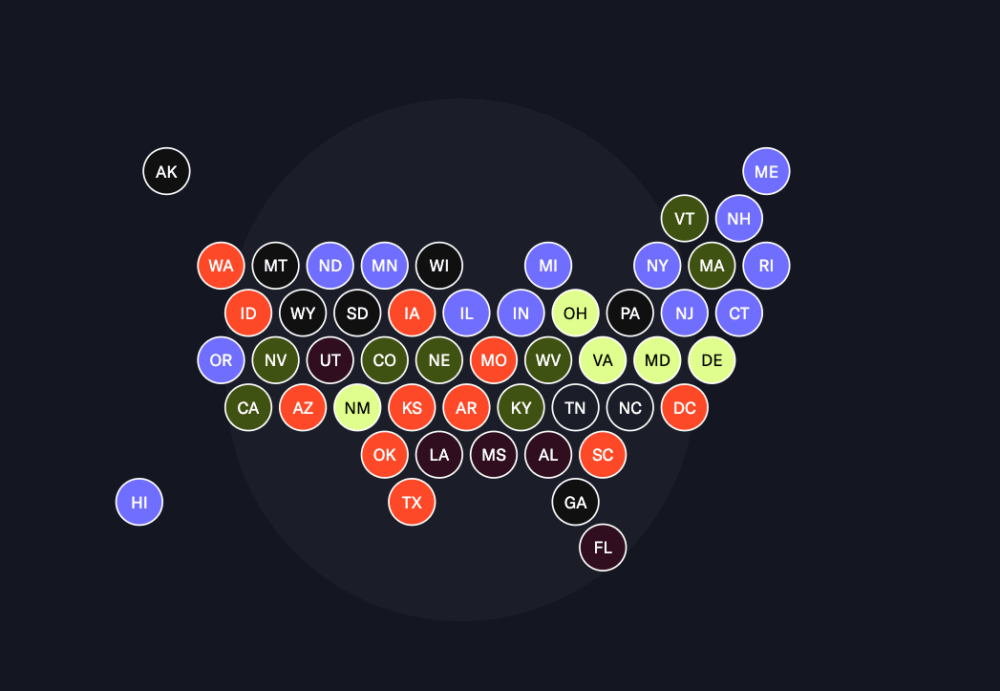
Election Policy Tracker
Explore our Election Policy Tracker for real-time updates and analysis.
Want weekly updates?
Subscribe to The Markup.