The Markup: Courts weigh federal election interference amid redistricting chaos
Welcome to the Markup, Voting Rights Lab’s weekly digest of election law and policy updates.
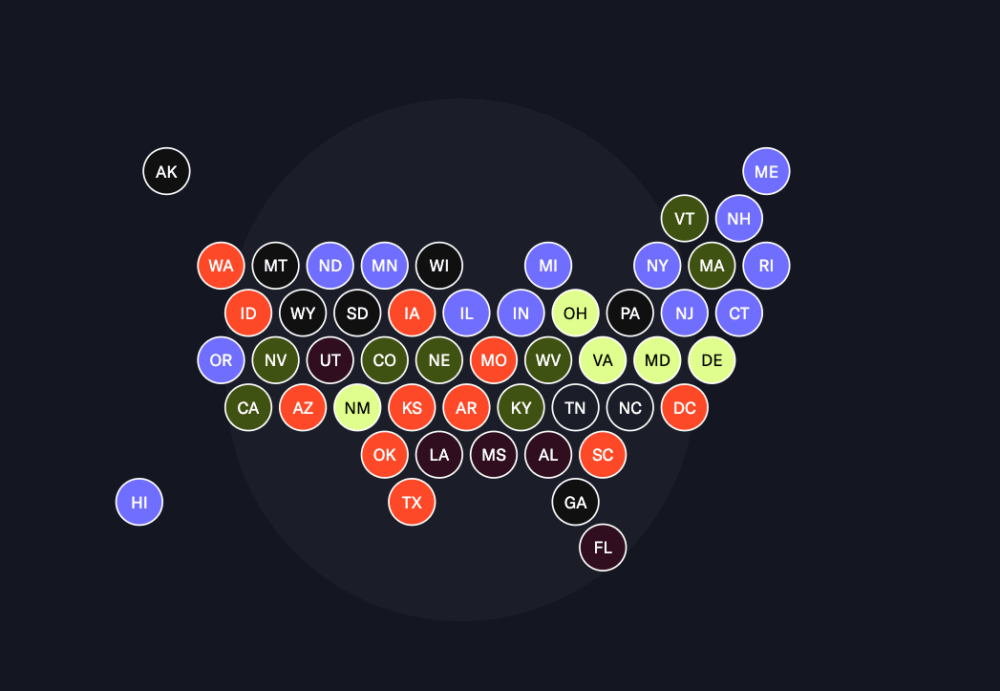
This week, we’re tracking 1,620 bills this session across 44 states and D.C. We’re continuing to follow redistricting efforts in the wake of the Louisiana v. Callais decision. We’re also tracking a suite of bills to improve elections in Maryland, as well as several court actions in Wisconsin, Montana, and D.C. Read on for more.
Good News
Maryland enacts package of bills improving election administration and voter access.
The measures aim to simplify ballot measure language, prevent the use of election-related deepfakes, streamline voter registration upon release from incarceration, and more.
Montana court preserves same-day voter registration while litigation plays out.
In 2025, lawmakers passed a bill to end same-day registration at noon on Election Day for voters casting ballots in federal races. A district judge determined earlier this month that the legislation would disproportionately affect Native American and young voters. The judge blocked the law from going into effect during litigation. A previous attempt to eliminate same-day registration on Election Day was ruled unconstitutional by the state Supreme Court in 2024.
Wisconsin judge reverses WEC decision and orders 23 “late” mail ballots to be counted.
In the recent state Supreme Court election, 23 mail ballots were sent on time but delivered late to local precincts for counting. A Dane County judge reversed a decision by the Wisconsin Election Commission (WEC) that ordered Madison to remove 23 ballots from its final count.
On Our Radar
Federal courts hear arguments over White House and DOJ actions on elections.
A district court judge in Washington, D.C., heard arguments in a challenge to President Donald Trump’s March executive order. The executive order aimed to create various federal voter lists and limit the delivery of mail ballots. Additionally, a federal appeals court heard arguments in a case involving the U.S. Department of Justice’s effort to obtain Michigan’s unredacted voter registration records containing sensitive information. The DOJ argues that it is entitled to inspect election materials under a provision of the 1960 Civil Rights Act. A lower court blocked the government’s request earlier this year. The case is part of a broader federal effort to obtain voter data from states nationwide.
Wisconsin election officials contacted by the FBI.
FBI agents have attempted to speak with the Milwaukee County elections director and other election workers. Initial reporting indicates the investigation is focused on absentee ballots cast during the 2020 presidential election. The FBI has launched investigations in Georgia and Arizona in recent months, while the DOJ recently demanded access to 2024 ballots in Michigan.
Georgia and South Carolina call special sessions for redistricting; Missouri court allows new maps to take effect; Alabama schedules special primary election; and activists file challenge to Illinois maps.
Georgia Gov. Brian Kemp called a special session for June, when legislators will consider redrawing congressional and legislative maps for 2028.
South Carolina Gov. Henry McMaster called a special session to consider new congressional maps that would eliminate the state’s sole majority-Black district ahead of the 2026 midterms. The legislature previously voted against extending its regular session.
The Missouri Supreme Court upheld the state’s new congressional map, rejecting several challenges. One challenge attempted to delay the map from taking effect unless Missouri voters approved it in a referendum this November. That referendum could still appear on the ballot if the secretary of state approves the signatures submitted by its backers.
Alabama Gov. Kay Ivey called a special primary election for August, to be held using maps drawn in 2023. Federal courts previously blocked the maps, but the U.S. Supreme Court reversed the lower court’s decision. This special election means officials will toss out tens of thousands of votes cast during the state’s May 19 primaries.
In Illinois, a conservative legal group filed a federal lawsuit. The lawsuit alleges that Illinois’ rules for drawing congressional and state legislative districts, contained in the state’s Voting Rights Act, violate the U.S. Constitution and the Voting Rights Act following the Supreme Court’s decision in Callais.
Election Policy Tracker
Explore our Election Policy Tracker for real-time updates and analysis.
Subscribe to The Markup for weekly updates.