The Markup: Strict voter ID, poll worker recruitment bills advance amid redistricting chaos
Welcome to the Markup, Voting Rights Lab’s weekly digest of election law and policy updates.
We are tracking 1,612 bills prefiled or introduced this session across 44 states and D.C. This week, we’re continuing to follow state redistricting efforts in light of the recent Supreme Court decision in Louisiana v. Callais. We also have our eyes on efforts to improve poll worker recruitment, expand drop box access, and tighten voter ID laws. Read on for more.
Jump to section:
Good News
Legislatures in New York, Oklahoma, and South Carolina advance poll worker recruitment bills.
In New York, the Senate passed a bill to increase the minimum pay for election workers. In addition, the Assembly approved legislation that would allow more college students to serve as poll clerks. Both bills now advance to the opposite chamber.
The Oklahoma House approved a bipartisan bill to grant county employees paid leave to serve as election workers. The bill now returns to the Senate for concurrence before it can head to the governor’s desk.
In South Carolina, the Senate passed a bill (H.B. 3551) that exempts poll workers’ compensation from state income taxes. The bill now goes to the House for concurrence with Senate amendments.
Colorado Senate advances bill expanding drop box availability.
The Senate passed a bill (H.B. 1113) which would make drop boxes available starting 22 days before an election, up from 15 days under current law. The bill would also expand the number of schools that must provide on-campus drop boxes. The bill now moves to Gov. Jared Polis for his signature.
Bad News
Louisiana Senate passes bill establishing strict voter ID requirement.
S.B. 319 would eliminate the option for voters who show up at the polls without acceptable identification to sign an affidavit in its place. Voters could meet the requirement with a photo ID or a combination of non-photo documents, such as a Social Security card and a utility bill. Under current law, voters are asked to provide a photo ID. The bill now moves to the House for consideration.
Iowa eliminates exception to voter ID requirement.
Gov. Kim Reynolds signed H.B. 2501 into law. The law removes an exception that permitted a person without identification to vote a regular ballot if another registered voter attested to their identity.
Alaska governor introduces more restrictive election omnibus proposal after veto.
Following his veto of S.B. 64 and a failed override attempt from the legislature, Gov. Mike Dunleavy introduced companion election reform bills (S.B. 289/H.B. 390) in each chamber. The new bills would add new mail ballot verification requirements. They also retain elements of S.B. 64, which expanded the number of accepted voter IDs and created a cure process for mail ballots at risk of rejection. The bills will need to move quickly, as Alaska’s legislative session ends on May 20. S.B. 289 is scheduled for its first committee hearing tomorrow.
On Our Radar
Virginia Supreme Court invalidates redistricting referendum; fallout from U.S. Supreme Court’s Callais decision continues across states.
The Virginia Supreme Court invalidated a referendum — passed by voters last month — on procedural grounds. The decision means the state must revert its U.S. House districts to those adopted after the 2020 census.
Meanwhile, Tennessee Gov. Bill Lee signed a new congressional map into law. The map splits up the Memphis-based 9th Congressional District, which had been the state’s sole majority-Black district.
Alabama Gov. Kay Ivey signed legislation that could allow the state to hold a special primary, contingent on the U.S. Supreme Court lifting an injunction. The primary would be held under maps adopted in 2023 but blocked by courts. This change would eliminate a plurality-Black district.
In Louisiana, lawmakers debated and heard testimony on proposed maps in light of the Callais decision. Most of these maps would eliminate one or both of its majority-Black districts. A vote is expected this week.
In South Carolina, the legislature is debating whether to extend its session to consider drawing a new map that would eliminate the state’s sole majority-Black district.
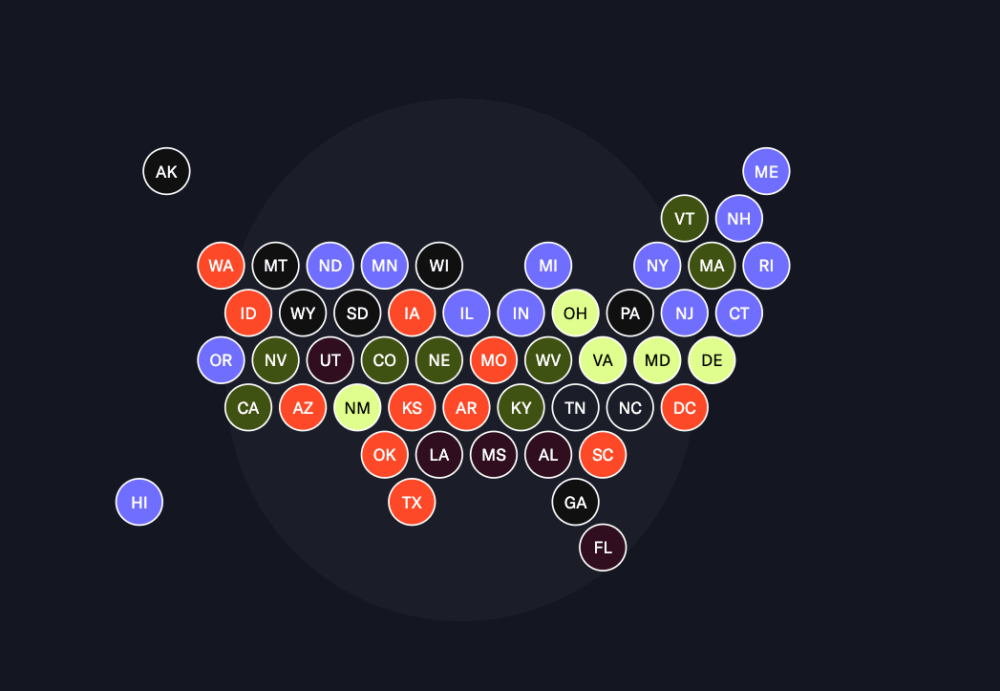
Election Policy Tracker
Explore our Election Policy Tracker for real-time updates and analysis.
Subscribe to The Markup
Sign up here to get these updates delivered straight to your inbox.