Primary Season is Here. The Stakes Could Not Be Higher.
The 2026 primaries offer the first real test of how new election laws, redrawn maps, and post-2024 tensions are playing out in districts across the country. But these primaries are consequential far beyond the fall. In many states and districts, candidates and elected officials have been eager to adopt President Trump’s marching orders, whether that means pursuing extreme proof of citizenship mandates or restricting access to mail ballots.
Here’s what we’re tracking this primary season — and what they can tell us about what to expect this November.
What We’re Watching
Primary season is not a single day. This year’s primary season runs for six months, from the first Tuesday in March through September 15, across nearly every state. The national spotlight will focus on congressional races, but voters across the country are also choosing the next governors, secretaries of state, and state lawmakers.
| This election cycle, voters will weigh in on: | |
|---|---|
| 435 | U.S. House seats (that’s all of them) |
| 35 | U.S. Senate seats, including special elections in Ohio and Florida |
| 36 | Governors |
| 26 | Secretaries of state |
| 30 | State attorneys general |
| 6,122 | State legislative seats across 46 states |
In many states, midterm primaries are often the most competitive races of the cycle. This is especially true in the wake of mid-decade redistricting that gives one party a clear advantage in many districts.
Voters Are Already Navigating New Rules
In some states, voters stepping into a polling place or casting a mail ballot this spring and summer will face an unfamiliar — and often confusing — process. State legislatures have been busy passing new election laws since the 2024 presidential election. Our team behind the Election Policy Tracker has been documenting all of the changes taking effect this cycle.
- Proof-of-citizenship requirements are in effect in New Hampshire and Wyoming. The primaries mark the first major statewide elections under these new requirements.
- Mail ballot deadlines have tightened in Ohio, Kansas, North Dakota, and Utah. These states eliminated postmark grace periods, meaning ballots must now arrive — not just be mailed — by Election Day. An additional 14 states could impose similar changes depending on how the U.S. Supreme Court rules in Watson vs. RNC.
- Voter ID changes could disenfranchise some eligible citizens — fewer forms of identification will be accepted at the polls in eight states.
- Election oversight has shifted authority in North Carolina. Control of the state and county boards now rests with the state auditor, not the governor. This change has significant implications for how election challenges are handled.
New Maps Add Another Layer Of Confusion
To complicate matters further, at least six states have approved new congressional maps redrawing voting districts. Already overstretched election administrators must reassign voters to new precincts and districts quickly in time for spring and summer primaries. These changes represent a particular challenge at a time of high turnover among election administrators.
One recent study found that more than half of all counties in Western states have changed their chief election administrator at least once since November 2020.
Mid-decade redistricting is playing out in Texas this spring, where voters in the 18th congressional district are preparing for their fourth election in just seven months. That stretch included a delayed special election to replace the late Rep. Sylvester Turner, a mid-decade redrawing of that district, and a 2026 primary match-up between two incumbent members of Congress.
Despite the potential confusion, states such as Virginia and Florida may follow Texas’s lead and redraw their maps before the primaries. And with many legislative sessions still in progress, these new maps could take effect just in time for the midterms.
Texas and North Carolina Preview What Could Go Wrong
In Texas this year, county Republican officials in Dallas, Williamson, and other counties decided to run their primaries using precinct-based polling places rather than the countywide polling place system voters were accustomed to. As a result, thousands of voters arrived at their usual polling places only to be told they were in the wrong location. In addition, subsequent court challenges and confusion over voting-hour extensions left thousands of votes in limbo for days after the election.
Behind these harmful changes was a push for hand-counting in some counties. As in previous years, hand-count efforts reinforced longstanding criticisms of the method’s accuracy and efficiency.
The data is clear: in Calhoun County, the Republican Party missed the state-mandated deadline to report hand-counted results, while the Democratic Party, using machine tabulation, had no issues.
While Texas illustrates what can go wrong with hand counts and other last-minute rule changes, a competitive state senate race in North Carolina threatened a preview of potential litigation and delayed certification of election results we could see in November. In the 26th State Senate District, unofficial results showed challenger Sam Page ahead of incumbent Senate Majority Leader Phil Berger by two votes. After accounting for provisional ballots and partial recounts, that number rose to 23 votes. In the days that followed, both sides raised allegations of voter intimidation and potential conflicts of interest.
Weeks after the election, Berger requested several partial recounts and a full hand recount. The latter did not appear to be supported by state law. Berger ultimately conceded the race three weeks after Election Day once the partial recounts confirmed the tabulations. This resolution stands in stark contrast to the protracted legal battle over the 2024 North Carolina Supreme Court race that extended nearly six months after Election Day before the race was ultimately certified.
Stay in the Know
The first primaries of the cycle showed something encouraging: voters are turning out in large numbers. Texas saw nearly 4.5 million votes cast — roughly 24% of registered voters — compared to 17-18% turnout in 2018 and 2022. In North Carolina, early voting participation climbed from 559,000 in 2022 to 701,000 in 2026.
High turnout is a sign of a healthy democracy. But it’s also a stress test for election administrators who are grappling with last-minute rule changes, high turnover, and rising tensions during a pivotal election year.
Voting Rights Lab is tracking the latest changes in election law and policy. To receive weekly updates straight to your inbox every Monday, subscribe to The Markup.
Subscribe to The Markup
The Markup is Voting Rights Lab’s regular analysis of the latest election policy issues and trends. Sign up here to get these updates delivered straight to your inbox.
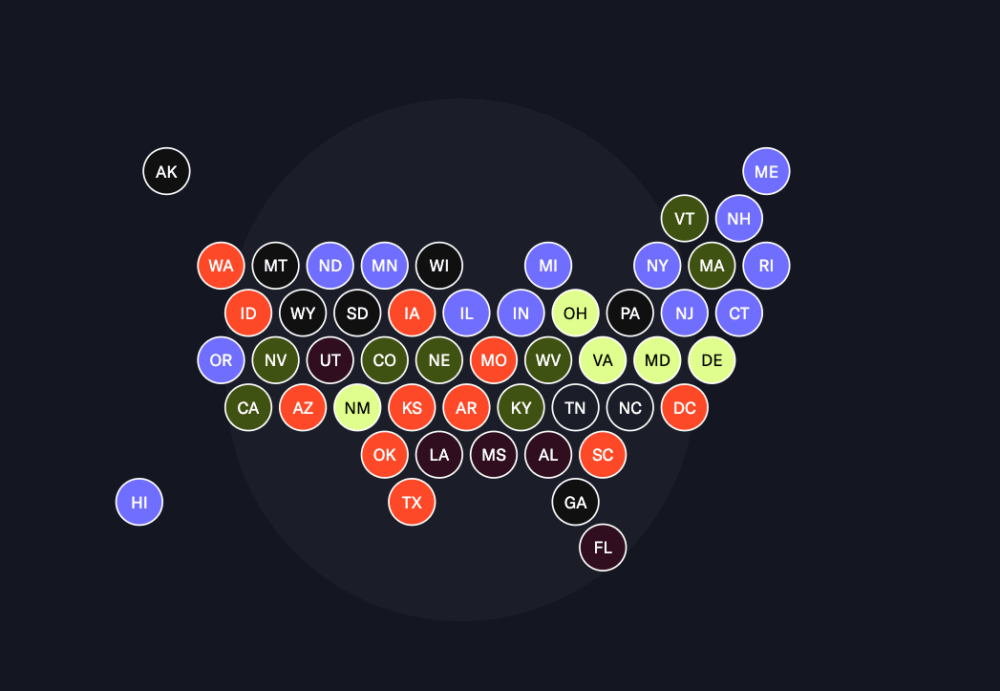
Election Policy Tracker
We are committed to providing unique, state-focused insights from a national perspective. Explore our Election Policy Tracker for real-time updates and analysis and learn more about our work to ensure free and fair elections.