Report
2026 Legislative Session in Review
We have all seen the stories leading up to this year’s elections: sweeping executive orders, threats of federal takeovers, and constant doomsday scenarios. But, as usual, the reality is more nuanced. While states roundly rejected Trump’s extreme elections agenda, some did enact watered-down versions of his proposals.
Here’s the real story behind the headlines:
- Despite all the bluster, President Donald Trump’s elections agenda continues to fail on the federal level. His legislative priorities lack the votes to pass, and courts have rebuffed unconstitutional unilateral attempts to impose a proof-of-citizenship requirement and create a citizenship database.
- States picked up the baton. Trump’s vocal support for these failed federal efforts did succeed on another level – sending clear marching orders to his allies in state capitals. They listened, introducing hundreds of bills across the country inspired by the president’s proposals and his false claims about elections.
- No state enacted Trump’s extreme agenda. Despite all the copycat bills, no state did what the president asked. No state passed a law requiring every citizen to show a passport or birth certificate to register to vote. And no state did away with mail voting or in-person early voting.
- Some states enacted restrictive laws in line with — but less extreme than — the president’s proposals. These laws make it harder for election officials to administer elections and harder for eligible Americans to cast their ballots. Four states, for example, passed less-restrictive versions of the president’s proof-of-citizenship proposal.
- Other states moved in the opposite direction – improving voting and election administration. States passed laws to improve mail voting systems, expand access to in-person early voting, and restore voting rights for Americans with past convictions.
Ultimately, Trump failed to get his extreme election agenda across the finish line — at the national or state level. But some new laws have created barriers to voting and may make it harder for election officials to do their jobs this November and beyond.
Proof of Citizenship
Mandating proof of citizenship has been the centerpiece of the president’s elections agenda, fueled by falsehoods about noncitizens voting. It also offers a perfect case study of the president’s impact on state legislatures — and the limits of his power in practice:
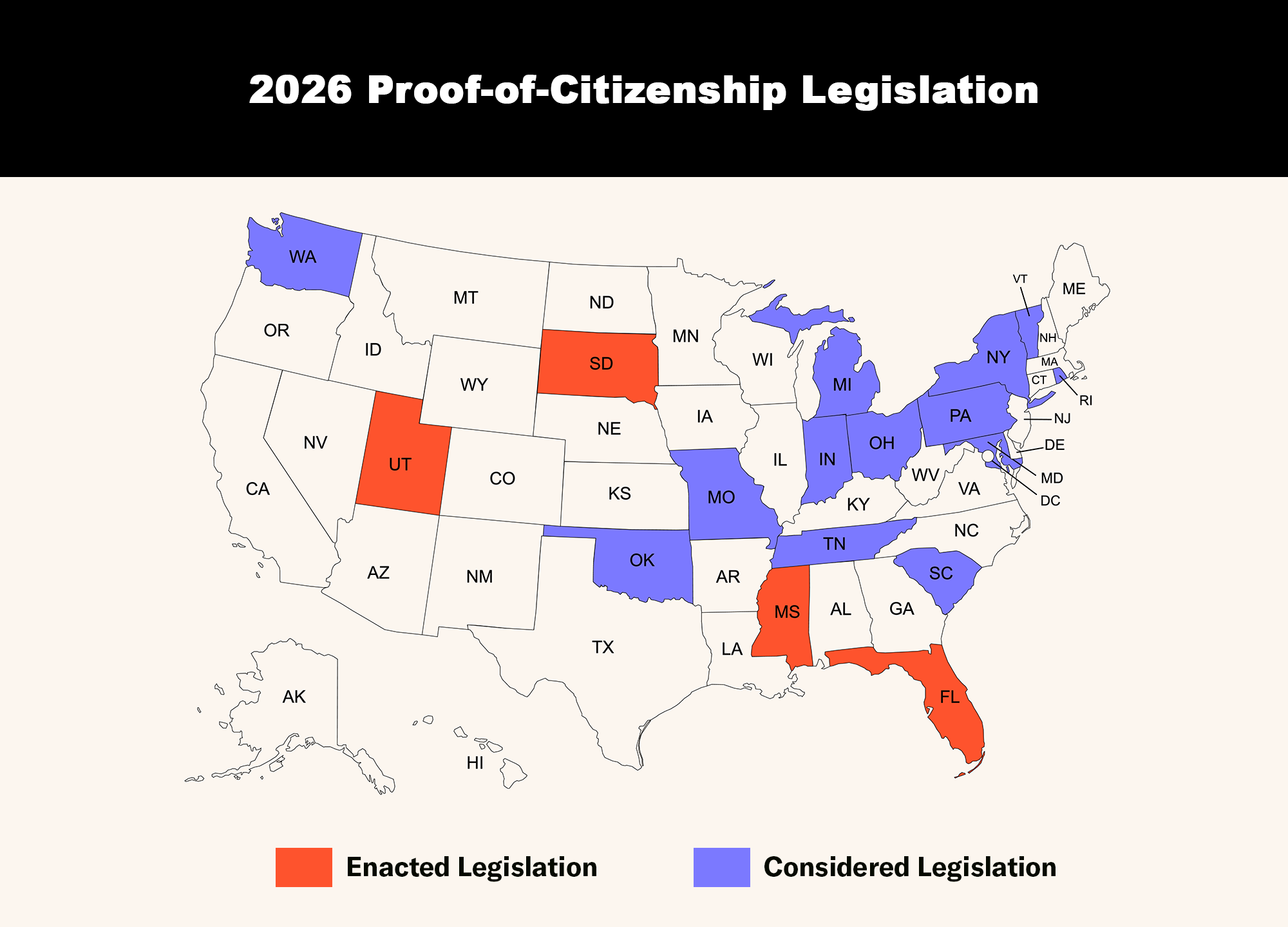
- This year, as courts invalidated the president’s executive order (purporting to create proof-of-citizenship requirements) and federal proof-of-citizenship bills failed, 17 states considered 28 bills to create proof-of-citizenship mandates.
- No state passed a law that met the president’s extreme demand that every American provide a passport or birth certificate to register to vote.
- Four states, however, did enact less extreme proof-of-citizenship laws: Florida, Mississippi, South Dakota, and Utah.
States Pass Less-Restrictive Versions
Instead of requiring every citizen to show a passport or birth certificate, as the SAVE Act and Trump’s 2025 executive order demanded, four states enacted laws that rely primarily on existing DMV records or documents to verify citizenship:
- In Florida, Mississippi, and Utah, voters with citizenship documentation on file with the state DMV will not be required to provide additional documentation.
- In South Dakota and Utah, the requirement applies only to voting in state elections. Voters without proof of citizenship on file will continue to be able to vote in federal elections by providing a driver’s license number or Social Security number and attesting to their citizenship under penalty of perjury.
- In Florida and South Dakota, driver’s licenses with markers indicating U.S. citizenship — which the states have or will begin issuing — qualify as proof of citizenship.
- The Florida law also will not take effect before the midterms as originally proposed, giving time for voters and officials to adjust and for legal challenges to move through the court system.
Update: New Hampshire Rolls Back Mandate
In New Hampshire, which in 2024 enacted the state law most closely aligned with the president’s vision, the legislature advanced legislation that would roll back its burdensome proof-of-citizenship mandate for the second year in a row. This move comes after hundreds of voters were turned away in municipal elections last year. Specifically, the legislature passed, and the governor signed, S.B. 438 to modernize and connect state voter and driver’s license data.
Separately, a federal court found the law unconstitutional, reinstating the option for voters to attest to their citizenship under penalty of perjury rather than provide a passport or birth certificate.
Flawed Voter Purges in Search for Noncitizens
While states generally rejected proof-of-citizenship mandates, over half of states considered such mandates, and eight states enacted legislation to identify and purge noncitizens from their voter rolls. Maintaining accurate voter rolls is a vital function of state and local election officials. Every state has checks and balances in place to identify registered voters who move, die, or otherwise become ineligible. However, these mandated targeted hunts for noncitizens raise multiple concerns. They often:
- Utilize unreliable data provided by the federal government.
- Lack adequate safeguards to ensure the person being removed is actually the person identified as ineligible.
- Fail to give voters advanced notice and an opportunity to contest wrongful removal.
The Department of Homeland Security’s SAVE (Systematic Alien Verification for Entitlements) program was not intended for voter-registration verification. Using this federal data to purge voters carries a high risk of U.S. citizens being wrongly removed from the voter rolls just before the midterms.
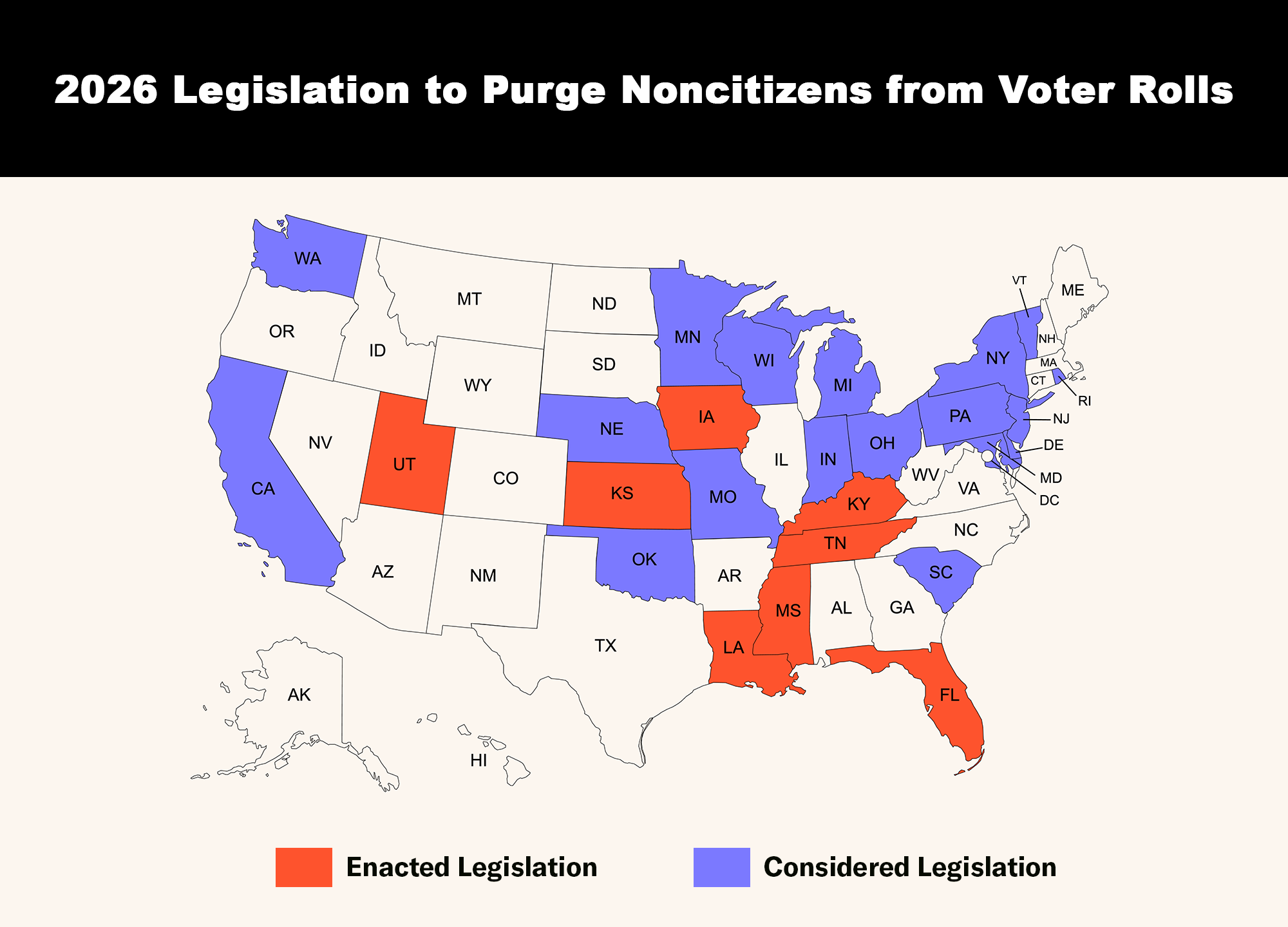
- Five states — Iowa, Kansas, Louisiana, Mississippi, and Tennessee — enacted new laws mandating that officials attempt to verify the citizenship of all registered voters using the flawed SAVE program.
- Three states — Florida, Kentucky, and Utah — enacted laws requiring officials to check the voter rolls against unspecified state and federal databases.
- The North Carolina State Board of Elections adopted administrative rules requiring officials to run voters’ personal information through the federal SAVE database at least annually. Pending legislation would also require election officials to conduct post-election audits to verify the eligibility of all early and mail-in voters. This would put these ballots at risk of being tossed out due to data errors.
- Mississippi attempted to use consumer credit report data to identify registered voters who had moved. This flawed data led to 50,000 voters being moved to inactive status, many erroneously.
Restrictive Voter ID
When extreme proof-of-citizenship mandates failed, states tried a different tactic. Building on a 2025 trend, eight states made existing voter ID requirements more difficult for voters to comply with. This legislation — in states that already had some type of voter ID law — quietly chipped away at voter flexibility and backup options.
Additionally, some states have proposals on the ballot for later this year that would make voter ID laws more restrictive. These restrictions would create additional barriers for voters this November, especially students, older Americans, and other vulnerable groups.
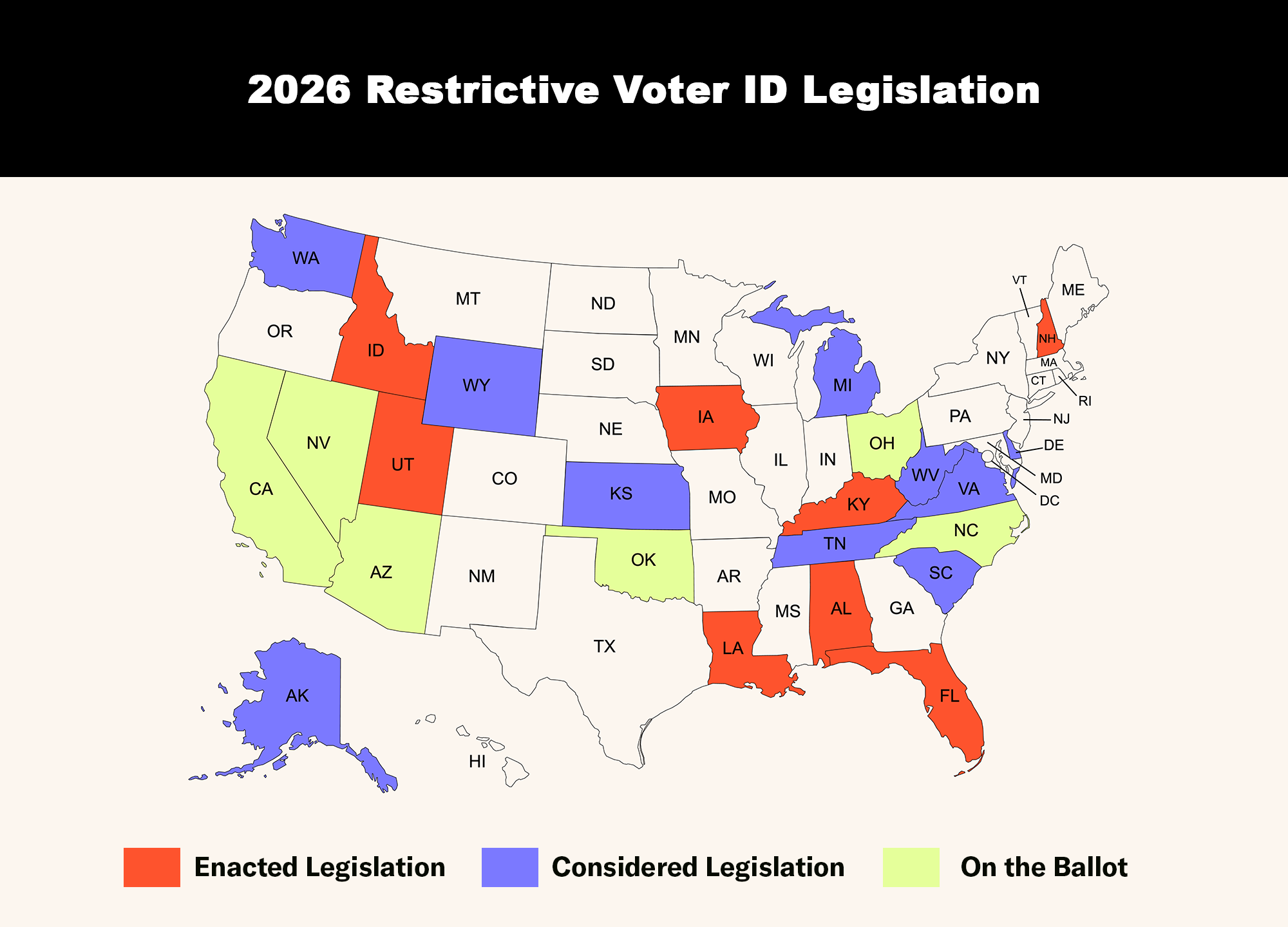
Five states restricted the types of ID accepted to vote:
- Florida removed student IDs, retirement center credentials, and financial cards from its list of accepted voter IDs.
- New Hampshire ended the acceptance of student IDs as voter ID.
- Utah fast-tracked the elimination of utility bills and bank statements as valid forms of identification for voting, a change previously scheduled for 2029.
- Kentucky removed Social Security cards and government benefit documents from the list of backup forms of identification.
- Alabama enacted a ban on using digital identification for voting, even though it is accepted for driving.
Three states restricted or eliminated their backup options for citizens without IDs:
- Iowa ended the practice of allowing another registered voter to attest to a voter’s identity without ID.
- Louisiana eliminated the affidavit option for voters without a photo ID.
- Idaho now requires voters using an affidavit, instead of a physical ID, to provide their date of birth or a license number.
Additionally, six states will have voter ID proposals on the ballot later this year:
- Arizona is considering a legislative referral that would expand the state’s ID requirement to mail voting and remove non-government-issued IDs from the list of accepted IDs.
- California is considering a citizen-initiated constitutional amendment that would require a photo ID for in-person voting and the last four digits of an ID number for mail voting.
- Nevada is considering a citizen-initiated constitutional amendment to require a photo ID for in-person voting and the last four digits of an ID number for mail voting. This must be passed twice to become part of the state constitution; the first leg was passed in 2024.
- North Carolina voters are considering a legislative referral (from 2024) to expand the state’s constitutional requirement that in-person voters present a photo ID to cover all voters, including mail and overseas voters. State law already requires mail voters to provide ID.
- Ohio voters will consider a legislative referral to enshrine the state’s existing ID requirement in the state constitution.
- Oklahoma is considering a legislative referral during the August primary that would put an ID requirement into the state constitution. This would threaten the current backup option for voters: providing an affidavit and voting a provisional ballot.
Mail Voting: Targeting Military & Overseas Voters and a Supreme Court Battle
Although mail voting enjoyed widespread bipartisan support before 2020, and roughly one-third of voters cast ballots by mail in 2024, Trump has repeatedly attacked the popular practice. He doubled down on this rhetoric early this year with an executive order attempting to force the U.S. Postal Service to refuse delivery of certain mail ballots.
Despite this intense national rhetoric, states did not enact sweeping restrictions on mail voting this year. Even states that pursued mail voting restrictions failed to seal the deal. In Ohio, for example, Gov. Mike DeWine vetoed a bill that would have required voters to show ID when requesting and returning mail ballots.
Instead, we saw new restrictions on specific voters: members of the military and other Americans living abroad.
Restrictions on Overseas and Military Voters
Lawmakers in several states considered legislation that would require new documents, such as proof of citizenship, from overseas and military voters, or entirely strip voting rights from U.S. citizens born abroad who have never resided in the United States. However, only West Virginia enacted such a measure into law. This law strips voting rights from some overseas citizens and limits others to federal-only ballots.
At the same time, we are tracking new litigation in state courts challenging the voting rights of U.S. citizens born abroad who have never resided in the country. This group includes children of active-duty military members raised overseas:
- In Colorado and Nevada, the Republican National Committee (RNC) filed lawsuits asking a state court to strip voting rights for all “never-resident” overseas voters. This comes after lawsuits in Arizona, Michigan, and North Carolina last year.
- In North Carolina, state courts are considering whether the state Supreme Court’s 2025 ruling that “never-resided” citizens could not vote in state elections also applies to federal elections. A Wake County superior court recently ruled against these citizens. The legislature is also considering the issue.
- Arizona Gov. Katie Hobbs vetoed a bill that would have taken away the right to vote a federal-only ballot from “never-resided” citizens.
Additionally, the U.S. Supreme Court rejected the RNC’s attempt to invalidate state laws allowing ballots postmarked by Election Day to be received after. This decision marks a major setback for the Trump administration’s elections agenda.
Redistricting Battles
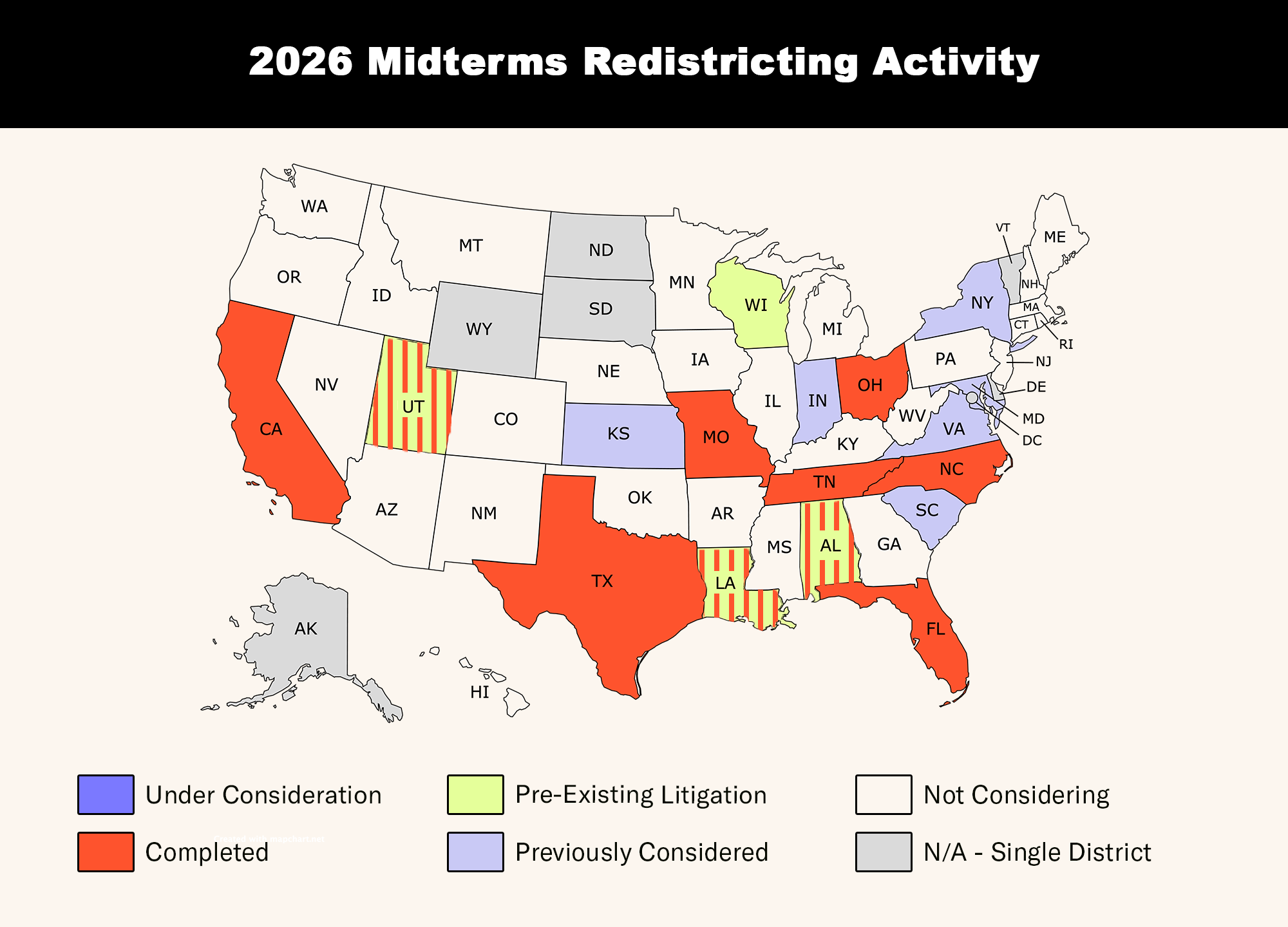
In addition to changes to how voters cast their ballots, we are closely following an unprecedented wave of mid-decade redistricting. These efforts intensified following the U.S. Supreme Court’s decision in Louisiana v. Callais, which opened the door for states to redraw districts for partisan advantage with no regard for minority representation. Ten states are expected to operate under different congressional maps than in 2024.
- Alabama, Florida, Louisiana, and Tennessee adopted new maps this year through legislation or litigation.
- Lawmakers in Georgia (which considered redistricting for 2028) and South Carolina ultimately declined to redistrict this year, despite holding special legislative sessions on this issue.
- The Virginia Supreme Court invalidated a redistricting referendum adopted by voters.
- An effort in New York to use state-court litigation to reopen the map-drawing process was halted by the U.S. Supreme Court.
The result of this off-cycle redistricting activity has been constant litigation, burdens on election administrators, and voter confusion ahead of the midterms.
The Good News
Many states have made policy changes to improve voter access and election administration this year.
Mail voting
Despite the president’s calls to restrict it, 11 states moved to improve their mail voting systems this year. Some highlights include:
- Connecticut eliminated its excuse requirement, allowing all voters to cast a mail ballot, no special reason necessary.
- Delaware advanced an amendment to their state constitution to allow no-excuse mail voting.
- Colorado increased the availability of drop boxes across the state and on college campuses.
- Rhode Island modernized electronic return options for military, overseas, and disabled voters.
- New Jersey bolstered its cure process to help ensure that ballots cast by eligible voters are not rejected for minor errors on return envelopes.
Early voting
Some states moved to ensure voters can vote early in person:
- Delaware advanced a proposed constitutional amendment to allow in-person early voting. While early voting is currently offered under statute, there have been legal challenges questioning its constitutionality.
- Virginia enacted a law guaranteeing access to in-person early voting on Sundays.
Voter list maintenance
Some states improved their voter list maintenance processes to ensure accurate, up-to-date voter registration lists:
- Virginia imposed limits on the use of the DHS SAVE program to protect voters from erroneous removals. The commonwealth also rejoined ERIC (the Electronic Registration Information Center). The bipartisan multistate organization shares voter data and helps ensure accurate voter rolls. Virginia had previously left ERIC under former Gov. Glenn Youngkin in 2023.
- Washington put in place procedural protections for voters against erroneous cancellation of registrations.
Voting Rights Restoration
In two Southern states, lawmakers restored eligibility to some Americans with past felony convictions:
- Tennessee dropped the requirement that residents pay off all court debt before regaining the right to vote.
- Virginia advanced a constitutional amendment to restore voting rights automatically upon release from incarceration. A federal court in Virginia also ruled that disenfranchisement for offenses that were not felonies in 1870 violates federal law.
Additionally, a Missouri bill to restore voting rights to individuals on probation or parole for nonviolent offenses is awaiting the governor’s signature.
Voting Rights Acts and Protections Against Election Interference
In the face of a federal government hostile to state election administration and Voting Rights Act enforcement, states have been stepping up to fill the void. Maryland and Vermont enacted state Voting Rights Acts. These laws provide new avenues for voters to pursue legal claims against attempts to suppress or dilute the votes of protected communities, as the judiciary chips away at the federal Voting Rights Act.
Additionally, California, Connecticut, Colorado, Virginia, and Washington enacted laws meant to protect election systems and voters from interference.
Election Risk Heat Map
If there is one takeaway from the 2026 session, it is this: Trump cannot simply overhaul our elections from the top. This has — and always will be — a local fight, county by county, state by state. And it’s a fight we can win.
We built the Election Risk Heat Map to filter through the noise and drill down on the exact counties most at risk of election interference this year. This new tool from VRL breaks down where election deniers are overseeing our elections, where state laws have critical gaps, and where close races give bad actors an opening to act. Check it out here.
Filter Through the Noise
Our Election Risk Heat Map breaks down where election deniers are overseeing our elections, where state laws have critical gaps, and where close races give bad actors an opening to act.