The Markup: NC gov signs, vetoes bills; federal legal fights escalate
Welcome to the Markup, Voting Rights Lab’s weekly digest of election law and policy updates. We’re tracking 1,702 bills this session across 44 states and D.C. This week, we’re tracking two bills — one signed, one vetoed — out of North Carolina. We’re also following notable ballot referendums out of Michigan, Oklahoma, and Missouri. Read on for more.
The Good News
North Carolina governor signs law extending deadlines, facilitating election administration and vetoes bill expanding ballot challenges and shortening early voting.
Gov. Josh Stein signed into law H.B. 834, giving voters more time to cure registration, ID, and other potential deficiencies after Election Day. Stein also vetoed H.B. 958, which would have expanded post-election ballot challenges, shortened the early voting period for some primaries, and expanded the state auditor’s role in election oversight. Any effort by the legislature to override Stein’s veto would take place after the November election.
Nebraska court rejects RNC lawsuit targeting overseas voters.
The 2005 Nebraska law allows U.S. citizens born abroad who have never resided in the country to vote if a parent is a registered Nebraska voter. Just over 100 voters are eligible under this law. The RNC argued the statute violates the state constitution’s residency requirement by enfranchising non-residents. The RNC plans to appeal the state district court ruling to the state Supreme Court.
The Bad News
North Carolina State Board rejects Sunday early voting in most disputed counties.
The North Carolina State Board of Elections voted along party lines to resolve disputes over early voting schedules in 20 counties, rejecting proposals for Sunday early voting in most of the counties where local election boards had deadlocked. The Republican majority generally sided with Republican county board members who opposed Sunday hours, although some counties will retain Sunday voting or other expanded weekend hours.
Minnesota Supreme Court upholds mail ballot witness-signature rule.
Mail voters in Minnesota must continue having a witness sign their ballot envelope after a unanimous state Supreme Court ruling. The Minnesota Alliance for Retired Americans sued over the requirement, arguing that the witness requirement functions as an illegal “voucher” requirement under the Voting Rights Act. Minnesota is among 11 states with a witness or notary requirement for mail ballots.
Texas mail voting and voter assistance requirements reinstated by federal appeals court.
Texas will continue to require voters to provide a driver’s license number or Social Security number on their mail ballot applications under the ruling from the 5th Circuit Court of Appeals. Plaintiffs had argued these provisions, part of S.B. 1 (2021), created excessive burdens for voters with disabilities.
On Our Radar
Legal battle escalates over mail voting executive order as USPS issues final rule.
On August 11, a Massachusetts federal judge issued a nationwide preliminary injunction blocking implementation of President Donald Trump’s March 2026 executive order on mail voting. The executive order had already been blocked by the same judge in a ruling only applicable to the 23 states that brought a lawsuit. Despite the injunction, the USPS published a final rule on August 21. The agency will not enforce the rule for the 2026 midterm elections unless the district court injunctions are lifted. The U.S. Supreme Court has yet to rule on the administration’s emergency petition to pause the district court ruling after nearly a month.
Federal courts deal further defeats to DOJ voter roll data demands.
On August 14, a federal judge dismissed the Department of Justice’s (DOJ) lawsuit against Nevada, ruling that the federal government’s demands for voters’ partial Social Security and driver’s license numbers were invalid under federal law. A few days later, a federal district judge dismissed the DOJ’s lawsuit against Minnesota, marking the administration’s 23rd trial court loss on this issue. The DOJ’s appeal of the Minnesota case will put the issue in front of the conservative 8th Circuit Court of Appeals, where 10 of 11 judges were appointed by Republican presidents. The DOJ also suffered a defeat at the appellate level when the U.S. 6th Circuit Court of Appeals affirmed the dismissal of the department’s case seeking Michigan’s voter rolls.
In a separate case, a panel of federal judges ruled that the Public Interest Legal Foundation is not entitled to Wisconsin’s full voter registration list.
Michigan proof of citizenship and strict voter ID proposal may not qualify for November ballot.
The Michigan Bureau of Elections determined petitioners may not have secured enough valid signatures to make the November ballot.The Board of State Canvassers will make a final decision on ballot qualification by September 3.
California Supreme Court hears arguments in cases over sheriff’s seizure of 650,000 ballots.
One case challenges the seizure under S.B. 73, a 2025 law restricting law enforcement access to voted ballots. In the second, the court will consider whether Attorney General Rob Bonta has authority to halt Riverside County Sheriff Chad Bianco’s investigation of seized ballots from the November 2025 special election. The Court will hear arguments in both cases today.
Oklahoma voters to decide on constitutional voter ID mandate.
Tomorrow, August 25, voters will head to the polls to decide on a legislatively referred measure that would enshrine a voter ID requirement in the state constitution for all voting methods. Under current law, in-person voters are requested to provide voter ID, but voters without ID can cast a provisional ballot if they sign a sworn statement. Mail voters are not required to provide voter ID; instead, they must have their signature notarized to confirm their identity. The proposal leaves the specific definition of what qualifies as acceptable identification up to the state legislature.
Missouri Supreme Court to decide whether redistricting referendum will appear on November ballot.
Missouri’s Supreme Court will hear arguments on September 2 in a case challenging Secretary of State Denny Hoskins’ rejection of a citizen-led referendum seeking to overturn the state’s new congressional map. Supporters of the referendum submitted enough signatures to qualify the measure for the ballot; however, the secretary of state determined that congressional redistricting is not subject to Missouri’s veto referendum process. The court is scheduled to hear the case just six days before the September 8 deadline for courts to add measures to the ballot.
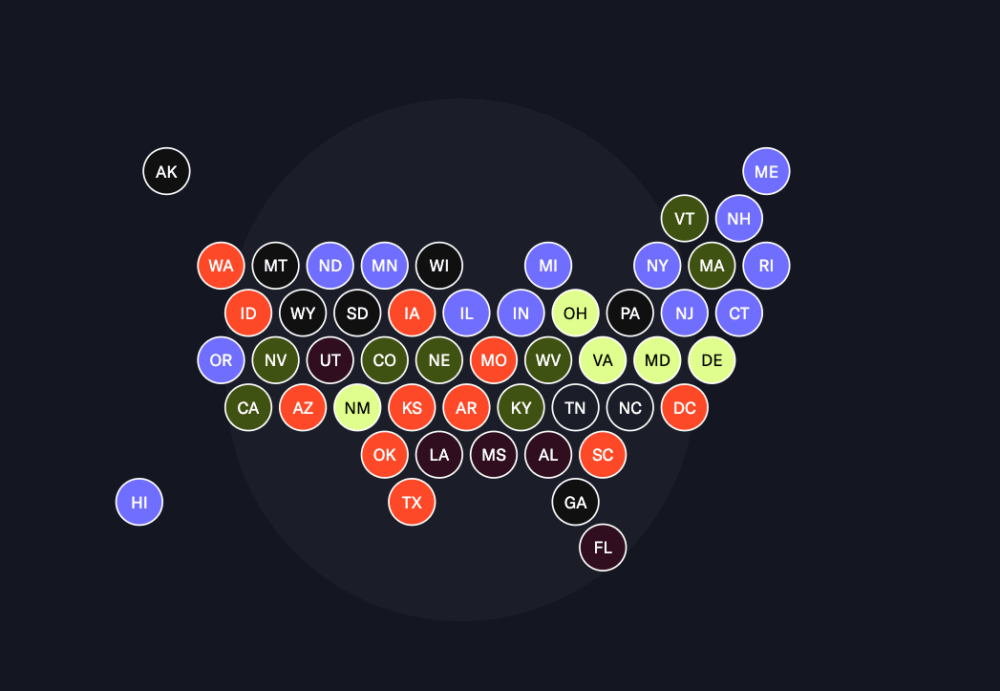
Election Policy Tracker
Explore our Election Policy Tracker for real-time updates and analysis.
Sign up for weekly updates
Subscribe to The Markup.