The Markup: SCOTUS to determine fate of mail voting EO; VA restores voting rights
Welcome to the Markup, Voting Rights Lab’s weekly digest of election law and policy updates. We’re tracking 1,689 bills this session across 44 states and D.C. This week, we take a look at voting rights restoration in Virginia, proposals to strengthen mail voting in Nevada, and two election bills awaiting gubernatorial action in North Carolina. Read on for more.
The Good News
Virginia governor restores voting rights for 66,000 citizens with past felony convictions.
Gov. Abigail Spanberger’s order restored eligibility for thousands who have been released from incarceration. Virginia is one of only four states where the voting rights of citizens with past felony convictions are never automatically restored. In November, Virginians will vote on a proposed amendment to the state constitution to automatically restore voting rights to individuals upon release from incarceration.
Kansas Supreme Court ruling leaves postmark grace period for mail ballots intact for primary election.
The Kansas Supreme Court denied Secretary of State Scott Schwab’s request to overturn a lower court’s order, which blocked a 2025 law eliminating the state’s three-day grace period for mail ballots postmarked by Election Day. The grace period was in effect for the August 4th primary election. While the trial court ruling remains in effect, Kansas is one of 15 states, along with Washington, D.C., to allow ballots with timely postmarks to be received after Election Day.
Delaware enacts state Voting Rights Act.
Gov. Matt Meyer signed the “Delaware John Lewis Voting Rights Act” (H.B. 444) into law. This legislation establishes safeguards against voter suppression and discrimination. The enactment makes Delaware the latest state to adopt its own state-level voting rights framework following the U.S. Supreme Court’s decision in Louisiana v. Callais that weakened the federal law.
Nevada lawmakers advance proposals to speed up mail ballot processing, protect against federal election interference for 2027 session.
The Joint Interim Committee on Legislative Operations and Elections approved several election proposals for consideration during next year’s legislative session. The proposals would require large counties to review mail ballot signatures within 24 hours of receipt, allow smaller counties to send mail ballots to voters sooner, and restrict the presence of armed federal agents at polling places.
Federal courts reject four more DOJ lawsuits seeking state voter registration records.
Federal district court judges dismissed the U.S. Department of Justice’s lawsuits seeking sensitive voter registration records from Colorado, Illinois, New Jersey, and Washington, D.C. The rulings add to a growing series of court defeats for the administration’s nationwide effort to obtain state voter registration data for list maintenance investigations.
Federal judge blocks USCIS ban on voter registration at naturalization ceremonies.
A federal district judge temporarily blocked a 2025 U.S. Citizenship and Immigration Services rule that prohibited the League of Women Voters and other nonpartisan groups from registering new citizens to vote at the agency’s facilities. The judge found that the ban likely violates First Amendment free speech protections and was motivated by discriminatory intent. The preliminary injunction allows these civic organizations to resume their voter registration efforts at USCIS ceremonies while the lawsuit proceeds.
On Our Radar
Legal fight over mail voting executive order moves to Supreme Court as implementation timeline tightens.
The Trump administration petitioned the U.S. Supreme Court to pause a district court ruling blocking the president’s March 2026 executive order’s mail voting restrictions from taking effect while their appeal is pending. This order covers the 23 plaintiff states. The states submitted their opposition on August 3, and a ruling is expected at any time. Meanwhile, a second D.C. Circuit Court of Appeals panel ruled that challenges to the executive order were premature.
The executive order called for the U.S. Postal Service to establish a new rule governing mail ballot delivery by Wednesday, July 29. A proposed, but not finalized, rule published by USPS calls for states to inform the agency of their intention to send mail ballots by August 5.
North Carolina lawmakers send mixed bag of election bills to governor.
North Carolina lawmakers passed H.B. 958 and H.B. 834, sending them to Gov. Josh Stein to sign or veto. H.B. 958 would allow post-Election Day challenges to early voters, shorten the primary early voting period from 17 days to 10, authorize the state auditor to conduct recurring post-election audits of county election systems, establish a process for removing voters identified as potentially ineligible through federal data, and require the DMV to provide additional voter registration data to the State Board of Elections. Stein has said he will veto this bill.
H.B. 834 would expand ballot cure options, allow visually impaired voters to use the state’s accessible mail ballot portal, permit mail ballot counting to begin as early as 9 a.m. on Election Day, and allow litigation over State Board of Elections decisions to be filed anywhere in the state.
Texas House Elections committee holds interim hearing on voter registration and early voting.
The committee addressed concerns around the state’s TEAM voter registration system. Officials have worked to navigate a bumpy update process and the urgent addition of several large counties to the program, after their prior vendor went out of business. The committee also heard testimony on the implementation of S.B. 2753, which will shift the early voting period later so that it ends right before Election Day. Election administrators raised staffing, resource, and logistical concerns about the change, though counties have until August 2027 to comply.
Arizona’s new mail ballot return option speeds up results.
A 2024 Arizona law allowed voters to show ID, rather than undergo a more time-intensive signature verification process, when returning a mail ballot in person. The law saw its first test in the state’s July primary. In Maricopa County (the state’s most populous county), 30% of voters returning ballots on Election Day took advantage of the new ballot return option, which helped the county report results much faster than in the past.
Maryland takes step toward redistricting; Missouri secretary of state rejects referendum; Mississippi solicits public input on redraw.
The Maryland legislature approved a November 2026 ballot referral to change the state’s congressional redistricting process. If voters approve the measure, then the state could eliminate its sole Republican-leaning district ahead of the 2028 elections. State Republican Party officials have filed a lawsuit seeking to block the measure from appearing before voters.
Missouri Secretary of State Denny Hoskins rejected a citizen-led referendum seeking to overturn the state’s recently enacted congressional map. Hoskins argued that congressional redistricting is not subject to referendum under Missouri law, despite supporters submitting more than 300,000 signatures. The decision keeps the new map in place for now, though referendum supporters have brought a lawsuit.
Mississippi’s Joint Redistricting and Reapportionment Committee met for the first time since the U.S. Supreme Court’s decision in Louisiana v. Callais — the landmark decision that eliminated protections for minority communities in redistricting. Lawmakers will consider redrawing the state’s legislative, congressional, and judicial districts next year. The committee will solicit input from voters in eight different areas of the state over the next two months on how the districts should be redrawn.
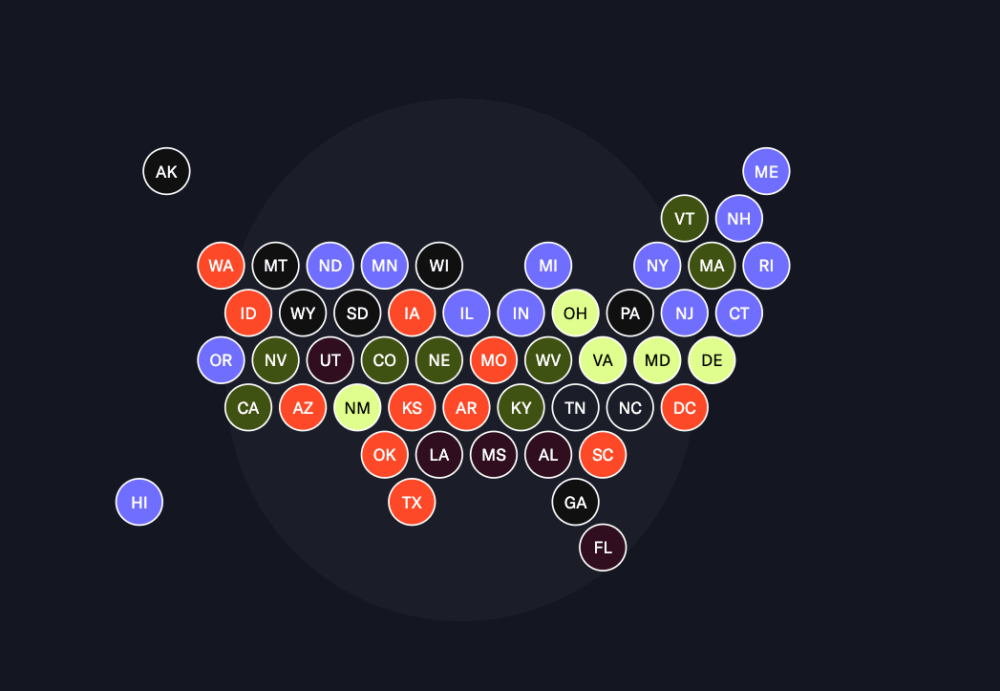
Election Policy Tracker
Explore our Election Policy Tracker for real-time updates and analysis.
Sign up for weekly updates
Subscribe to The Markup.