The Markup: Voter ID bills are on the move
Welcome to the Markup, Voting Rights Lab’s weekly digest of election law and policy updates.
We’re tracking 1,660 bills this session across 44 states and D.C. This week, we have our eyes on a pro-voter omnibus that just passed in Colorado, a restrictive ballot referral headed to voters in Arizona, and an upcoming special session in Georgia. Let’s get into it.
The Good News
Colorado enacts elections omnibus expanding drop box access, campus voting, and protections against election interference.
Gov. Jared Polis signed H.B. 1113, expanding access to drop boxes across the state and on college campuses. Additionally, the bill lowers the age requirement for student election judges and expands the types of acceptable voter IDs. The bill also explicitly prohibits election officials from providing access to election records to any third party except as authorized by law, such as in response to a formal public records request or court order.
Vermont enacts Voter Protections Act.
Gov. Phil Scott signed the “Voter Protections Act of 2026” (S.B. 298) into law. The legislation prohibits voting procedures that deny or abridge a voter’s right to vote on the basis of race, color, or membership in a language minority group. The new law authorizes the state attorney general to enforce these protections in court.
Pennsylvania House passes bill allowing earlier mail ballot processing.
H.B. 37 would allow election officials to begin pre-canvassing mail ballots seven days before Election Day. Under current law, officials cannot begin canvassing mail ballots until the morning of Election Day. The measure now moves to the Senate for consideration.
The Bad News
Arizona legislature places restrictive mail voting, ID measure on the November ballot; sends governor bills on overseas voters and voter roll access.
Bypassing a potential veto from Gov. Katie Hobbs, the legislature voted to place H.C.R. 2001 on the ballot in November. If approved by voters, the measure would require all voters, including mail voters, to provide a government-issued ID. Under current law, the identities of mail voters are confirmed via signature-matching, and non-government forms of documentation, such as bank statements, can be used for in-person voting.
Additionally, the legislature passed (S.B. 1060), which strips the right to vote from U.S. citizens who have never resided in the U.S. but have a parent whose last U.S. residence was in the state. The legislature also passed (S.B. 1040), which requires counties to make voter lists available for free online. Both bills now go to Hobbs to sign or veto.
Louisiana imposes a strict voter ID requirement.
Gov. Jeff Landry signed S.B. 319 into law. The new law eliminates the option for voters without the requested voter ID to sign an affidavit confirming their identity. The bill allows those without a qualifying ID to vote provisionally, though voters must provide ID later for their ballot to count.
Ohio legislature passes new mail voter ID requirements and proposed constitutional amendment; FBI targets voting rights group.
The legislature passed H.B. 472, a bill that would require mail voters to provide a photo ID when applying for a mail ballot and returning their voted ballot. The bill now heads to Gov. Mike DeWine’s desk. Lawmakers also approved S.J.R. 10, sending a proposed constitutional amendment to voters for consideration on the November 2026 ballot. The amendment would codify Ohio’s existing photo ID requirements for in-person and mail voting into the state constitution.
Separately, the FBI executed search warrants at the offices of a voting rights organization. Officials have not publicly disclosed the basis for the investigation.
North Carolina House to consider bill to revise post-election audits and create ID requirements for overseas voters.
The House Elections Committee will consider a new version of H.B. 958 at a hearing tomorrow morning. The bill would create new post-election audits of the voter rolls. Voters identified as potentially ineligible through these audits would be at risk of having their ballots flagged and their votes removed from the count based on flawed data. The bill would also create new documentation requirements for military and overseas voters and bar U.S. citizens born abroad who have never resided in the United States from voting in any state elections.
Iowa enacts law requiring citizenship checks using error-prone system.
Gov. Kim Reynolds signed S.B. 2218 into law. This law requires the state registrar to use the federal Systematic Alien Verification for Entitlements (SAVE) program to verify the citizenship of all registered voters and conduct monthly checks of newly registered voters. This system has been found to be unreliable in other states, improperly flagging the voter registrations of U.S. citizens. Voters whose citizenship cannot be verified will be designated as “unconfirmed” and required to provide proof of citizenship within 90 days, or their registration will be canceled.
On Our Radar
Georgia to begin special session focused on voting machine issue and redistricting; State Election Board adopts resolution on ballots.
Lawmakers will convene on Wednesday to address an impending ban on ballot tabulators that rely on QR codes. During the regular session, the legislature failed to pass S.B. 214, which would have delayed the prohibition until 2028. Meanwhile, the State Election Board advanced a nonbinding resolution allowing counties to switch to hand-marked paper ballots, contrary to guidance from Secretary of State Brad Raffensperger.
During the special session, lawmakers will also consider redistricting in the wake of the U.S. Supreme Court’s Louisiana v. Callais decision.
Federal courts consider challenges to Trump’s executive order on elections.
The D.C. Circuit Court of Appeals agreed to expedite its consideration of a lawsuit challenging President Donald Trump’s March 2026 executive order on elections. Separately, in the D.C. district court, the NAACP filed a motion arguing that the proposed USPS rule requiring the agency to refuse delivery of certain mail ballots violates a 2021 settlement agreement.
Meanwhile, a federal district court in Massachusetts heard oral arguments in a separate lawsuit brought by 23 states challenging the order.
Arizona county employees are under investigation for unauthorized removal of election equipment and ballots.
After two employees were caught on camera loading a scanner and provisional ballots into an unmarked vehicle during a March local election, the Maricopa County Attorney’s Office assigned a special investigator to conduct an inquiry. The situation has raised chain-of-custody concerns. County Recorder Justin Heap and the county board of supervisors – already embroiled in a dispute over election duties – disagree about which entity has oversight of the equipment, and whether the employees should face criminal charges.
Alabama and Florida redistricting validated by courts; Georgia, New York, and Wisconsin move closer to new maps for 2028.
The U.S. Supreme Court reversed a district court’s finding that Alabama’s new congressional map intentionally discriminated against Black voters. The court allowed the state to use a map enacted by the legislature following the Callais decision.
Florida’s Supreme Court allowed new maps adopted by the legislature to take effect, despite a state constitutional prohibition against drawing district lines to favor a political party.
Georgia’s legislature, in a special session beginning this week, will consider drawing new congressional and legislative maps that would take effect in 2028.
New York’s legislature advanced a proposed constitutional amendment that would change the state’s congressional redistricting process and pave the way for new maps by 2028. The proposal must be approved again in the next legislative session before it can appear on the ballot.
Wisconsin’s Supreme Court agreed to hear challenges to the state’s congressional map based on partisan and anti-competitive gerrymandering claims.
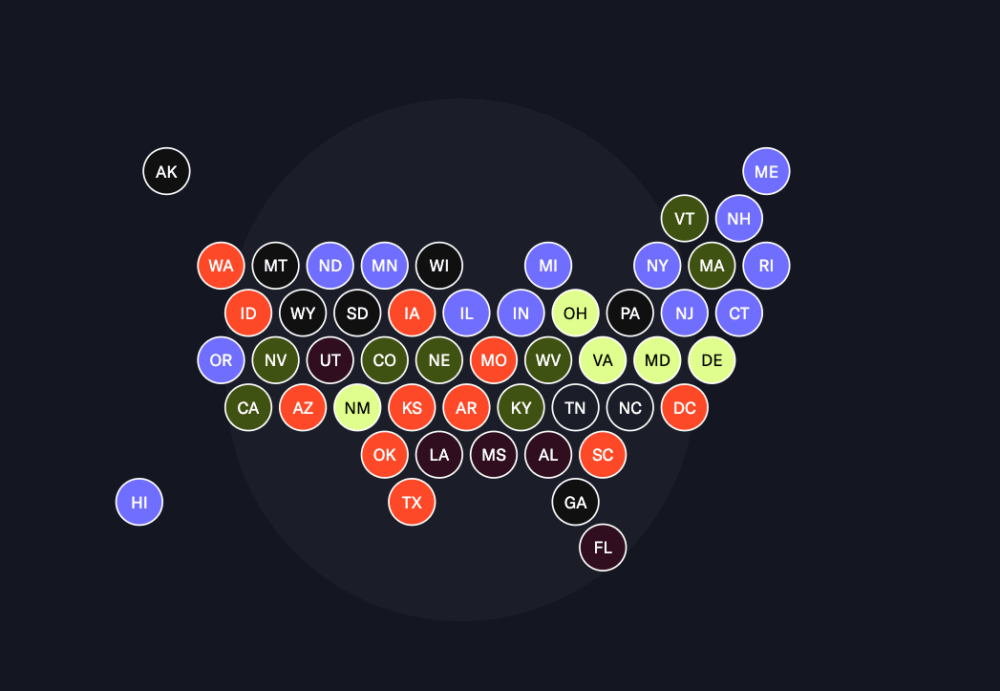
Election Policy Tracker
Explore our Election Policy Tracker for real-time updates and analysis.
Stay in the Know
Sign up for weekly updates.