The Markup: President Trump issues new voting executive order, prompting lawsuits
Welcome to the Markup, Voting Rights Lab’s weekly digest of election law and policy updates.
We are tracking 1,574 bills prefiled or introduced this session across 44 states and D.C. Our analysis finds that 724 bills would improve voter access or election administration, while 324 would restrict them.
This week’s Markup features policy updates in Arkansas, Florida, Georgia, Louisiana, Mississippi, New Hampshire, Rhode Island, Tennessee, Texas, West Virginia, and Wisconsin.
Jump to section:
Improving Voter Access or Election Administration
Tennessee enacts law easing financial requirements for voting rights restoration.
Gov. Bill Lee signed S.B. 336 into law. This bill removes the requirement that citizens with former felony convictions must pay all court costs before regaining voting rights. It also restores voting rights for individuals who have complied with child support obligations for the previous 12 months. Under prior law, individuals had to be fully “current” on all obligations to have their voting rights restored. Tennessee remains one of four states without automatic voting rights restoration.
Rhode Island restores electronic voting for disabled and UOCAVA voters.
Gov. Dan McKee signed H.B. 7007 / S.B. 2341 into law. This law reinstates an expired, successful program that allows eligible voters with disabilities and voters serving in the military or residing overseas to receive ballots through a secure electronic transmission system. These voters may also cast their ballots via the same electronic system. Military and overseas voting has been under threat in recent years.
Arkansas voters can continue to use electronic signatures on voter registration forms.
The Eighth Circuit Court of Appeals upheld a lower court ruling preventing Arkansas from enforcing a requirement that voter registration forms include handwritten (“wet”) signatures. The decision allows the continued use of electronic or digitized signatures, a practice the State Board of Election Commissioners voted to end ahead of the 2024 general election. Litigation is ongoing. Arkansas is one of only seven states that does not offer online voter registration.
Restricting Voter Access or Election Administration
President Trump issues executive order on voter eligibility and mail voting, prompting lawsuits.
President Donald Trump issued an unconstitutional executive order that would impinge on states’ ability to run elections. The order directs the Department of Homeland Security to compile unprecedented lists of citizens aged 18 or older residing in each state. It also calls on the U.S. Postal Service to refuse to deliver ballots from voters who are not on a separate list of approved mail voters. The order has prompted several lawsuits, including those from a coalition of 23 states, Democratic Party groups and congressional leaders, the NAACP, the League of United Latin American Citizens, and the League of Women Voters, among others. Multiple courts have blocked core provisions of a prior executive order on elections, issued last March.
Florida enacts restrictive proof-of-citizenship law.
Gov. Ron DeSantis signed H.B. 991. Starting in 2027, the law will impose new citizenship verification requirements and restrict the types of voter ID acceptable for voting. The law will require proof of citizenship, such as a passport or birth certificate, for individuals registering to vote who do not already have proof of citizenship on file with the Department of Highway Safety and Motor Vehicles. The bill will also remove student IDs, retirement center IDs, public assistance IDs, neighborhood association IDs, and debit and credit cards as acceptable forms of voter ID for in-person voting. Within minutes of the governor signing the law, voting rights organizations filed multiple lawsuits challenging it.
Mississippi adopts restrictive proof-of-citizenship requirement and list maintenance process.
Gov. Tate Reeves signed into law S.B. 2588, dubbed the “SHIELD Act.” The law will require voter registration applicants to provide proof of citizenship, such as a passport or birth certificate, under the following circumstances: if they do not appear in the state’s Department of Public Safety (DPS) database, if DPS data indicates they are not a citizen, or if the federal Department of Homeland Security SAVE database indicates they are not a U.S. citizen. The law also requires officials to check the entire voter list against the unreliable SAVE database annually.
New Hampshire prohibits use of student IDs for voting.
Gov. Kelly Ayotte signed H.B. 323 into law. The law eliminates student IDs as acceptable forms of identification for voting. Under prior law, public and private university and high school IDs qualified as voter ID. Across the country, numerous laws have been enacted that specifically target students.
West Virginia enacts law restricting voting for overseas citizens.
West Virginia Gov. Patrick Morrisey signed H.B. 5401 into law. This law strips voting rights from citizens who have established permanent residency in another country. It also bars citizens born abroad with a parent who last resided in West Virginia from voting in state races. These citizens will be limited to voting in federal elections only.
Louisiana House passes bill mandating use of unreliable federal database.
The Louisiana House passed H.B. 691. This bill would require Louisiana’s secretary of state to submit voter registration rolls annually to the federal government for comparison against the Systematic Alien Verification for Entitlements (SAVE) system. Election officials would be required to use data from the SAVE program to identify registered voters who may be noncitizens, prompting further investigation. The SAVE database has proven unreliable, erroneously flagging citizens for cancellation in other states. The bill heads to the Senate for further consideration.
On Our Radar
Georgia legislature ends 2026 session without approving new voting machines for the midterms.
Under a 2024 law, Georgia has banned existing voting equipment that requires QR codes on ballots for vote tabulation, effective this July. The legislature adjourned its session without passing a bill that would have delayed the ban on QR code ballots until next year. Without a special session to pass a bill, Georgia could face a slow, inaccurate hand-count of ballots for the November midterm elections.
Wisconsin partisan gerrymandering lawsuit dismissed by three-judge panel.
A Wisconsin judicial panel rejected a lawsuit brought by Democratic voters seeking to redraw the state’s congressional maps. The plaintiffs argue that the current maps are a partisan gerrymander and should be struck down. Six of the battleground states’ eight congressional seats are held by Republicans. Another lawsuit challenging the congressional maps is still pending and likely to go to trial next year.
Texas advocates file lawsuit over potential voter list removals.
Voting rights advocates in Texas filed a lawsuit to prevent the state from removing registered voters from the rolls based on citizenship data obtained from the federal Department of Homeland Security’s SAVE program. The lawsuit alleges, among other claims, that the state failed to check its own records to verify whether voters flagged as noncitizens had, in fact, provided documentation proving their citizenship. County officials warn that this federal data is prone to errors.
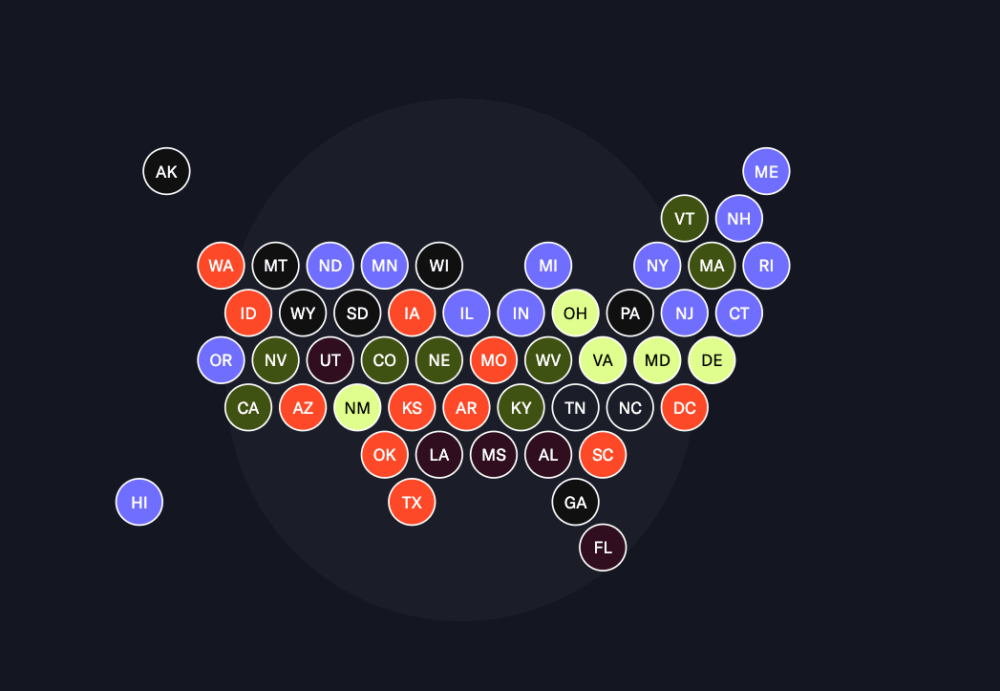
Election Policy Tracker
We are committed to providing unique, state-focused insights from a national perspective. Explore our Election Policy Tracker for real-time updates and analysis and learn more about our work to ensure free and fair elections.
Subscribe to The Markup
The Markup is Voting Rights Lab’s regular analysis of the latest election policy issues and trends. Sign up here to get these updates delivered straight to your inbox