The Markup: Feds intervene in MI, TX; DE advances mail voting
Welcome to the Markup, Voting Rights Lab’s weekly digest of election law and policy updates.
We are tracking 1,589 bills prefiled or introduced this session across 44 states and DC. Our analysis finds that 728 bills would improve voter access or election administration, while 328 would restrict them. This week’s Markup features policy updates from Alabama, Arizona, California, Delaware, Florida, Kentucky, Louisiana, Maryland, Michigan, North Carolina, Oklahoma, Texas, and Virginia.
Jump to section:
Improving Voter Access or Election Administration
Delaware legislature advances constitutional amendment to allow no-excuse mail voting.
The Delaware legislature adopted a constitutional amendment (S.B. 3) that would eliminate the state constitution’s requirement that voters have a qualifying excuse to vote by mail. This move would add Delaware to the 36 states that allow all voters the option to vote by mail. The legislature also adopted a measure (S.B. 2), which would codify the state’s current 10-day in-person early voting period into the state constitution. To be enshrined in the state constitution, the legislature must pass both measures again during the 2027-2029 legislative session.
Maryland enacts bills expanding transit access to polling sites, sends voting rights bill and other protections to the governor.
Gov. Wes Moore signed S.B. 100 / H.B. 263 into law. The bill requires buses to drop off passengers at early voting locations near routes, even if they are not standard stops. Legislators also sent several measures to the governor’s desk: S.B. 255 (establishes a new state Voting Rights Act), H.B. 1001 (requires police officers on duty at polling places to follow the direction of election officials and election judges), and S.B. 949 (clarifies how mail ballots will be processed should an upcoming U.S. Supreme Court ruling necessitate a change to state law).
Virginia governor signs multiple bills improving voting and election administration.
Gov. Abigail Spanberger signed eight bills into law. These bills include S.B. 438 (establishes mandatory early voting days on the second and third Sundays before an election), S.B. 57 (requires Virginia to rejoin the Electronic Registration Information Center [ERIC]), and H.B. 1244 (expands reasons for an emergency absentee ballot).
Restricting Voter Access or Election Administration
Louisiana sues federal agency for refusing to add citizenship requirements to voter registration form.
Louisiana filed a lawsuit against the U.S. Election Assistance Commission (EAC) after the commission refused to add state-specific instructions to the federal voter registration form. The state is requesting that voter registration applicants provide their place of birth, sex, and, for native-born citizens, their mother’s maiden name, or, for naturalized citizens, a unique immigration identifier. The EAC refused, arguing that Congress must approve any such changes. In 2024, the state enacted S.B. 436, which requires unspecified proof of citizenship to register to vote. The law is also the subject of ongoing litigation.
Michigan House advances bill requiring proof of citizenship to register to vote.
The Michigan House approved a bill (H.B. 4765) that would require individuals to provide proof of U.S. citizenship, such as a passport or birth certificate, when registering to vote. The requirement would also apply to automatic and electronic voter registration. Election officials would be prohibited from processing applications without such documentation. The bill now moves to the Senate, where it is not expected to move forward.
Oklahoma legislature sends voter ID constitutional amendment to the ballot.
S.J.R 47 would require all voters to provide a voter ID, eliminating current exceptions and imposing new restrictions on mail voters. Under current law, in-person voters without an ID may cast a provisional ballot if they sign a sworn statement, and mail voters must have their ballot envelope signatures notarized, but are not required to provide a copy of an ID. The measure will go before voters at an August special election.
Kentucky legislature overrides veto, enacts law limiting alternatives to photo ID and imposing new voter citizenship checks.
North Carolina board approves use of flawed federal citizenship data for voter removals.
The North Carolina State Board of Elections (NCSBE) adopted a new voter list maintenance process to identify and adjudicate potential noncitizens on the voter rolls. The NCSBE will check state voter rolls against the Department of Homeland Security’s SAVE system, then pass any flagged noncitizens to county election officials for investigation and potential removal. The SAVE database is unreliable, wrongly flagging citizens for potential removal in multiple states.
On Our Radar
Arizona court rules in favor of Maricopa County Recorder in election duties dispute.
DHS subpoenas Texas counties for voter registration data.
The U.S. Department of Homeland Security (DHS) has contacted at least three counties regarding administrative subpoenas for individual voters’ registration records. The subpoenas do not identify the specific voters whose records have been requested. This effort follows a broader pattern in which the federal government has sought to obtain confidential state voter registration lists and investigate them for potential noncitizens.
DOJ demands Detroit-area ballots from the 2024 election.
Assistant U.S. Attorney General Harmeet Dhillon sent a letter to Wayne County election officials demanding that they turn over all 2024 ballots and other election materials to the U.S. Department of Justice within 14 days. Michigan Secretary of State Jocelyn Benson and Attorney General Dana Nessel replied to the demand, stating that Wayne County will not comply.
California Supreme Court halts sheriff’s investigation into seized ballots.
The California Supreme Court stopped an investigation by a sheriff and gubernatorial candidate. Riverside County Sheriff Chad Bianco seized more than 650,000 ballots tied to the 2025 Proposition 50 special election in an attempt to conduct his own recount. The order followed a petition from Attorney General Rob Bonta and a separate lawsuit filed by a voting rights group seeking to stop the investigation.
Alabama enacts bills establishing audits and granting the federal government access to voter rolls.
Gov. Kay Ivey signed two bills into law: H.B. 95 (establishes a post-election audit process for certain races) and H.B. 67 (expands access to the voter list to include the federal government).
Florida postpones special session on congressional redistricting; Virginia set to vote on redistricting constitutional amendment.
Florida Gov. Ron DeSantis is postponing the redistricting special session originally scheduled to begin today. The session has been rescheduled for April 28. Some Republicans have become wary of plans to redistrict the state this year. In Virginia, voters head to the polls tomorrow to vote on a constitutional amendment that would allow the legislature to draw new maps for the remainder of this decade. The state constitution generally requires maps to be drawn by an independent commission.
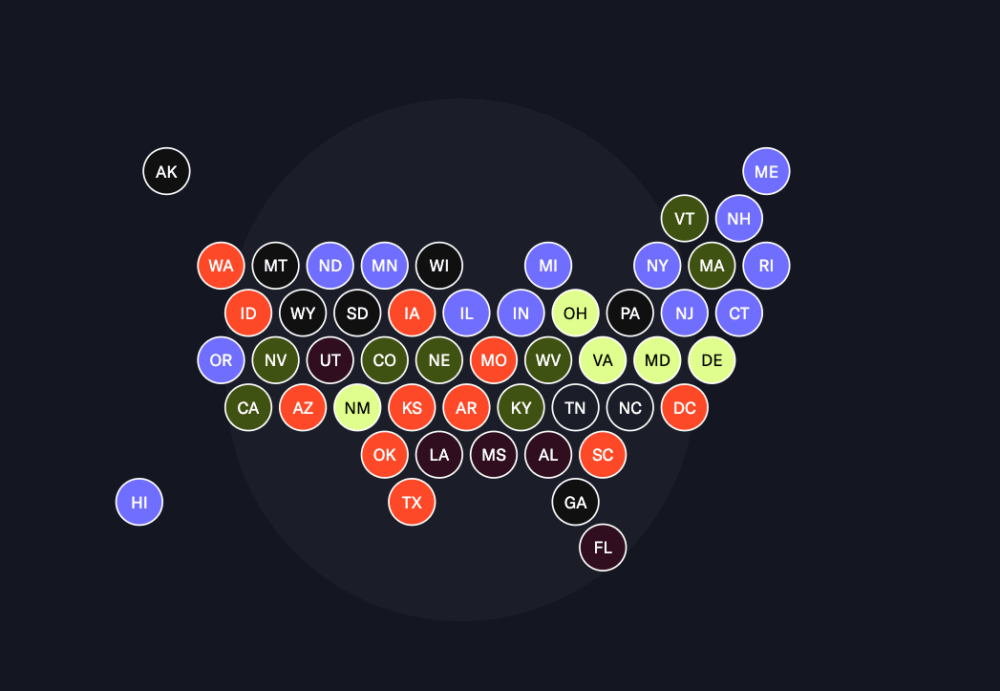
Election Policy Tracker
Explore our Election Policy Tracker for real-time updates and analysis.
Subscribe to The Markup
Sign up here to get these updates delivered straight to your inbox.