The Markup: California county sheriff seizes election materials, prompting lawsuits
Welcome to the Markup, Voting Rights Lab’s weekly digest of election law and policy updates.
We are tracking 1,565 bills prefiled or introduced this session across 44 states and D.C. Our analysis finds that 721 bills would improve voter access or election administration, while 323 would restrict them.
This week’s Markup features policy updates in Alaska, Arizona, California, Delaware, Idaho, Missouri, Mississippi, New Hampshire, New Jersey, North Carolina, South Dakota, Utah, and Virginia.
Jump to section:
Improving Voter Access or Election Administration
Alaska legislature sends comprehensive election reform legislation to governor.
The Alaska House passed a slimmed-down version of S.B. 64. The bill would establish a statutory cure process for mail ballots at risk of rejection and overhaul list maintenance processes. The House cut provisions from the Senate version, which would have eliminated the state’s requirement that a witness sign mail ballot envelopes in addition to the voter; codified drop box usage; and created a permanent absentee voter list. Because the Senate concurred with the House amendments, the final bill now heads to Gov. Mike Dunleavy to sign or veto.
Delaware advances constitutional amendments to improve mail voting and protect early voting.
The Delaware House advanced two amendments to the state constitution: S.B. 3 (removes the state’s excuse requirement for mail voting and establishes a permanent mail voting list) and S.B. 2 (requires 10 days of in-person early voting, as under the existing statute). S.B. 3 returns to the Senate to approve technical amendments, while S.B. 2 is on hold until the next legislative session. For the Delaware legislature to amend the state constitution, a legislative supermajority must pass constitutional amendments in consecutive sessions. This is the first session for both proposals.
New Jersey Assembly passes state Voting Rights Act.
The New Jersey Assembly passed A.B. 1715 (the John R. Lewis Voter Empowerment Act). The bill would enact significant voter protections into law, including extensive prohibitions on vote dilution and voter suppression, new preclearance procedures for certain counties and municipalities, and expanded language access requirements. The bill now goes to the Senate for consideration.
Virginia governor directs state to rejoin ERIC.
Gov. Abigail Spanberger issued an executive order directing the Department of Elections commissioner to begin the process of rejoining the Electronic Registration Information Center (ERIC). The compact helps states maintain accurate rolls by sharing voter data. On a separate track, the state legislature passed a bill that would require the state to rejoin ERIC. In 2023, Virginia left the compact, despite being a founding member; 25 states plus D.C. are current members.
New Hampshire House passes bill to improve voter registration process.
The New Hampshire House passed H.B. 1600. This bill would modernize voter registration by requiring the Department of Safety (the driver-licensing agency) and the secretary of state to enter into a data-sharing agreement for information relevant to voter registration. In addition, the bill would require the secretary of state and localities to provide direct electronic access to the centralized voter database, allowing clerks to verify information on voter registration applications. New Hampshire is exempt from the 1993 National Voter Registration Act (commonly referred to as the “motor voter” law), which led nearly all states to integrate data between driver-licensing and voter-registration records. These changes would minimize the burden that the state’s proof of citizenship law imposes on voters. The Senate will now consider the bill.
Idaho enacts law allowing poll worker service as alternative to jury service.
Gov. Brad Little signed H.B. 560 into law. This bill creates a process for potential jurors to serve as poll workers if a county clerk determines there is a shortage of election workers. Individuals who qualify to be excused or to postpone jury service could volunteer to serve as poll workers instead. These volunteer poll workers would not be called for jury duty for two years. Jurisdictions around the country are facing challenges recruiting sufficient poll workers amid rising threats.
Restricting Voter Access or Election Administration
Utah enacts proof of citizenship requirement, adds new burdens to in-person and mail voting.
Gov. Spencer Cox signed H.B. 209 and S.B. 194 into law. H.B. 209 imposes a proof of citizenship requirement for state and local elections. Voters can register using a driver’s license number only if the state DMV has sufficient proof of citizenship on file. Otherwise, they will have to separately provide documentation such as a passport or birth certificate to register to vote, or be limited to voting in federal elections.
S.B. 194 immediately eliminates utility bills and financial statements as acceptable voter ID. These documents were set to be phased out in 2029. The bill also imposes signature verification on all mail ballots. Under prior law, voters could provide an ID number (such as a driver’s license or Social Security number) on their ballot envelope to avoid having their ballots rejected due to a perceived signature mismatch.
South Dakota enacts proof of citizenship requirement, other election-related measures.
Gov. Larry Rhoden signed S.B. 175, which requires voters to provide proof of U.S. citizenship to register to vote in state and local elections and designates voters without proof of citizenship on file as “federal-only voters.” The governor also signed S.B. 171 (updates absentee ballot precinct procedures and expands poll watcher access) and S.B. 214 (requires the secretary of state to post weekly updates of the complete statewide voter registration file online).
Mississippi governor signs restrictive mail voting bill, as legislature passes limited proof of citizenship bill.
Mississippi Gov. Tate Reeves signed H.B. 908. If the U.S. Supreme Court rules in Watson v. RNC — that states cannot accept federal general election ballots after Election Day — then this bill would require all mail ballots to be received by the day before Election Day. Currently, only one state requires mail ballots to be received before Election Day. Mississippi is one of 14 states that accept ballots with timely postmarks received after Election Day.
The legislature also sent S.B. 2588 to Reeves’s desk. The bill would require voter registration applicants to provide proof of U.S. citizenship if their citizenship cannot be confirmed via the state’s driver’s license records or if the unreliable federal SAVE database flags them as a potential noncitizen.
North Carolina’s restrictive same-day registration process upheld by federal court.
A federal court upheld North Carolina’s same-day registration restrictions established by S.B. 747 (2023). This process allows election officials to reject same-day registrants’ applications and ballots when the U.S. Postal Service returns a single address verification notice as undeliverable.
Arizona House advances bill to remove voting eligibility for some overseas Americans.
The House Federalism, Military Affairs, and Elections Committee passed S.B. 1060 along party lines. The bill would repeal a law that allows U.S. citizens who have never lived in the country — typically the children of citizens residing overseas — to vote in Arizona if a parent’s last U.S. residence was in Arizona. Next, the bill will go before the Rules committee and then the House floor for consideration.
On Our Radar
U.S. Senate leaves town without making progress on the SAVE America Act.
The U.S. Senate left the capital for a two-week recess in the midst of a heated debate over the SAVE America Act. This legislation, a key priority for President Donald Trump, would impose proof of citizenship requirements for voter registration; impose strict ID requirements for in-person and mail voting; and require states to provide federal officials with access to private voter information to run through an unreliable Department of Homeland Security database. The SAVE America Act has no clear path forward in Congress.
U.S. Supreme Court hears consequential case on mail ballot deadlines.
The Supreme Court heard oral arguments in Watson v. RNC. The Republican National Committee is challenging Mississippi’s policy of accepting mail ballots received up to five days after Election Day, as long as they were postmarked on or before Election Day. Mississippi is among 14 states that count ballots with a timely postmark, even if they are received after Election Day itself. President Donald Trump’s March 2025 executive order targeted this policy.
Missouri Supreme Court rejects challenge to congressional redistricting; Utah attempt to repeal independent redistricting falls short.
For the latest on redistricting around the country, check out our resource on mid-decade redistricting.
The Missouri Supreme Court rejected a challenge to the state’s mid-decade congressional redistricting plan. The new map, enacted during a September 2025 special session, is set to face a veto referendum in November 2026. Separate litigation is pending over whether the upcoming veto referendum means the new maps cannot take effect in 2026.
In Utah, supporters of a petition to put a question on the ballot that would repeal the state’s independent redistricting commission failed to gather sufficient signatures. Utah voters passed Proposition 4 in 2018, creating the redistricting commission. In the years since, the commission has been the target of repeated attempts to weaken it.
California county sheriff seizes election materials, prompting lawsuits from state attorney general.
Riverside County Sheriff Chad Bianco, a candidate for governor, seized over 650,000 ballots related to California’s 2025 redistricting special election. The sheriff was attempting to conduct his own recount following unsubstantiated allegations of irregularities. The sheriff’s unprecedented actions prompted Attorney General Rob Bonta to file a court petition seeking to halt the sheriff’s rogue investigation. A voting rights group filed a separate lawsuit, arguing Bianco’s ballot seizures violate state laws.
Election Policy Tracker
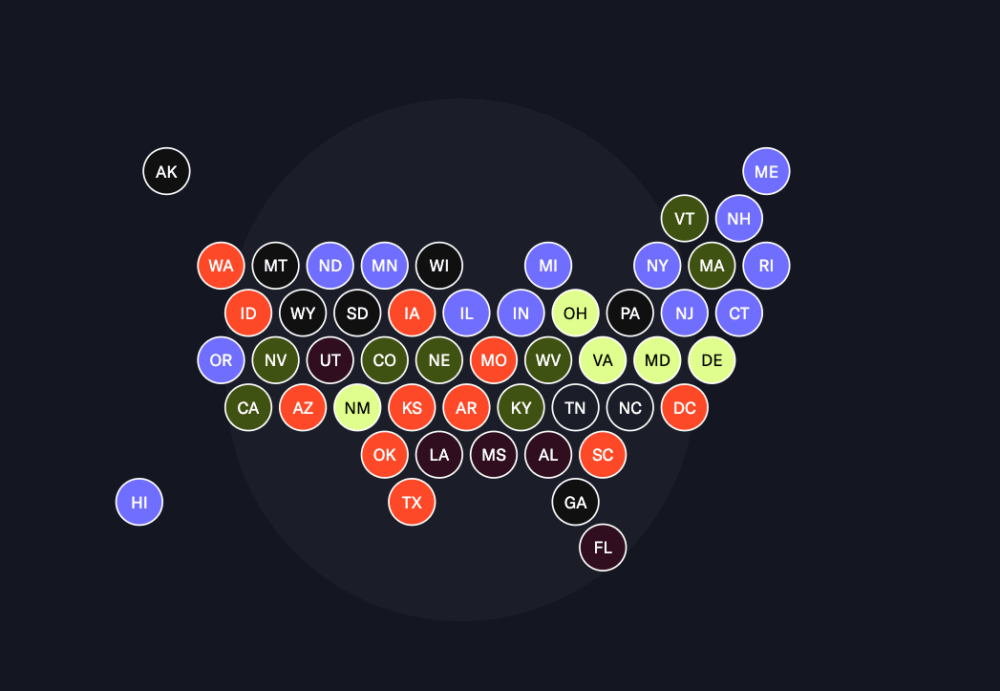
We are committed to providing unique, state-focused insights from a national perspective. Explore our Election Policy Tracker for real-time updates and analysis and learn more about our work to ensure free and fair elections.
Subscribe to The Markup
The Markup is Voting Rights Lab’s regular analysis of the latest election policy issues and trends. Sign up here to get these updates delivered straight to your inbox.