Report
What Comes After Watson? A Proactive Policy Agenda for Impacted States
The countdown to the 2026 midterms has already begun — but for hundreds of thousands of Americans, the fundamental rules of how to return a mail ballot hang in the balance before the U.S. Supreme Court.
In the case Watson v. RNC, the Republican National Committee is challenging a Mississippi law that allows ballots received a few days after Election Day to be counted — as long as they are postmarked on or before Election Day. Mississippi is one of 30 states with grace periods allowing at least some voters’ mail ballots to be counted if they are sent by Election Day but received afterward. Specifically:
Fourteen states and Washington, D.C., currently have postmark deadlines with grace periods for all mail ballots. In these states, many voters — especially rural voters, voters without access to drop boxes or early voting sites, and voters who experience unexpected mail-delivery delays — often rely on grace periods to ensure their ballots are counted.
Sixteen additional states provide a grace period specifically for military and overseas voters.
Grace periods are not a prerequisite for mail voting. Many states, such as Colorado, have strong mail voting systems and do not offer grace periods. These states offer ballot drop boxes and other flexible options for voters to return ballots without relying on the mail.
However, we’ve also seen the negative fallout in states that have eliminated grace periods — without putting additional safeguards in place. For example:
- In North Carolina in 2024, election officials tossed 2,382 ballots that arrived within what had been a grace period until lawmakers mandated that ballots be received by Election Day.
- In Ohio’s primary this spring, the percentage of mail ballots tossed out for arriving late increased tenfold compared to the 2024 general election after the state eliminated its grace period last year.
The magnitude of this ruling’s impact will depend on each state’s unique characteristics and existing election laws. In certain states, a prompt response will be particularly critical to ensuring that all ballots cast by eligible voters are counted. For example:
- In Alaska, where many parts of the state are not accessible by road, the postmark grace period is key to ensuring every vote is counted. In 2024, 12% of mail ballots were received during the state’s grace period.
- In Illinois and Virginia, over 10% of mail ballots were received during the states’ grace periods in 2024. Neither of these states requires drop boxes to be available 24/7.
By contrast, some impacted states already have laws that will protect against the negative effects of a ruling prohibiting grace periods. For example, although Oregon and Washington, D.C., have grace periods, they also have robust drop box networks that allow voters to bypass the Postal Service altogether. In these jurisdictions, fewer than 1% of mail ballots cast in 2024 were received during the grace period. If these states invest in public education campaigns ahead of the midterms, voters will have time to adjust their behavior and return their ballots using a drop box, rather than relying on a postmark.
The bottom line: voters, state lawmakers, and election officials do not need to wait for a final ruling.
States with grace periods should take proactive steps now to prevent last-minute confusion and ensure every eligible vote is counted.
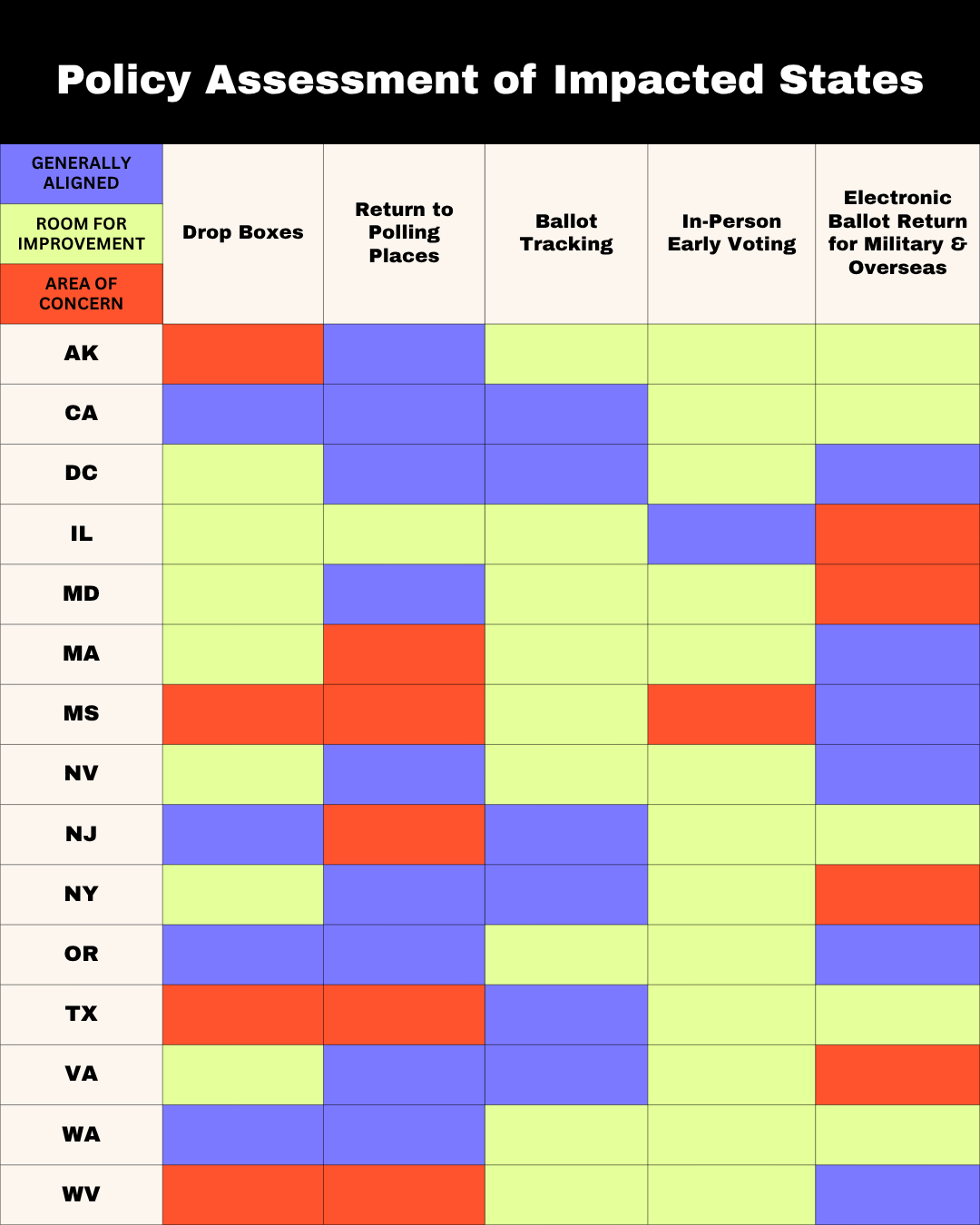
This report lays out our state-specific policy prescriptions for the 14 states with grace periods for all mail ballots: Alaska, California, Illinois, Maryland, Massachusetts, Mississippi, Nevada, New Jersey, New York, Oregon, Texas, Virginia, Washington, and West Virginia, along with Washington, D.C.
Our recommendations include:
- Establish a robust ballot drop box network.
- Allow voters to return mail ballots in person at all polling places.
- Establish or expand in-person early voting.
- Implement robust ballot tracking to alert voters if they need to vote in person.
- Provide electronic ballot return options (EBR) for military and overseas voters.
To speak to one of our experts, email press@votingrightslab.org.
Appendix
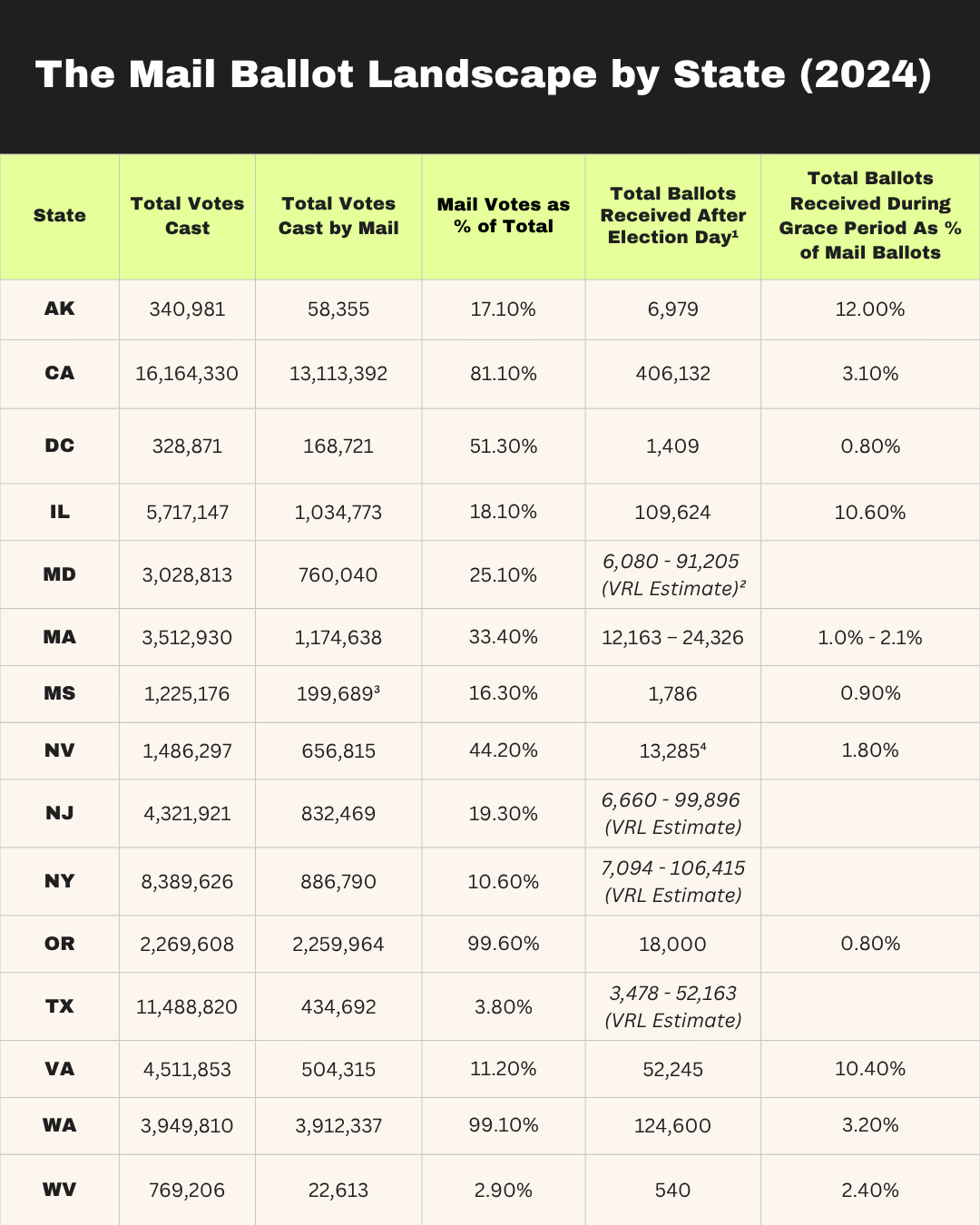
[1] Walker, Carter. How many voters could be affected by earlier mail ballot deadlines? We ran the numbers. Votebeat, 2026, https://www.votebeat.org/2026/02/11/how-many-mail-voters-absentee-ballots-arrive-after-election-day-2024-2026-postmark-supreme-court/. Accessed 26 May 2026.
[2] Numbers noted as a “VRL Estimate” were calculated by extrapolating the 0.8%–12.0% mail-ballot estimate from Votebeat’s data.
[3] Estimated by combining the number of ballots reported as received by the secretary of state on the day before Election Day with the Votebeat estimate of ballots received after Election Day. Includes absentee ballots cast in person at an election official’s office.
[4] Estimated by extrapolating the rates from Clark and Washoe counties from Votebeat’s data to the rest of the state.