The Markup: Georgia House committee delays state’s costly transition to hand-marked paper ballots
Welcome to the Markup, Voting Rights Lab’s weekly digest of election law and policy updates.
We are tracking 1,534 bills prefiled or introduced this session across 44 states and D.C. Our analysis finds that 708 bills would improve voter access or election administration, while 319 would restrict them. This week’s Markup features policy updates in Arizona, Georgia, Maryland, Michigan, Mississippi, New York, Vermont, and Wisconsin.
Jump to section:
Improving Voter Access or Election Administration
Vermont Senate passes state Voting Rights Act.
The Vermont Senate unanimously passed S.B. 298, which would create the “Vermont Voting Rights Act of 2026.” The bill would prohibit voting standards or procedures that restrict a citizen’s right to vote based on race, color, or membership in a language minority group. It would also authorize the attorney general to enforce this prohibition and create new criminal and civil penalties for intimidating election officials or voters, as well as providing false information to voters. The bill is scheduled for a House committee hearing on March 24.
The Maryland legislature advances bills to improve election administration and voter information sharing.
Lawmakers in Maryland passed several bills out of their first chamber. These include: H.B. 115 (requires the re-activation of voter registration status for individuals released from state correctional facilities and requires regular data sharing between corrections officials and election administrators); H.B. 1001 (requires police officers on duty at polling places to follow the direction of election officials, including board employees and election judges); and S.B. 848 / H.B. 1448 (requires municipalities to submit information on how and where to vote to the State Board of Elections shortly after candidate filing deadlines). These bills now move to the opposite chambers for consideration.
Georgia House committee passes legislation to delay costly transition to hand-marked paper ballots.
The Georgia House committee passed S.B. 214, legislation delaying the state’s transition to hand-marked paper ballots. While S.B. 189 (2024) banned the use of QR-codes to tabulate votes starting July 2026, this bill would push that deadline to December 31, 2027. The State Election Board is pushing to make the change as quickly as possible. County election officials have warned they will not be able to implement the change required by the 2024 law for this year’s elections, as lawmakers have not appropriated the necessary funds.
Wisconsin legislature sends bill altering election timelines to governor.
The Wisconsin Senate approved A.B. 374, which would alter the state’s certification and canvassing deadlines to comply with the federal Electoral Count Reform Act. The bill now goes to Gov. Tony Evers for his approval.
New York Senate passes bill allowing election officials to keep their addresses private.
The New York Senate passed S.B. 566. The bill would permit election officers to participate in the state’s address confidentiality program to protect their privacy. It would require the state to designate county boards of elections to assist with enrollment. Current law limits the program to certain crime victims and individuals connected to reproductive health care services. The bill now moves to the Assembly for consideration. Election officials around the country have faced increased threats since 2020. Since 2021, four states have enacted laws to keep election workers’ addresses confidential.
Restricting Voter Access or Election Administration
Michigan House advances proof of citizenship bill.
On a party-line vote, the Michigan House Election Integrity Committee passed H.B. 4765. The bill would require eligible voters to prove U.S. citizenship when registering to vote. The bill now moves to the House floor for consideration. Sixteen states have considered proof of citizenship mandates this year.
Arizona committees advance constitutional amendments to tighten voter ID requirements.
The Arizona Senate Judiciary and Elections Committee passed H.C.R. 2001, and the House Federalism, Military Affairs, and Elections Committee passed S.C.R. 1001. These identical resolutions propose a constitutional amendment requiring voters to show a government-issued ID before casting a ballot. This change would apply to mail ballots, which are currently validated by signature matching and were used by three-in-four Arizona voters in 2024. The proposal would also require on-site tabulation at all voting locations, without providing counties with funding to acquire the necessary tabulators. These measures now head to each chamber’s Rules committees. If adopted by both chambers of the legislature, the amendment will go before voters in November. Gov. Katie Hobbs cannot veto the resolution.
On Our Radar
Supreme Court hears oral arguments in mail ballot receipt case.
Earlier today, the U.S. Supreme Court heard oral arguments in Watson v. RNC. Originating in Mississippi, the case will determine whether federal statutes defining “Election Day” override state laws that offer voters grace periods to return their mail ballots, so long as the ballot is postmarked by Election Day. Currently, 14 states and D.C. provide a grace period for postmarked ballots. The court will issue its ruling before its current term ends in June.
U.S. Senate begins debate on proof of citizenship law.
Last week, the Senate opened debate on the SAVE America Act. Backed by President Donald Trump, the legislation would require voters to provide proof of citizenship, such as a U.S. passport or birth certificate, to register to vote. In addition, the bill would require a photo ID to vote in person or a copy of a photo ID for mail ballots.
Georgia Court of Appeals sides with Fulton County in fight over election board appointments.
The Georgia Court of Appeals ruled that the Fulton County Board of Commissioners has the authority to reject political-party nominees for the county election board. This decision overturns a previous trial court order that ordered Fulton County to appoint two conservative activists or face daily fines.
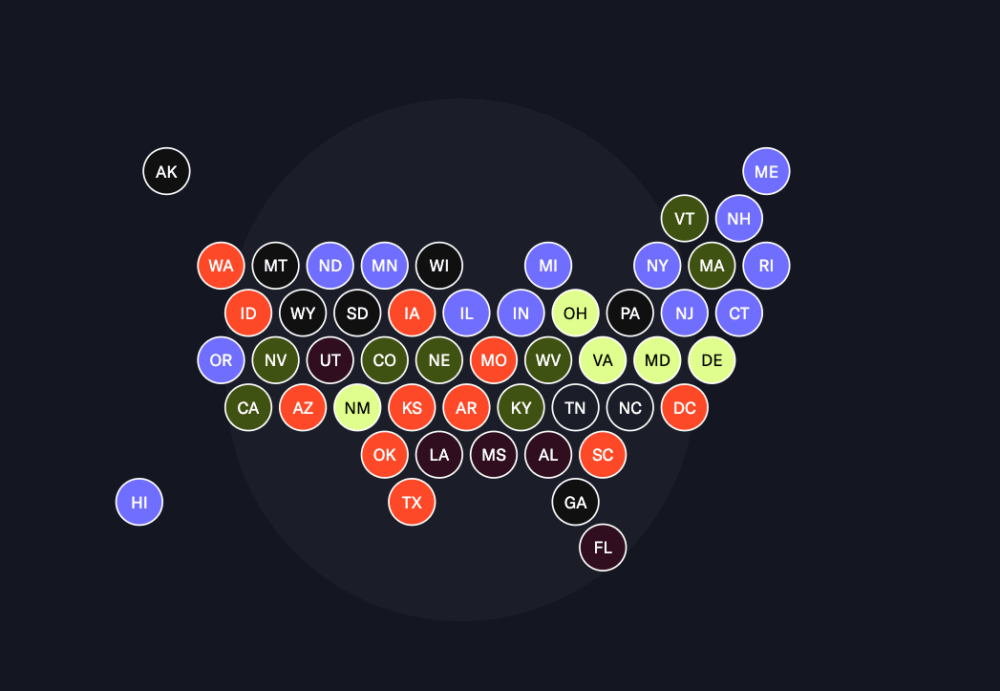
Election Policy Tracker
We are committed to providing unique, state-focused insights from a national perspective. Explore our Election Policy Tracker for real-time updates and analysis and learn more about our work to ensure free and fair elections.
Subscribe to The Markup
The Markup is Voting Rights Lab’s regular analysis of the latest election policy issues and trends. Sign up here to get these updates delivered straight to your inbox.