The Markup: Proof of citizenship bill headed to Utah governor
We are tracking 1,474 bills prefiled or introduced this session across 44 states and D.C. Our analysis finds that 687 bills would improve voter access or election administration, while 319 would restrict them. This week’s Markup features policy updates in California, Colorado, Florida, Mississippi, Missouri, New York, Rhode Island, South Dakota, Texas, Utah, Virginia, and Washington.
Jump to section:
Improving Voter Access or Election Administration
Virginia legislature sends multiple bills to improve elections to governor’s desk.
The Virginia legislature passed several pieces of legislation to improve voter access. These bills include S.B. 58/H.B. 82 (extends the time a voter can submit election documents to fix mistakes on mail ballots, return absentee ballots, and verify provisional ballots submitted without acceptable ID); H.B. 774 (establishes a cure process for provisional ballots and increases time to cure absentee ballots); and S.B. 162 (establishes automatic rights restoration after release from incarceration, effective upon adoption of a related constitutional amendment). These bills now move to Gov. Abigail Spanberger for her signature.
Missouri House passes bill restoring voting rights to individuals on probation or parole.
The Missouri House passed H.B. 2592, which would restore voting rights to citizens with past felony convictions upon release from incarceration. Under current law, the state revokes voting rights for those with felony convictions until the full sentence is completed, including probation or parole. If enacted, Missouri would join 23 states that restore voting rights following incarceration. The bill now heads to the Senate for consideration.
Colorado House passes bill expanding drop box availability.
The House passed H.B. 1113, which would expand the availability of mail ballot drop boxes and the accepted forms of voter ID. The bill would make drop boxes available starting 22 days before an election, up from 15 days under current law. It would also reduce the number of students necessary to trigger a requirement for on-campus drop boxes. The bill now goes to the Senate for consideration.
Rhode Island and Washington legislatures advance bills allowing electronic ballot return for military and overseas voters.
The Rhode Island Senate passed S.B. 2341, which would reinstate an expired electronic ballot return program for overseas and military voters, as well as certain voters with disabilities. The bill now goes to the House, which has already passed a similar bill.
The Washington State House passed S.B. 6035, which would authorize the secretary of state to create an online ballot return portal for overseas, military, and disabled voters, as well as members of federally recognized tribes. The bill now returns to the Senate for concurrence with House amendments.
Restricting Voter Access or Election Administration
Utah legislature sends proof of citizenship bill to governor.
The Utah legislature gave final approval to H.B. 209, a bill that would impose new proof of citizenship requirements for Utah voters. If Gov. Spencer Cox signs the legislation, voters who have not provided proof of U.S. citizenship, such as a passport or birth certificate, would be allowed to vote only in federal elections. The bill also includes provisions that allow election officials to aggressively remove registered voters who are alleged to be noncitizens. These requirements would take effect prior to this year’s midterm elections.
South Dakota legislature passes proof of citizenship bill for voter registration.
Lawmakers advanced S.B. 175, which would require proof of U.S. citizenship to register to vote in state and local elections. The bill would designate voters who have not provided proof of citizenship as “federal-only voters.” A driver’s license or Social Security number is sufficient to register to vote based on federal law. The measure now heads to Gov. Larry Rhoden for his signature. These requirements would take effect prior to this year’s midterm elections.
Mississippi House passes limited proof of citizenship bill.
The Mississippi House passed S.B. 2588, which would establish new procedures for local election officials to check the citizenship status of voter registration applicants. If election officials cannot confirm an applicant’s citizenship using the Department of Public Safety driver’s license data or the unreliable federal SAVE database, applicants would be required to provide documents proving their citizenship, such as a passport or birth certificate. The bill now goes to the Senate for consideration.
California voter ID referendum expected to qualify for November ballot.
A California initiative requiring voters to present identification at the polls and requiring additional processes to verify the citizenship of registered voters is expected to qualify for the statewide ballot later this year, pending signature review. California is one of 13 states where poll workers do not ask voters to show ID to vote.
On Our Radar
Florida proof of citizenship bill scheduled for Wednesday vote.
The Florida Senate is scheduled to vote on a new proof of citizenship bill this Wednesday. S.B. 1334 would require applicants for voter registration to provide proof of citizenship, or have their citizenship confirmed via driver’s license records, as part of the registration process. It would also remove registered voters from the voter rolls if election officials fail to confirm their citizenship. The House passed a similar bill last month.
Texas voters turned away from Dallas County polling places during primary election.
In Dallas County, hundreds of Texas voters were turned away at polling places after the county’s Republican Party declined to hold a joint primary using the county’s vote centers. Under state law, this decision required voters to vote at their precinct polling place after years of being able to vote at any polling place in the county. Amidst the chaos, a judge ordered the polls to remain open for two additional hours. Then the state’s supreme court ruled that officials must separate and potentially not count ballots cast during these additional polling hours. Over 2,300 ballots remain in limbo.
Supreme Court halts New York redistricting; Virginia Supreme Court greenlights redistricting ballot measure; Florida delays deadline for candidates to qualify for the ballot.
In a 6-3 decision, the U.S. Supreme Court stayed a New York state court decision that required the state to redraw New York’s 11th Congressional District for the 2026 election. The current map will stay in place for the upcoming election.
The Virginia Supreme Court overturned a Tazewell County Circuit Court decision that would have halted preparations for a referendum to allow the state to redraw its congressional map for 2026. The referendum vote is scheduled for April 21, and early voting began last week.
The Florida Senate passed S.B. 620 with an amendment that would move up the deadline for congressional candidates to qualify for the ballot. By moving the deadline from April to June, the bill would allow more time for potential redistricting.
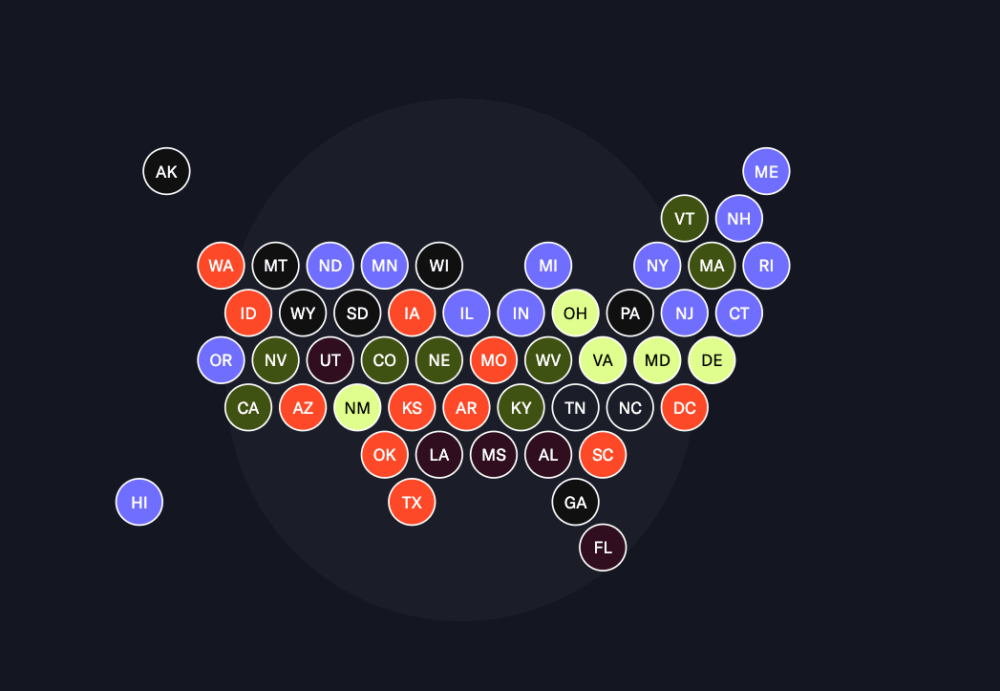
Election Policy Tracker
We are committed to providing unique, state-focused insights from a national perspective. Explore our Election Policy Tracker for real-time updates and analysis and learn more about our work to ensure free and fair elections.
Subscribe to The Markup
The Markup is Voting Rights Lab’s regular analysis of the latest election policy issues and trends. Sign up here to get these updates delivered straight to your inbox.