The Markup: Georgia court reinstates ban on providing food and water to voters in line
We are tracking 1,783 bills prefiled or introduced this session across 50 states. Our analysis finds that 778 bills improve voter access or election administration, while 463 restrict it. This week’s Markup features policy updates in Georgia, Massachusetts, Michigan, Ohio, and Texas.
Jump to section:
Improving Voter Access or Election Administration
Massachusetts legislative committee advances same-day registration bill.
The Massachusetts legislature’s Joint Committee on Election Laws recommended passage of S.B. 505. The bill would allow eligible residents to register to vote at a polling place on Election Day and during early voting. Next, the Senate Committee on Ways and Means will consider the bill.
Twenty-eight states and D.C. currently allow some form of same-day voter registration. Massachusetts Secretary of State William Gavin has made this policy a priority.
Restricting Voter Access or Election Administration
Michigan judge directs officials to reject mail ballots received in incorrect envelopes.
A Michigan judge issued a ruling striking down the secretary of state’s guidance regarding mail ballots with missing or mismatching serial numbers. This guidance allowed officials to treat those ballots as “challenged,” potentially allowing them to be counted. For example, this guidance helped voters in the same household who may have inadvertently mixed up which return envelope corresponds to which ballot. Following this ruling, election officials will be forced to throw out these ballots.
Georgia court reinstates ban on providing food and water to voters in line.
An appeals court in Georgia reversed a lower court’s decision that had partially struck down provisions from S.B. 202. Enacted in 2021, this law prohibited the provision of food or water to voters waiting in line at a polling place.
The appeals court decision reinstates the ban and associated criminal penalty.
On Our Radar
Secretaries of state raise concerns about SAVE database as Trump administration brings lawsuits against additional states seeking access to voter data.
Thirteen secretaries of state submitted a letter to the chief privacy officer at the U.S. Department of Homeland Security (DHS) opposing the planned expansion of the use of the DHS SAVE database. While intended for verifying benefits program eligibility, several states have begun using the database to determine voter eligibility. DHS has encouraged this practice. The officials cite concerns about data accuracy, voter privacy, and broader intrusions into state-run elections. Additionally, the Department of Justice expanded its campaign against states that have refused to supply the agency with their voter registration lists, suing Delaware, Maryland, New Mexico, Rhode Island, Vermont, and Washington. The department has now sued 14 states in its pursuit of voter data, claiming states are not complying with federal voting laws.
Hundreds of Texas voters incorrectly identified as potential noncitizens.
County election officials have confirmed that hundreds of voters whom the secretary of state flagged as potential noncitizens are, in fact, citizens. The secretary’s office used the federal SAVE database to identify the potential noncitizens. The office failed to check with the Texas Department of Public Safety, the state agency that collects proof-of-citizenship documents before issuing driver’s licenses.
Texas officials seek to reinstate prohibition on payment for mail ballot return.
Texas officials appealed to the U.S. Court of Appeals for the Fifth Circuit to reverse a lower court’s ruling blocking enforcement of the state’s “ballot harvesting” prohibition. The law, passed as part of S.B. 1, an omnibus bill enacted in 2021, prohibits compensation for canvassers who collect mail ballots and other so-called “vote harvesting services.”
A previous Fifth Circuit ruling paused the lower court’s order to prevent confusion ahead of the 2024 election.
Ohio secretary of state announces AI tool for election workers.
Ohio Secretary of State Frank LaRose announced the launch of “Elections Virtual Assistant” (Eva). The AI-powered tool aims to assist county election administrators with answers to common election-related questions. However, LaRose warned officials not to rely solely on AI-generated answers.
Subscribe to The Markup
The Markup is Voting Rights Lab’s regular analysis of the latest election policy issues and trends.
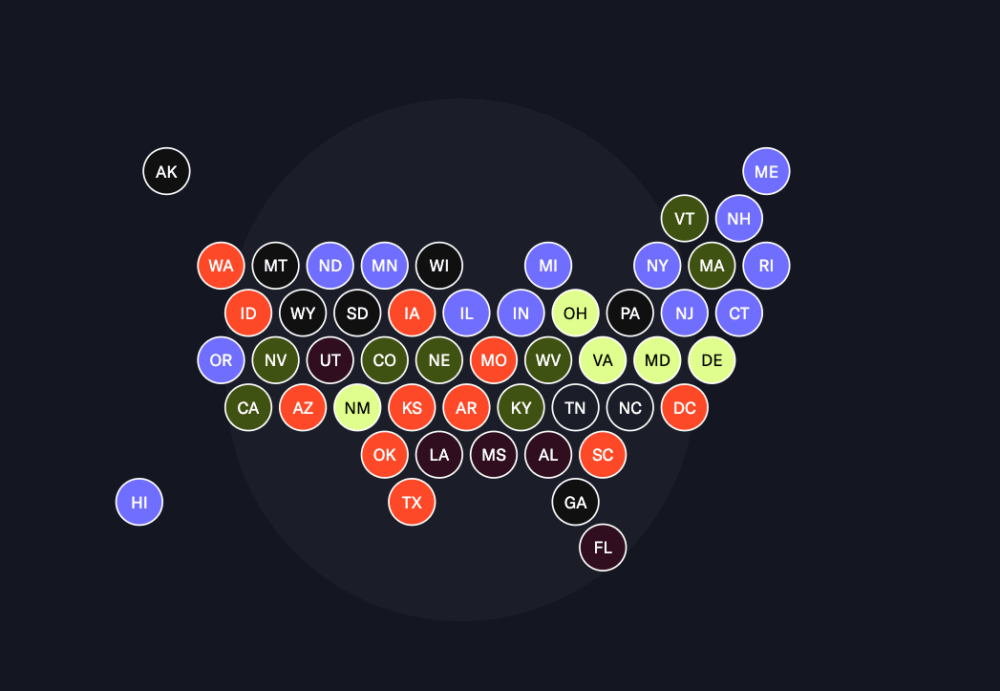
Election Policy Tracker
We are committed to providing unique, state-focused insights from a national perspective. Explore our Election Policy Tracker for real-time updates and analysis and learn more about our work to ensure free and fair elections.