The Markup: Arizona advances slate of restrictive voting bills
We are tracking 942 bills prefiled or introduced this session across 36 states and D.C. Our analysis finds that 469 bills improve voter access or election administration, while 218 bills restrict it. This week’s Markup features policy updates in Arizona, California, New Jersey, New York, North Carolina, Oregon, and Virginia.
This week, legislative sessions are kicking off in Alaska, New Mexico, North Dakota, and Utah.
1/26/26 Election Policy Tracker Training: Our free, powerful Election Policy Tracker powers this newsletter. We’re hosting a training on Monday, January 26th, at 1 p.m. ET to demonstrate how you can use this tool to monitor developments in election law and proposed legislation across all 50 states and D.C. Sign up today to save your spot!
Jump to section:
Improving Voter Access or Election Administration
New York Senate advances bills expanding early voting options and criminalizing election disinformation.
The New York Senate passed S.B. 568, which would allow county boards of elections to establish portable early voting locations in addition to existing standing locations. The Senate also passed S.B. 1085, which would establish new criminal offenses for spreading false election information or engaging in voter suppression. Both bills now move to the Assembly for consideration.
New Jersey enacts automatic voter registration and election audit improvements.
In his final days in office, Gov. Phil Murphy signed two election bills into law. S.B. 1636 improves the state’s automatic voter registration process by expanding the number of participating agencies and changing the opt-out timing so citizens may opt out via mail rather than in-person at a government agency. A.B. 5037 improves post-election audits by allowing the use of machines rather than requiring hand counts.
Virginia lawmakers send constitutional amendment to restore voting rights to the ballot.
The General Assembly passed H.J.R. 2, setting up the proposed constitutional amendment to go before voters during an upcoming special election. The amendment would provide for automatic restoration of voting rights upon a citizen’s release from incarceration following a past felony conviction. Virginia is currently one of only four states where voting rights are never automatically restored.
Restricting Voter Access or Election Administration
Arizona advances slew of harmful bills aimed at voter privacy, voting equipment, and overseas citizens.
The Senate Committee on Judiciary and Elections passed six election bills along party lines: S.B. 1040 (requiring public access to the state’s voter registration list); S.B. 1037 (imposing unrealistic and unfunded security requirements for voting equipment); and S.B. 1060 (repealing a law allowing U.S. citizens who have never lived in the country — typically the children of citizens residing overseas — to vote in Arizona if it was their parent’s last U.S. residence). These bills will next go to the Senate Rules Committee for consideration.
North Carolina State Board of Elections removes campus voting sites, cuts back on Sunday early voting.
The North Carolina State Board of Elections issued tie-breaking decisions in 12 counties where the county boards were unable to reach unanimous agreements on early voting. The adopted plans cut back on Sunday early voting and eliminated voting sites on college campuses, including North Carolina A&T, the nation’s largest historically Black university, as well as UNC Greensboro, Western Carolina University, and Elon University. While these changes only apply to the March primary election, they may signal the board’s intentions for the November midterms.
On Our Radar
Supreme Court gives candidates leeway to challenge election rules pre-election.
In Bost v. Illinois State Board of Elections, the Supreme Court held that federal candidates are sufficiently affected by state election laws to challenge them before Election Day, rather than waiting until results are contested. The court did not rule on the merits of the specific law challenged by the suit (Illinois’ grace period for mail ballots postmarked by Election Day). The court will take up that issue in Watson v. Republican National Committee later this term.
Oregon and California courts reject DOJ efforts to access unredacted voter lists.
Federal district courts in Oregon and California dismissed lawsuits filed by the U.S. Department of Justice. This dismissal comes after state election officials rebuffed requests to send a complete, unredacted list of registered voters, including sensitive personal information, to federal authorities. State officials based their objections on state privacy laws and federal constitutional concerns. The courts found that federal officials lack constitutional or statutory authority to require state officials to turn over these records.
Federal court leaves new California congressional map in place as Virginia legislature advances redistricting effort.
A three-judge federal panel denied a motion filed by California voters and the state Republican Party to prevent the state’s new congressional map from taking effect while litigation challenging the map remains ongoing. Unless the Supreme Court intervenes, the latest maps — approved by voters in November 2025 — will be in effect for the upcoming June primary and November general election.
Additionally, the Virginia General Assembly adopted H.J.R. 4. The proposed constitutional amendment would allow the General Assembly to redraw the commonwealth’s U.S. House districts ahead of the 2026 election. Voters will decide whether to amend the state constitution during a special election in the coming months.
Subscribe to The Markup
The Markup is Voting Rights Lab’s regular analysis of the latest election policy issues and trends.
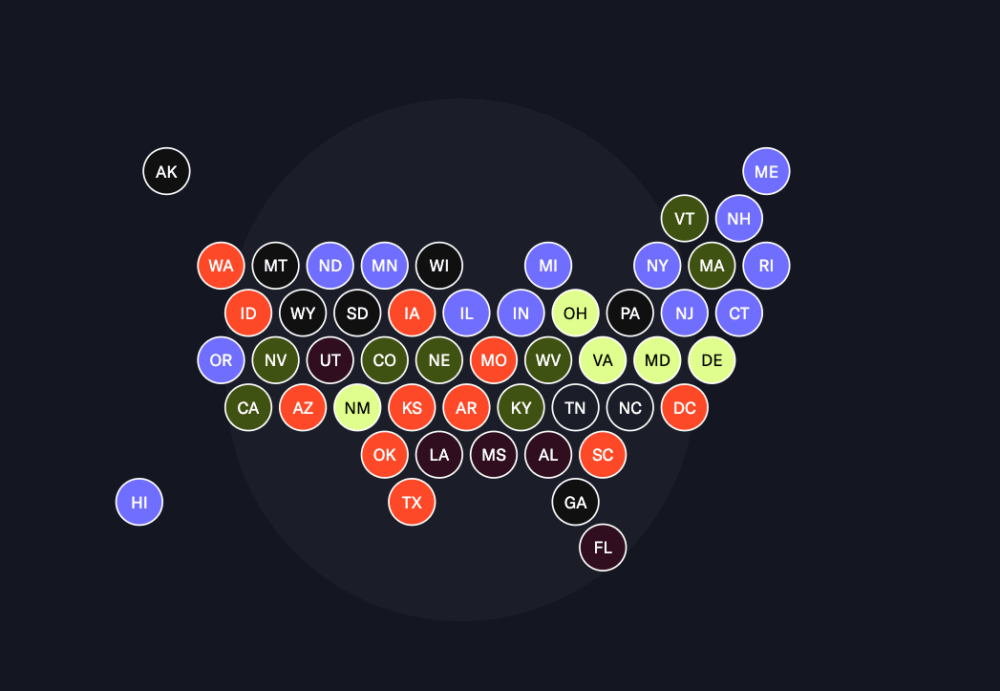
Election Policy Tracker
We are committed to providing unique, state-focused insights from a national perspective. Explore our Election Policy Tracker for real-time updates and analysis and learn more about our work to ensure free and fair elections.