The Markup: Third federal court strikes down key pieces of Trump’s executive order
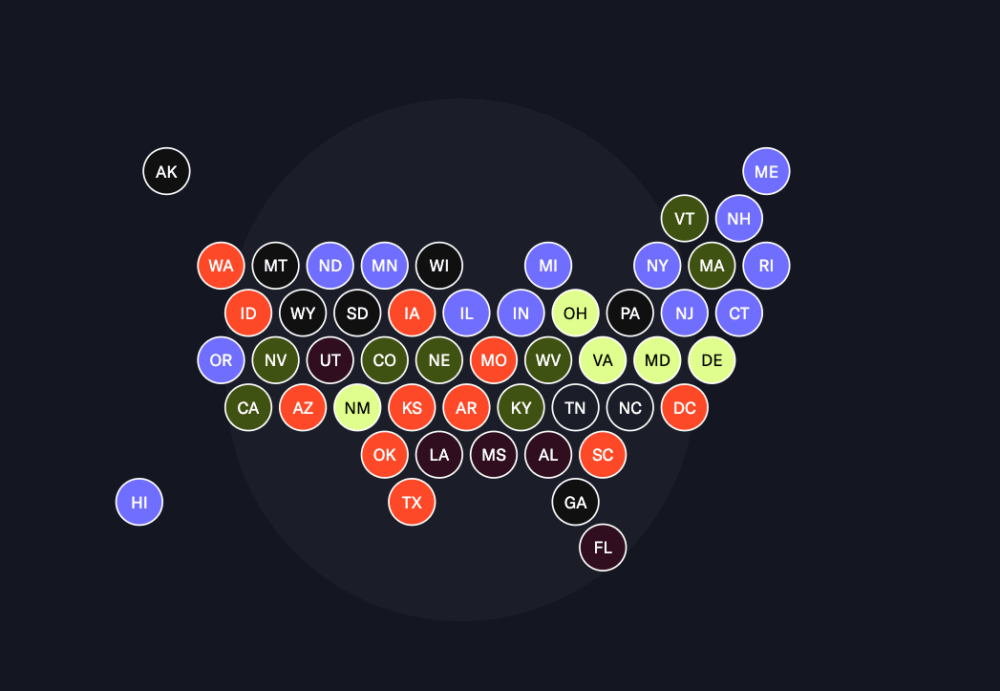
Voting Rights Lab is tracking 801 bills prefiled or introduced this session across 34 states and Washington, D.C. Our analysis finds that 384 would improve voter access or election administration, while 191 would restrict it.
This week, legislative sessions kick off in 17 states: Alabama, Arizona, Colorado, Delaware, Florida, Georgia, Hawaii, Iowa, Kansas, Maryland, Minnesota, New Jersey, South Carolina, Tennessee, Virginia, Washington, and West Virginia.
Jump to section:
Improving Voter Access or Election Administration
Third federal court strikes down key pieces of Trump’s executive order as unconstitutional.
A federal district court in Washington ruled that some provisions of President Trump’s March 2025 executive order on elections violate the constitutional separation of powers and prohibited their enforcement in Washington and Oregon. The banned provisions included requiring documentary proof of citizenship on the federal voter registration application, prohibiting the counting of mail ballots postmarked by Election Day but received after Election Day, and potentially forcing the Election Assistance Commission (EAC) to decertify widely used voting equipment. Last year, federal courts in Massachusetts and D.C. also found the order unconstitutional.
New Hampshire House passes bills on voter registration, polling place locations.
H.B. 365 would require the secretary of state to attempt to verify the citizenship of voter registration applicants who cannot provide citizenship documentation by referencing state and federal databases. The bill would also establish a voucher program to assist low-income applicants in obtaining a birth certificate for voter registration. S.B. 103 would require towns and cities to have at least one polling place for every 15,000 registered voters. Towns and cities that receive a waiver from the attorney general and secretary of state may be exempted. Both bills now go to the Senate: H.B. 365 for initial consideration and S.B. 103 for concurrence with House amendments.
New Jersey Assembly committees advance bill to improve mail ballot cure process.
In the Assembly, the Committee on State and Local Government and the Committee on Appropriations advanced S.B. 4835 with amendments. The bill would improve the mail ballot cure process by requiring that voters who make inadvertent errors — such as failing to include or seal the inner or outer envelope, or to complete the affidavit on their inner envelope — be sent notice and allowed to cast a new mail ballot or vote provisionally in person. The bill now goes to the full chamber for consideration.
Restricting Voter Access or Election Administration
New Hampshire House passes bills targeting student voters and restricting voter ID options.
H.B. 323 would remove student IDs from the list of acceptable voter IDs. The remaining accepted forms of ID would be driver’s licenses, non-driver state IDs, U.S. military IDs, and U.S. passports. Additionally, H.B. 317 would repeal a law that allows poll workers to verify the identities of voters they know personally without requiring the voter to show ID. Both bills passed the House and now go to the Senate for consideration.
Florida legislators prefile proof of citizenship bills.
Florida’s legislative session commenced today. Members in both chambers prefiled two bills that would impose proof of citizenship requirements. These would apply to both new registrants and Florida’s 13 million currently registered voters. H.B. 991 and S.B. 1334 would each require election officials to attempt to verify each voter’s citizenship using Department of Highway Safety and Motor Vehicles records. Voters whose citizenship could not be confirmed would be required to submit one of a limited list of documents before voting in any election.
On Our Radar
Texas governor threatens to take over Harris County elections.
Gov. Greg Abbott threatened to have the state take over election administration in Harris County, which includes Houston and is the state’s most populous county. The threat follows an investigation that uncovered approximately 100 voter registrations in which commercial post office boxes were listed as the voters’ addresses. State law requires county officials to send a confirmation notice to any voter whose registration address does not match their residence.
Lawsuit challenges Kentucky’s voting rights restoration policy for excluding residents with felony convictions from other states.
A Kentucky resident with a past felony conviction in another state sued the state, seeking to have his voting rights restored. Kentucky’s current rights restoration framework, established by a 2019 executive order issued by Gov. Andy Beshear, limits automatic restoration of rights for disenfranchised individuals who have completed their sentences to those with in-state convictions. The plaintiffs are asking the court to require the automatic restoration process to apply to out-of-state convictions as well.
Florida governor calls special session in April for congressional redistricting; Kansas abandons redistricting effort.
Florida Gov. Ron DeSantis issued a proclamation calling for a special legislative session in April to consider congressional redistricting. This session will take place following the conclusion of Florida’s regular legislative session in March. In Kansas, legislative leaders acknowledged they lack the votes to enact new maps, abandoning an election-year redistricting effort.
Subscribe to The Markup
The Markup is Voting Rights Lab’s regular analysis of the latest election policy issues and trends.
Election Policy Tracker
We are committed to providing unique, state-focused insights from a national perspective. Explore our Election Policy Tracker for real-time updates and analysis and learn more about our work to ensure free and fair elections.