Report
What’s at Stake for Elections at the Supreme Court
Last updated: February 12, 2026
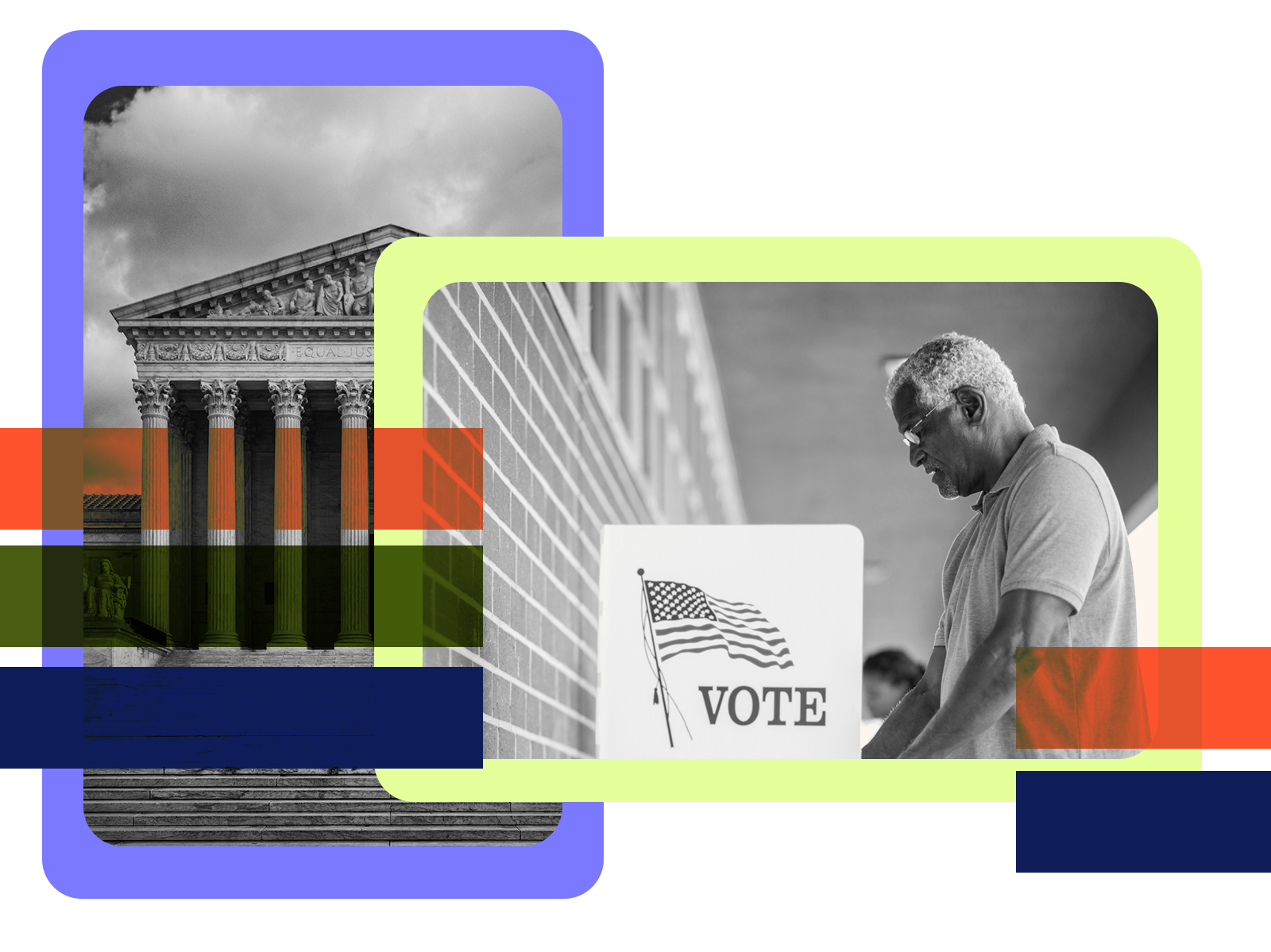
The Supreme Court is hearing — or could soon hear — several important cases that could reshape how Americans vote and who is represented.
Here’s a breakdown of the key election-related cases on the docket and in the pipeline:
Update: Decided: Bost v. Illinois State Board of Elections
What’s at Issue:
A member of Congress from Illinois and two candidates for presidential elector sued the state of Illinois to challenge the state’s law that deems mail ballots timely as long as they are postmarked by Election Day, even if election officials receive them after Election Day. Unlike the Watson case described below, this case does not address the substance of the issue. The question the Supreme Court answered in Bost is a procedural one: whether candidates for federal office have standing to challenge state election rules in their state before the election in which they will run.
Why It Matters:
The decision in favor of the plaintiffs gives candidates greater flexibility to challenge election laws before Election Day. This would allow more disputed issues to be resolved in advance and potentially reduce post-election challenges. If we were to rewind the clock and apply this decision to the recent North Carolina Supreme Court race, for example, Judge Jefferson Griffin could have filed his lawsuit before the election, and the issue could have been decided before voters cast their ballots. However, some observers are concerned that allowing candidates to sue before elections could increase the number of potentially frivolous lawsuits challenging election procedures.
What the Court Said:
The Supreme Court heard oral arguments on October 8, 2025, and issued its ruling on January 14, 2026. In a 7-2 ruling, the court found that candidates in a federal election have legal standing to sue concerning the implementation of those laws. The case was remanded to the Illinois trial court to hear the substantive issue.
While the impact of this decision is solely procedural, we are also closely watching Watson, described below. In that case, the Supreme Court will rule on whether election officials may count ballots received after Election Day — if the ballot is postmarked by Election Day. The decision will impact the validity of tens of thousands of ballots cast by eligible U.S. citizens.
Before the Court: Louisiana v. Callais
What’s at Issue:
Louisiana adopted a congressional map in 2024 with two majority-Black districts, following federal court orders that found its previous map likely violated the Voting Rights Act (VRA). The previous map included only one majority-Black district (out of six districts in the state), even though the state’s population is roughly one-third Black. Six self-described “non-African American” voters sued, arguing that using race to draw congressional districts violates the Equal Protection Clause of the U.S. Constitution.
Historically, courts and the states have interpreted the VRA to allow the use of race in creating districts. This can help prevent racial gerrymandering. The state of Louisiana and the Trump administration joined the six plaintiffs, and the NAACP Legal Defense Fund is representing the interests of Black Louisianans in defending the state maps.
Why It Matters:
The Supreme Court has significantly weakened the VRA in recent years. If the court sides with the plaintiffs, it could effectively strike down or substantially weaken Section 2 of the Voting Rights Act. This law has ensured fair representation for communities of color for decades. This decision could lead states like Florida to eliminate its remaining Section 2-compliant districts. In fact, experts estimate as many as 19 U.S. House districts (mainly in the South) could be redrawn to dilute the voices of people of color in those states.
Most media coverage has focused on the impact on congressional districts. But the effect on state legislative districts could also be profound. If the court weakens Section 2, states may draw new state legislative maps to increase partisan advantage and dilute the voting power of minority voters in state legislative elections. State legislatures pass far more legislation each year than Congress, so changing their composition could have far-reaching consequences.
What to Watch:
SCOTUS heard oral arguments on October 15, 2025. Close observers of the Supreme Court reported that the court appears poised to side with the plaintiffs and further curtail the Voting Rights Act. The court should issue a decision by June 2026. However, some states may preemptively draw new maps ahead of the ruling to fast-track district boundaries for the next election.
Updated: Before the Court: Watson v. Republican National Committee
(Case was previously titled Republican National Committee v. Wetzel)
What’s at Issue:
The Mississippi Republican Party, the Republican National Committee, and two Mississippi voters are challenging a Mississippi law allowing mail ballots postmarked by Election Day to be counted. Under Mississippi law, completed mail ballots are counted as long as they are postmarked on or before Election Day and received within five business days after the election. The Fifth Circuit Court of Appeals ruled that federal law establishing a “single Election Day” requires all ballots to be received by Election Day, even if mailed on time. The state of Mississippi appealed the decision to the Supreme Court. On November 10, 2025, the Supreme Court granted review of the case.
Why It Matters:
Mail ballot return deadlines vary by state. Sixteen states and D.C. currently have postmark deadlines with grace periods for all mail voters. Twenty-nine additional states offer similar postmark deadlines for military and overseas voters. There is logic to these laws — once a ballot leaves a voter’s hands, they no longer control when it arrives. In states without alternative mail-ballot return options (like drop boxes), a grace period is crucial to ensure that all eligible voters’ ballots are counted. In Mississippi, for example, the legislature has banned drop boxes. This means voters casting mail ballots must return those ballots by mail or in person at their election office. Military and overseas voters rely heavily on the ballot return grace period. Reducing or eliminating this period would threaten their ability to participate in our democracy.
What to Watch:
The Court will hear arguments in this case on March 23 and issue its ruling before the end of the term in June. If the court rules that federal law requires ballots to be received by Election Day, then the 16 states that currently have postmark deadlines would need to repeal those laws.
In the Pipeline: Turtle Mountain Band of Chippewa Indians v. Howe
What’s at Issue:
Native American voters sued North Dakota, arguing that the state’s redistricting plan unlawfully dilutes the voices of Native American voters. The plaintiffs claim these legislative maps violate Section 2 of the Voting Rights Act. A trial court ruled in the plaintiffs’ favor. However, the 8th Circuit reversed that decision, ruling that private citizens do not have the right to bring such lawsuits.
Why It Matters:
Historically, private plaintiffs have initiated nearly all Section 2 lawsuits. These private suits are often the only means to address state maps that dilute the voting strength of minority groups. If the Supreme Court rules that private plaintiffs can no longer sue under Section 2, then enforcement will be left solely to the Department of Justice. This ruling would give states a free hand to draw districts that effectively exclude minority groups from representation altogether. This case, combined with Louisiana v. Callais, described above, could effectively eliminate the last major provision of the federal Voting Rights Act. This could fundamentally transform congressional districts, particularly in southern states.
What to Watch:
The court could decide to hear this case at any time. If the court grants the appeal, it would be scheduled for argument in the next term beginning in October. The Supreme Court issued a stay of the 8th Circuit Court’s decision. While the Supreme Court deliberates on whether to hear the case, plaintiffs can continue to bring Section 2 lawsuits. If the court decides not to hear the case, that stay will be lifted. The 8th Circuit decision will then stand.
In the Pipeline: Mi Familia Vota v. Fontes
What’s at Issue:
Arizona voters challenged two 2022 laws, and a district court struck down several proof-of-citizenship provisions, including provisions that prohibited citizens from voting for president and voting by mail unless they showed a passport or birth certificate (Arizona state law already prohibits citizens from voting for state candidates unless they show proof of citizenship); required officials to throw out all state registration forms that did not include proof of citizenship (even though these voters would still qualify for some federal elections); and required county recorders to cancel voter registrations if they “have reason to believe” someone is not a citizen.
The Ninth Circuit Court of Appeals affirmed the district court ruling, striking down these provisions for violating the U.S. Constitution and federal election laws. On October 17, 2025, the Arizona Senate President (a candidate for state Attorney General in 2026) announced the legislature would appeal the decision to the Supreme Court.
Why It Matters:
Arizona is the only state that both (1) requires voters to show a passport or birth certificate to register to vote, and (2) is subject to the National Voter Registration Act (NVRA). In the past, the Supreme Court held that the NVRA prohibits states from requiring proof of citizenship for federal elections. This case tests whether the court will change or narrow that interpretation. Notably, six states (including New Hampshire, which recently enacted a proof-of-citizenship requirement) are not subject to the NVRA.
If the court takes the case and sides with Arizona, it will remove a significant barrier to states passing proof-of-citizenship requirements for federal elections. This case could open the door for more states to follow Arizona’s lead and potentially exclude the many millions of U.S. citizens who don’t have an original birth certificate or a valid U.S. passport.
What to Watch:
Arizona has until February 19 to file its petition seeking review with the Supreme Court. If the court decides to hear this case, arguments will likely be held during the October 2026 term.
Subscribe to our newsletters.
Get the latest in election law and policy analysis — delivered straight to your inbox.