Report
2026 Battleground Report: How Voting Rules Have Changed Since the 2022 Midterms
Nearly every state has changed its voting laws in some way since the last midterm election. In some states, these were minor amendments voters will not even notice. But in other states, the changes will require voters to adjust how they cast their ballots or significantly affect how election officials do their jobs — often in harmful ways. Some of the more significant trends since the 2022 midterms will bring new restrictions and risks to voters and election administrators. They include:
- Changes to mail ballot deadlines: Six states enacted laws to stop counting mail ballots that are postmarked by Election Day if they arrive afterward. A Kansas state court blocked the law from taking effect.
- Restrictions to voter ID: 13 states have limited the forms of ID voters can use or eliminated alternatives to showing identification
- Hunts for noncitizens on the voter rolls: 18 states have enacted laws meant to identify alleged noncitizens on their voter rolls.
- Leaving ERIC: Eight states have left the Electronic Registration Information Center (ERIC) since 2022, though Virginia later rejoined. Leaving ERIC has left local officials scrambling for other data sources to keep voter lists current.
In this report, we take a closer look at seven states with closely contested statewide races this fall — Georgia, Iowa, Michigan, New Hampshire, North Carolina, Ohio, and Texas — and examine how significant changes to election law in these states will affect how voters cast their ballots and how election officials do their jobs.
Table of Contents
- At a Glance: The Biggest Changes Since 2022 in Seven Battleground States
- Georgia: What’s Changed Since 2022
- Iowa: What’s Changed Since 2022
- Michigan: What’s Changed Since 2022
- New Hampshire: What’s Changed Since 2022
- North Carolina: What’s Changed Since 2022
- Ohio: What’s Changed Since 2022
- Texas: What’s Changed Since 2022
- Where the Risks Are This Fall
At a Glance: The Biggest Changes Since 2022 in Seven Battleground States
Some changes make voting easier. Other states added new hurdles, earlier deadlines, or new risks that voters’registration will be canceled or ballots rejected.
| State | Biggest Change for Voters | Biggest Change for Election Officials |
|---|---|---|
| Georgia | Improvement: New protections against frivolous voter registration challenges. | Risk: Secretary of state was removed from the State Election Board, leaving unelected appointees in control. |
| Iowa | Restriction: Voters without ID can no longer have another voter vouch for them. | Restriction: The state withdrew from ERIC while navigating aggressive new voter roll verification mandates. |
| Michigan | Improvement: All voters can vote early in-person or sign up to receive a mail ballot for every election. | Improvement: Officials are required by law to certify election results, with no discretion to refuse |
| New Hampshire | Restriction: Mail voters must provide photo ID or notarized signature; student IDs no longer accepted. | Risk: New annual and quarterly reviews of voter rolls could lead to erroneous removals. |
| North Carolina | Restriction: Photo ID required for in-person and mail voting; mail ballots that arrive after Election Day are no longer counted. | Risk: State auditor, not governor, now in charge of appointing board members |
| Ohio | Restriction: Photo ID required; drop boxes limited to one per county; mail ballots that arrive after Election Day are no longer counted. | Risk: Eligible voters may be flagged as noncitizens using unreliable federal data |
| Texas | Improvement: Voters can fix mail ballot errors online or by mail, not only in person | Risk: The secretary of state can now order oversight of a county’s elections, giving local officials less control. |
Georgia: What’s Changed Since 2022
Georgia voters gain stronger protections against mass registration challenges but will face tighter voter ID and residency rules. Election administrators must manage operations under a restructured state election board, expanded state law enforcement authority, and a mandatory 8 p.m. results deadline.
What’s Changed for Georgia Voters
Voters have stronger protections against frivolous registration challenges. A 2021 law opened the door to mass challenges to voters’ eligibility. In 2022, unfounded challenges totaling about 100,000 flooded understaffed election offices, and 89% of them came from just six people. A 2024 law now says that U.S. Postal Service change-of-address data, out-of-county college enrollment, or government service elsewhere do not, on their own, justify a challenge. Any challenge filed within 45 days of an election must now wait until after Election Day.
There were 100,000 voter challenges in 2022, and 89% of them came from six people.
Voters can’t use a digital driver’s license as voter ID. Voters using a Georgia driver’s license as ID must present the physical card. Prior law allowed any driver’s license.
Residency rules for registration are clearer. Voters without a permanent address must now use their county registrar’s office as their registration address, and owning a P.O. box no longer establishes residency. Registering to vote in another state ends Georgia residency. The law also lets county registrars use postal change-of-address records for routine list maintenance.
What’s Changed for Georgia Election Officials
The secretary of state is no longer on the State Election Board. A 2021 law removed the secretary of state as board chair, and a 2024 law removed the office from the board entirely. Appointed members now hold the majority.
The Georgia Bureau of Investigation has greater authority over elections. The bureau can now identify and investigate potential election law violations.
Officials must report early and mail ballot results by 8 p.m. on Election Day. Officials must report results from in-person early voting and mail ballots received and verified by the day before the election by 8 p.m. Prior law set no deadline.
Election officials and poll watchers have new protections. The felony for using or threatening violence to interfere with poll officers now also covers conduct toward election officials and poll watchers.
Officials delayed a ban on QR-code voting machines until 2028. A 2024 law banned voting equipment that uses QR codes or barcodes to tabulate votes, but lawmakers did not fund replacement equipment. In 2026, the legislature passed S.B. 3EX. The law pushes the deadline to 2028 so counties won’t be forced to switch to slow, inaccurate hand counts.
Courts blocked several State Election Board rules. The Georgia Supreme Court struck down rules the board adopted before the 2024 election. They included hand-count requirements, new limits on dropping off ballots at drop boxes for others, and broad access to election materials for local board members before they certify results.
Iowa: What’s Changed Since 2022
Iowa voters face a higher risk of having their registration canceled under new citizenship checks, and they can no longer have another voter vouch for their identity at the polls. State election officials must maintain voter lists without ERIC, follow narrower recount rules, and report certain investigations to the state.
What’s Changed for Iowa Voters
New citizenship checks put eligible voters at risk. Gov. Kim Reynolds signed a series of laws in 2025 and 2026 that require the state registrar to check the voter list continuously against data from federal and state agencies, other states, and third parties. That includes the U.S. Department of Homeland Security’s unreliable SAVE system. The Iowa Department of Transportation must also share information on people who submitted documents showing they are not U.S. citizens. If officials receive information suggesting a registered voter is not eligible, the voter has 90 days to provide proof, such as a passport or birth certificate, or their registration will be canceled.
Voters without an acceptable ID can no longer have another voter vouch for them. A 2026 law eliminated Iowa’s attestation option, which let a registered voter from the same precinct confirm the identity of a voter without approved ID. Older voters without a current driver’s license used it most often. Voters without ID must now cast a provisional ballot and bring the required documents by noon the Monday after Election Day for their ballot to count.
What’s Changed for Iowa Election Officials
Officials no longer have access to ERIC. Iowa withdrew from ERIC, a bipartisan, multistate program that helps states keep voter rolls accurate, in 2023 after lawmakers repealed the requirement to use it. Leaving ERIC has forced local officials to scramble for other data sources to keep voter lists current.
Recounts are harder to trigger. A 2025 law lowered the margin that allows a recount in statewide and federal races from 1% to 0.15%. Candidates can no longer post a bond to request a recount outside that margin. Local election officials, rather than dedicated recount boards, now run recounts, and they must recount every precinct where ballots were cast in the race.
Investigators must report to the state commissioner. Law enforcement and other government agencies investigating an election matter must now notify the state commissioner of elections right away, or the governor if the commissioner is the subject.
Michigan: What’s Changed Since 2022
Michigan voters have more ways to cast a ballot, including statewide in-person early voting, a permanent mail ballot list, guaranteed drop boxes, and expanded automatic voter registration. Election officials have a clear legal duty to certify results, more time to process mail ballots, and new recount procedures.
What’s Changed for Michigan Voters
Every voter can now vote early in person. A 2023 law put into effect a constitutional amendment voters approved in November 2022. Early voters insert their ballots directly into tabulators at early voting sites. Before, voters who wanted to vote early — even in person at a clerk’s office — had to use a mail ballot.
Voters can sign up once to get a mail ballot for every election. Under a 2023 law, voters no longer need to apply for each election. Previously, the permanent list only sent voters an application. Nearly 2 million voters were on the list as of the August 2026 primary. Michigan is one of nine states that let all voters opt in to receive a mail ballot for every election.
Nearly 2 million Michigan voters are signed up to get a mail ballot for every election.
Every community must offer a drop box. All municipalities must provide at least one drop box, plus one for every 15,000 registered voters in larger communities. Local officials can add more. Drop boxes used to be optional.
Automatic voter registration now reaches beyond the DMV. Under a package of bills, eligible residents are automatically registered when they apply for Medicaid through the Department of Health and Human Services or are released from Department of Corrections custody.
Mail ballots come with prepaid return postage, and more voters will learn about fixable errors. A 2023 law requires prepaid return postage. It also requires officials to notify voters of a missing or mismatched signature by phone, email, text, or mail.
More IDs are accepted, and giving voters a ride is no longer a crime. A 2023 law added IDs from professional and vocational schools and from local governments to the list of accepted photo IDs. The state also repealed a criminal ban on hiring or arranging rides to the polls, which previously applied unless the voter was “physically unable to walk.”
Military voters stationed abroad can return ballots electronically. A new law lets active-duty service members and merchant marines overseas return ballots using secure digital signatures verified by the Department of Defense. Michigan is one of 31 states that allow some or all military and overseas voters to return ballots electronically.
What’s Changed for Michigan Election Officials
Certifying results is now a required, nondiscretionary duty. A 2022 constitutional amendment, enacted in 2024, makes certification a “ministerial, clerical, and nondiscretionary duty” for state and county canvassing boards. Boards must certify based only on the official returns.
Clerks have more time to process mail ballots. A 2023 law lets jurisdictions with at least 5,000 residents process mail ballots from 7 a.m. to 8 p.m. starting the second Monday before Election Day.
Recounts follow new, standardized procedures. A 2024 law set uniform rules for post-election recounts. It also made it a felony for anyone — not only recount staff — to willfully interfere with a recount.
New Hampshire: What’s Changed Since 2022
New Hampshire voters face stricter ID rules for mail and in-person voting, while gaining guaranteed accessible voting equipment and more polling places. State election officials must maintain voter lists more often, audit certain voters’ citizenship, and audit tabulators after every election.
What’s Changed for New Hampshire Voters
Mail voters must include a photo ID or notarized signature with their application. Applicants must mail or hand-deliver a copy of their photo ID to their town clerk, or have their application signature notarized. Before, applicants needed to provide only their name and address.
Student IDs no longer count as voter ID. Voters must show government-issued photo ID, such as a New Hampshire driver’s license or non-driver ID, a U.S. passport, or a military ID. The state used to accept photo IDs from accredited high schools, colleges, and universities.
Every polling place must have accessible voting equipment. Jurisdictions that use an official ballot system must provide at least one accessible voting system at each polling place. State law previously set no minimum.
Towns and cities must offer more polling places in presidential years. Municipalities must provide at least one polling place per 15,000 registered voters in presidential general elections.
A federal court blocked the state’s proof-of-citizenship requirement. New Hampshire required documents such as a passport or birth certificate for in-person and mail registration. As a result, hundreds of voters were turned away in local elections. The state then added ways to verify citizenship through state databases. In May, a federal court ruled the requirement unconstitutional. Voters can again attest to their citizenship under penalty of perjury when they register.
What’s Changed for New Hampshire Election Officials
Officials must update voter lists more often. Supervisors of the checklist must meet at least every 90 days to update addresses, send removal notices, and remove voters, including a session six to 13 days before each election. (New Hampshire is exempt from the federal law that bars systematic list removals within 90 days of a federal election.) A separate law moved the full list review from once every 10 years to every year. Officials must remove voters who are not newly registered and have not voted in five years unless they re-register.
The state will randomly audit some voters’ citizenship. The secretary of state must audit a random sample of voters who attested to their citizenship by affidavit when they registered.
New Hampshire is one of 18 states that have enacted laws meant to identify alleged noncitizens on the voter rolls since the 2022 midterms.
Tabulators must be audited after every primary and general election. A 2024 law requires the secretary of state to audit at least eight randomly selected ballot-counting machines statewide.
Vote counting must happen in public view. Tabulation at polling places must take place in full public view, and printed tabulator results must be posted within one hour of running the final ballot.
North Carolina: What’s Changed Since 2022
North Carolina voters face new hurdles to cast a ballot, including a new photo ID requirement, higher risks for same-day registrants, an earlier mail ballot deadline, and stricter envelope rules — along with more time to fix certain ballot problems. State election boards have new appointing authorities, officials have lost access to ERIC, and counting starts earlier on Election Day.
What’s Changed for North Carolina Voters
Voters must show photo ID. North Carolina voters did not need photo ID in 2022. In 2023, the state Supreme Court reversed its earlier decision blocking a voter ID law, and the legislature enacted S.B. 747 over Gov. Roy Cooper’s veto. Voters must now show an acceptable photo ID, such as a North Carolina driver’s license, U.S. passport, free voter photo ID card, or approved student or government employee ID. Voters without one can cast a provisional ballot and either complete an ID exception form or bring ID to their county board before the canvass. Mail voters must include a copy of their ID or an exception form.
Same-day registrants’ ballots are easier to reject. Under S.B. 747, officials must discard a ballot cast by someone who registered during early voting if a single address confirmation mailing comes back undeliverable. Previously, it took two undeliverable mailings, which in practice could not happen before certification.
Mail ballots must arrive by Election Day. Ballots postmarked by Election Day but received afterward no longer count. In the November 2024 general election, officials rejected 2,382 mail ballots because they arrived late. North Carolina is one of five states that have eliminated its postmark grace period since 2023.
2,382 North Carolina mail ballots postmarked by Election Day were rejected in 2024 because they arrived late.
Voters have more time to fix problems after the election. H.B. 834, enacted in August 2026, extends several deadlines from the third to the fifth business day after the election. These include deadlines to fix missing information on registration forms, provide ID, cure certain provisional ballot issues, and correct fixable mail ballot errors. County boards must notify voters of fixable problems by the end of the next business day after reviewing their ballot.
Citizens born abroad who never lived in North Carolina can no longer vote in state elections. Court rulings in 2025 and 2026 found that a law allowing these voters to cast ballots based on their parents’ last U.S. residence violated the state constitution.
Mail voters face stricter envelope rules. Under State Board of Elections guidance, staff must reject a mail ballot if the inner return envelope is not sealed, even if the outer envelope is. This used to be treated as a minor error. County staff must notify the voter and follow set procedures to issue a new ballot or accept a fix.
What’s Changed for North Carolina Election Officials
The state auditor, not the governor, now appoints election boards. After a state court struck down a 2023 law moving board appointments from the governor to the legislature, lawmakers passed S.B. 382 in late 2024. It gave that power to the state auditor instead. The auditor now appoints all five members of the State Board of Elections and the chair of each county board. (The governor is a Democrat; the auditor is a Republican.)
Officials are barred from ERIC and are using flawed federal data instead. A 2023 law prohibits North Carolina from joining ERIC. In 2026, the state began using the U.S. Department of Homeland Security’s unreliable SAVE system to flag potential noncitizens.
Counting starts earlier on Election Day. An August 2026 law requires county boards to begin tabulating early and mail votes between 9 a.m. and 5 p.m. on Election Day, rather than waiting for polls to close.
Ohio: What’s Changed Since 2022
Ohio voters face stricter ID rules for in-person and mail voting, fewer drop boxes, and an earlier mail ballot deadline. Election officials must keep voter lists accurate without ERIC and are being pushed to use unreliable federal data, but a new rule helps them process mail ballots sooner.
What’s Changed for Ohio Voters
Non-photo IDs are no longer accepted. Voters must show a photo ID, such as a driver’s license or state ID card. Documents like a utility bill, bank statement, or Social Security card no longer qualify. Ohio is one of 13 states that have limited forms of voter ID since the 2022 election. A November ballot measure would add the strict ID requirement to the Ohio Constitution.
Mail voters must include a driver’s license or Social Security number. Voters must write one of these numbers on their mail ballot envelope. Previously, mail voters could use the same non-photo documents as in-person voters.
Voters have fewer places to drop off mail ballots. Each county may have only one drop box, located at the board of elections office and open only during business hours. Previously, counties could place drop boxes at any board of elections office and keep them available around the clock.
Mail ballots must arrive by Election Day. Under a 2025 law, ballots postmarked by Election Day but received afterward no longer count. In this spring’s primary, the share of mail ballots rejected for arriving late rose tenfold compared with the 2024 general election.
Ohio is one of five states that eliminated its postmark grace period since 2023.
What’s Changed for Ohio Election Officials
Officials must maintain voter lists without ERIC. Ohio withdrew from ERIC in 2023. Leaving ERIC has forced local officials to scramble for other data sources to keep voter lists current.
New list removal processes may remove eligible citizens. In August, a federal court blocked a 2025 law that would have required proof of citizenship, such as a passport or birth certificate, to register at the Bureau of Motor Vehicles. That law will not be in effect for the midterms. But the state has rolled out new processes to flag alleged noncitizens on the rolls, including by using unreliable federal data.
Counties must verify mail ballots as they arrive. Before this change, counties could choose to process ballots before or after polls closed on Election Day.
Texas: What’s Changed Since 2022
Texas voters will see a mix of improvements and new hurdles: more ways to fix mail ballot errors and uniform early voting hours, alongside new requirements and penalties for people who help voters and for curbside voters. Election officials face more state oversight, the loss of ERIC, steeper penalties for administrative mistakes, and new transparency rules that carry privacy risks.
What’s Changed for Texas Voters
Mail voters have more ways to track and fix their ballots. Voters now get faster notice of errors on their ballot envelopes and applications, and they can see those notices in the online ballot tracker. Voters can fix errors by mail and, in some cases, online. In 2022, voters had to fix errors in person.
Early voting hours are the same statewide. In the last week of early voting, every county must offer at least 12 consecutive hours each weekday, 12 consecutive hours on the last Saturday, and six consecutive hours on the last Sunday. These rules used to apply only to larger counties, and the hours did not have to be consecutive. Starting in 2027, early voting will include the weekend before Election Day, with longer minimum weekend hours.
People who help voters face new requirements and penalties. Under a 2023 law, anyone who drives seven or more voters to the polls during the voting period must fill out a form describing their help. Before, the form was required only when driving seven or more voters at once. People who help mail voters and don’t sign the outer envelope can now be charged with a class A misdemeanor.
Curbside voters face a new form and penalty. A 2025 law requires voters who vote from their vehicle to sign a form affirming they need to. Knowingly failing to do so is a misdemeanor. An eligible voter who accompanies a curbside voter may now also vote curbside.
What’s Changed for Texas Election Officials
Harris County has less control over its elections. The secretary of state can now order oversight of a county’s elections if a complaint identifies a recurring pattern of problems. A complaint was filed against Harris County, home to Houston, in late 2025. Lawmakers also eliminated the county’s elections administrator position.
Officials lost ERIC and are using flawed federal data instead. Texas withdrew from ERIC in 2023, forcing local officials to scramble for other data sources. The state has instead used the U.S. Department of Homeland Security’s unreliable SAVE system to flag potential noncitizens.
Of 2,724 registered voters the secretary of state initially flagged, more than one in five have since been confirmed as U.S. citizens, and only seven people have been charged.
Officials face more penalties for administrative mistakes. Lawmakers expanded existing crimes and created new ones for failing to supply enough ballots or other materials to polling places. The secretary of state has more power to withhold funds from voter registrars who don’t carry out registration duties. The attorney general’s expanded authority to prosecute election cases also makes it more likely officials will face charges for good-faith errors.
New transparency rules may put ballot secrecy at risk. A 2023 law gives the public access to ballot images, cast vote records, and — 61 days after the election — the voted ballots themselves. In some cases, members of the public have used these records to figure out how specific people voted.
Where the Risks Are This Fall
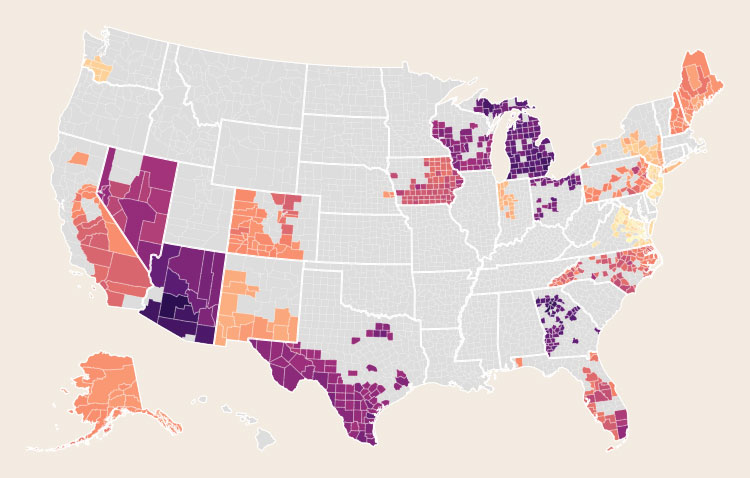
New laws are only one part of the picture. Our Election Risk Heat Map has become a key planning tool for organizations to prepare for county-level threats — helping them direct resources to the areas of greatest risk and concern. Since its launch in June, over 600 partners, journalists, and election officials have registered to access its full features — which span 879 at-risk counties across 30 states. Learn more about the risks facing your county or state here.