Report
2025 Roundup: How Trump’s Elections Agenda Fared in the States
Throughout 2025, we monitored the impact of President Donald Trump’s election agenda in state legislatures. We witnessed his state allies work to pass legislation that complicates election administration and makes it more difficult for Americans to cast their ballots. But how successful were Trump and his allies in enacting this agenda at the state level?
To answer this question, we analyzed the data. For the first time since we began tracking state election legislation in 2021, voter registration policy surpassed mail voting as the most common area of legislative activity. This significant shift was influenced by Trump’s marching orders — outlined in a failed executive order — calling on states to pass proof of citizenship mandates.
Our Election Policy Tracker illustrates the adverse effects of Trump’s election agenda and rhetoric on the state election policy landscape:
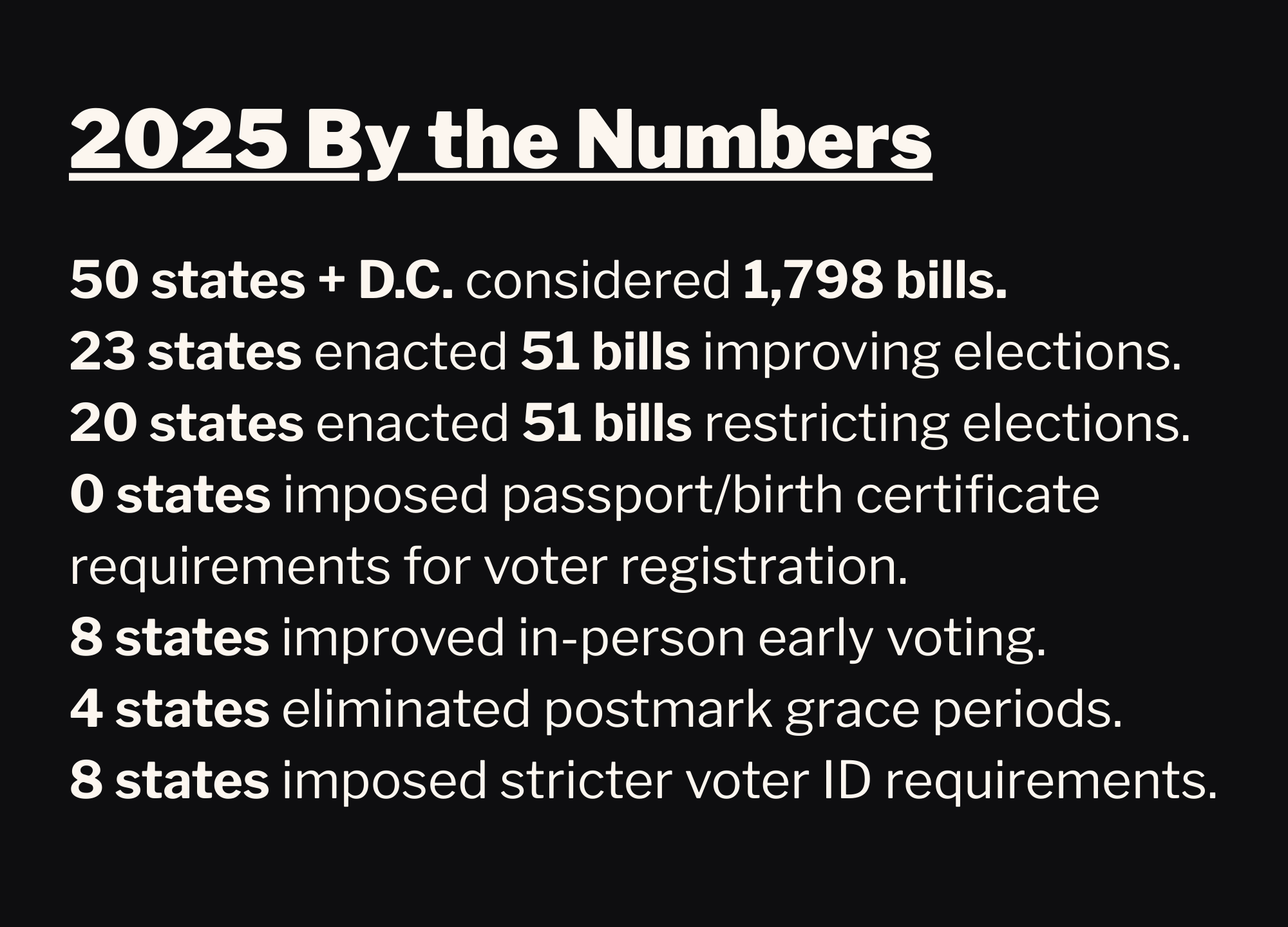
- 38 restrictive bills were enacted — the highest number since 2021.
- One-quarter (25.9%) of all enacted bills restricted access to the ballot — the highest share we have ever recorded.
- 51 bills aimed at improving voting and elections were enacted this year — the lowest total since we began tracking.
- While one-third (32%) of enacted bills improved voter access, this figure is down from the previous low of 42% in 2023.
These figures, stark as they are, tell only part of the story. Trump’s heavy-handed attacks ran into roadblocks in state legislatures and the courts. Federal courts and dozens of state legislatures have rejected proof of citizenship requirements — the centerpiece of Trump’s elections agenda. And even amid growing threats, several 2025 elections demonstrated the strength and resilience of our democracy.
In this end-of-year roundup, we analyze how Trump’s elections agenda fared in the states — and what it reveals about the state of our elections less than one year out from the midterms.
In this analysis:
- Proof of Citizenship – a Centerpiece of Trump’s Strategy to Control Elections — Fizzled in State Legislatures
- When Proof of Citizenship Failed, States Pivoted to Other Trump Priorities
- But There Were Bright Spots – Even in a Turbulent Year
- Looking Ahead: Key Areas to Watch
Proof of Citizenship – a Centerpiece of Trump’s Strategy to Control Elections — Fizzled in State Legislatures
While President Trump stoked disinformation around noncitizens voting in the lead-up to the 2024 elections, his March 25 executive order on elections poured gasoline on the fire. One key provision called on the Election Assistance Commission (EAC) to revise the National Mail Voter Registration Form to require Americans to provide “documentary proof of citizenship” to register to vote. While the courts ruled this move unconstitutional, states were pressured to act.
In 2025, Voting Rights Lab tracked a wave of proof of citizenship bills introduced in state legislatures. Twenty-seven states considered some form of restrictive proof-of-citizenship legislation in 2025, nearly triple the number in 2023. These burdensome mandates threatened to disenfranchise millions of U.S. citizens, particularly people who do not have a current passport or an original birth certificate.
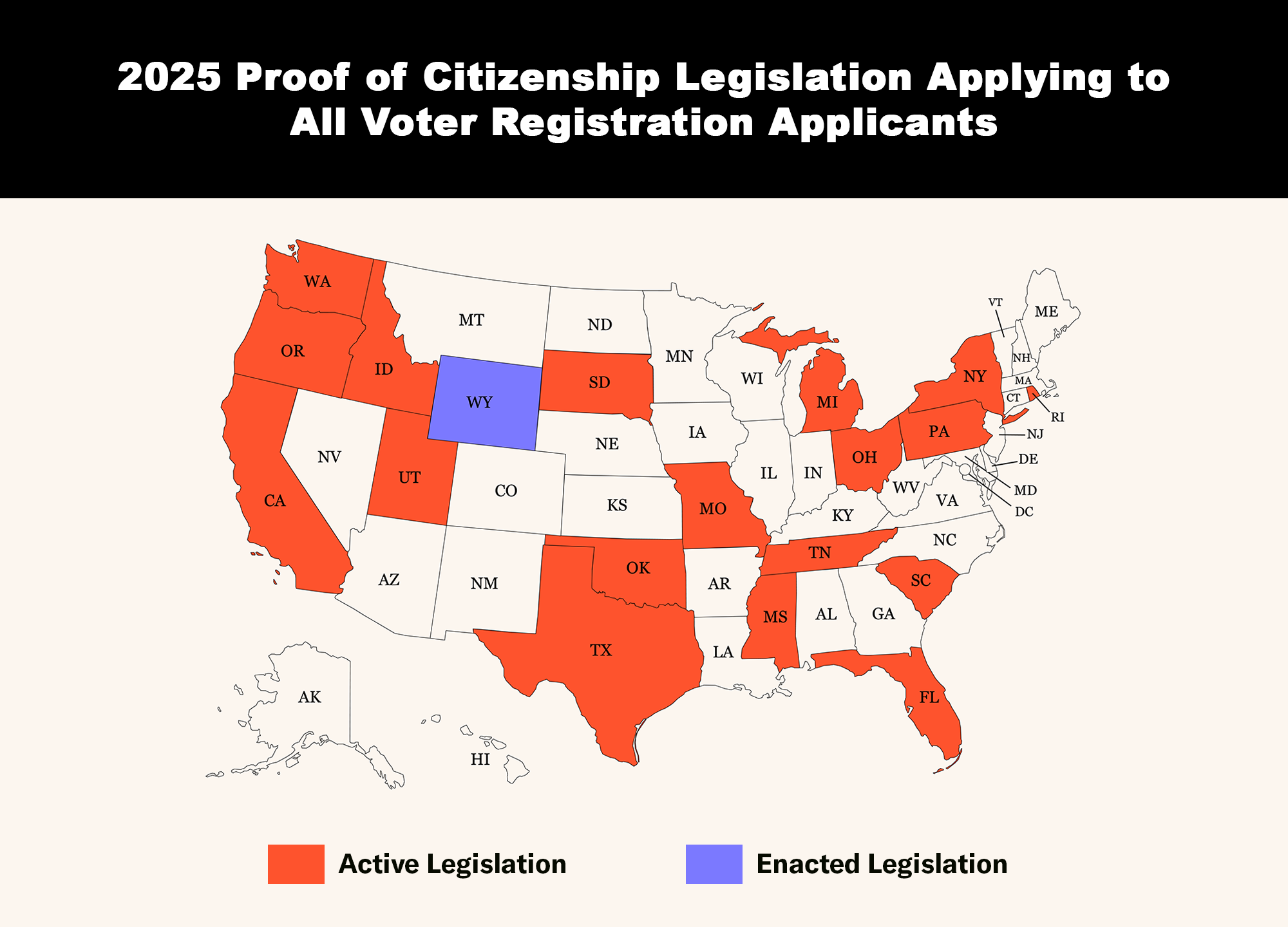
These proposals vary significantly. As shown in the map below, only nineteen states considered bills that would apply the proof of citizenship requirement to all voter registration applicants. Of these states, only Wyoming passed a proof of citizenship law that applies to all citizens registering to vote. However, the new Wyoming law allows REAL ID to satisfy the requirement, falling short of Trump’s call for every registrant to show a passport or birth certificate to register to vote.
In fact, no state enacted a law that matched Trump’s extreme vision.
This reflects the limits of the president’s influence; even his supporters were forced to recognize these burdensome requirements for what they are: a bureaucratic, costly nightmare for elected officials and American voters alike.
When Proof of Citizenship Failed, States Pivoted to Other Trump Priorities
As proof of citizenship mandates failed to gain traction, state legislators turned to other restrictive policies aligned with Trump’s agenda. These included new barriers to voting by mail and stricter voter ID requirements.
New Hurdles for Mail Voters
In 2021 and 2022, nearly every state enacted legislation related to mail voting. Many of these bills expanded access to mail ballots after seeing how well the option worked during the 2020 election; others curtailed mail voting in response to Trump’s disinformation campaign attacking the secure and popular voting method. While the total number of mail voting bills declined this year, 2025 saw the most significant rollback since we began tracking legislation.
Utah became the first state to end universal mail ballots (effective in 2029), after resisting partisan pressure to do so over the past few years. Since 2012, Utah counties have had the discretion to send mail ballots to all voters. Every county in the state voluntarily opted to do so. The legislature officially expanded the policy statewide in 2020. However, in March of this year, the state enacted H.B. 300, which repealed the 2020 law and prohibited counties from mailing ballots to voters without receiving an application. This legislation also restricts mail voting in other ways by moving up deadlines and requiring voters to include an ID number with their ballot application.
Shorter Ballot Return Windows
Taking their cue from Trump’s executive order on elections, and under the guise of speeding up results, states considered laws that would bar election officials from counting ballots received after Election Day, even if they are postmarked on or before Election Day. Ballot receipt grace periods — currently available to all voters in 16 states and Washington, D.C. — are essential to ensure all Americans can participate in our elections.
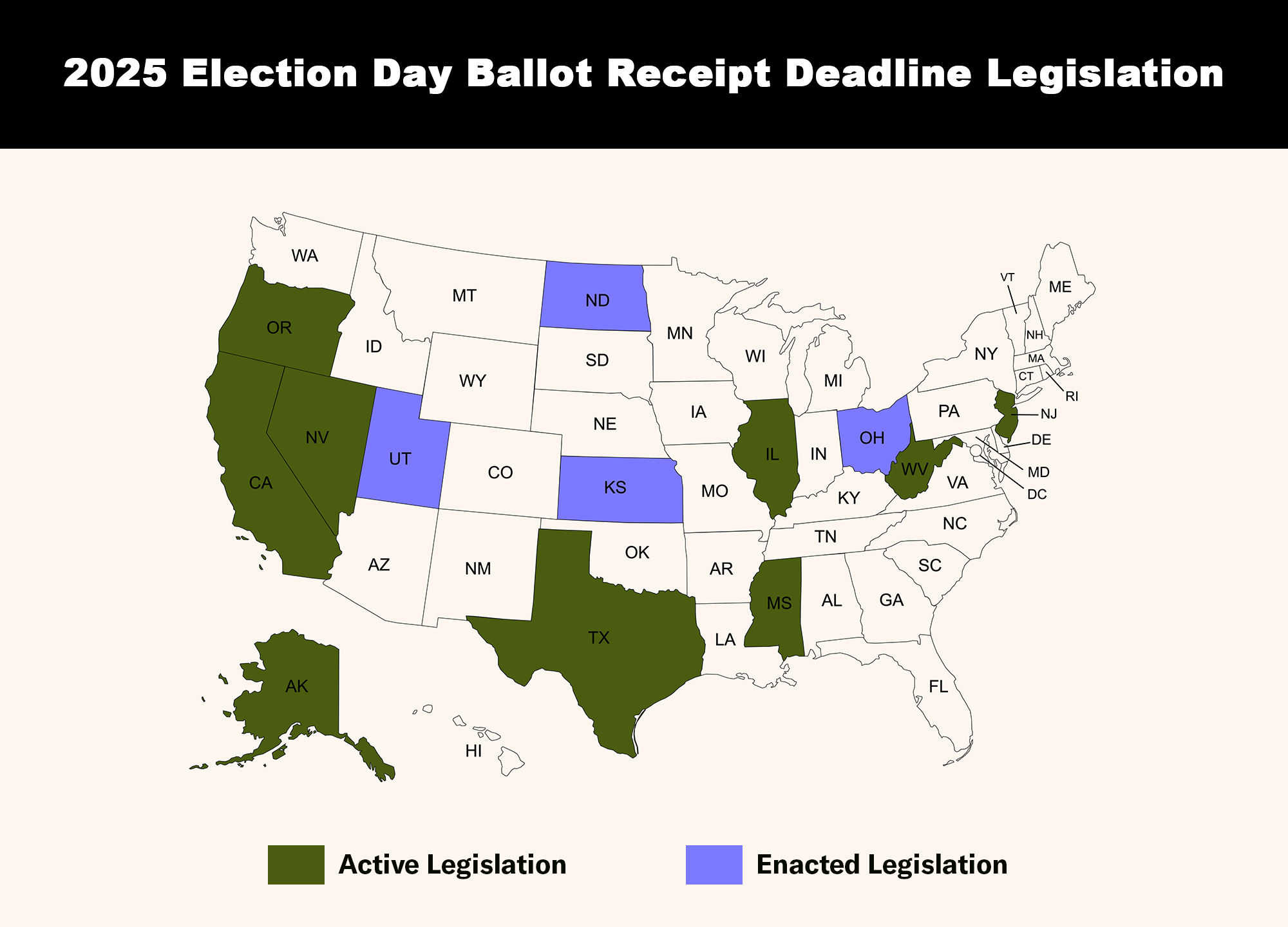
In 2025, lawmakers in 13 states — out of 19 that started the year with postmark deadlines — considered bills that would require ballots to be received by the close of polls, regardless of when the voter mailed them. Four of these states — Kansas, North Dakota, Ohio and Utah — enacted new laws requiring election officials to toss out ballots mailed on or before Election Day if the mail carrier delivers them after the election. This policy is also currently before the U.S. Supreme Court, with the Republican National Committee seeking to invalidate all state grace periods.
Without these grace periods, voters have far less time to return their mail ballots — and a postal delay could silence their voice in our democracy. Shorter ballot return deadlines could prompt officials to discard tens of thousands of otherwise valid votes. These new laws are especially damaging to overseas and military voters, who don’t have the option of voting in person and often rely on mail services that vary widely in speed, especially internationally.
Attacks on Military Voters
For over 150 years, Americans serving in the military and living overseas have relied on absentee voting to participate in U.S. elections. Recently, this access has come under attack, from Trump’s executive order and legislation in Congress seeking to impose new documentary burdens on overseas voters, to state-level attacks on the voting rights of children and spouses of non-resident citizens.
North Carolina offers a cautionary tale about the at-risk status of military and overseas voters today. State Supreme Court candidate Judge Jefferson Griffin demanded courts throw out thousands of valid military and overseas votes in a legal battle over his narrow loss in the 2024 Supreme Court election. Griffin’s lawsuit challenged ballots cast by military and overseas voters, even though they had complied with state law as understood at the time of registration and voting. While Griffin eventually conceded, his efforts to invalidate these votes cast doubt on the system — and set a dangerous precedent.
Stricter Voter ID Laws
Most states have ID laws that require citizens to present forms of ID commonly used in daily life. Acceptable forms of ID include driver’s licenses, utility bills, or student IDs. Thirty-seven states have such laws in place — designed to ensure that the person casting their ballot is who they say they are.
In 2025, however, lawmakers took a page from Trump’s agenda by adding additional restrictions to existing voter ID laws. In some cases, these restrictions would limit the types of ID accepted. Others would eliminate alternatives for eligible voters who lack a qualifying ID. In total, 20 states considered legislation to restrict or eliminate alternatives to photo ID, and eight enacted such measures.
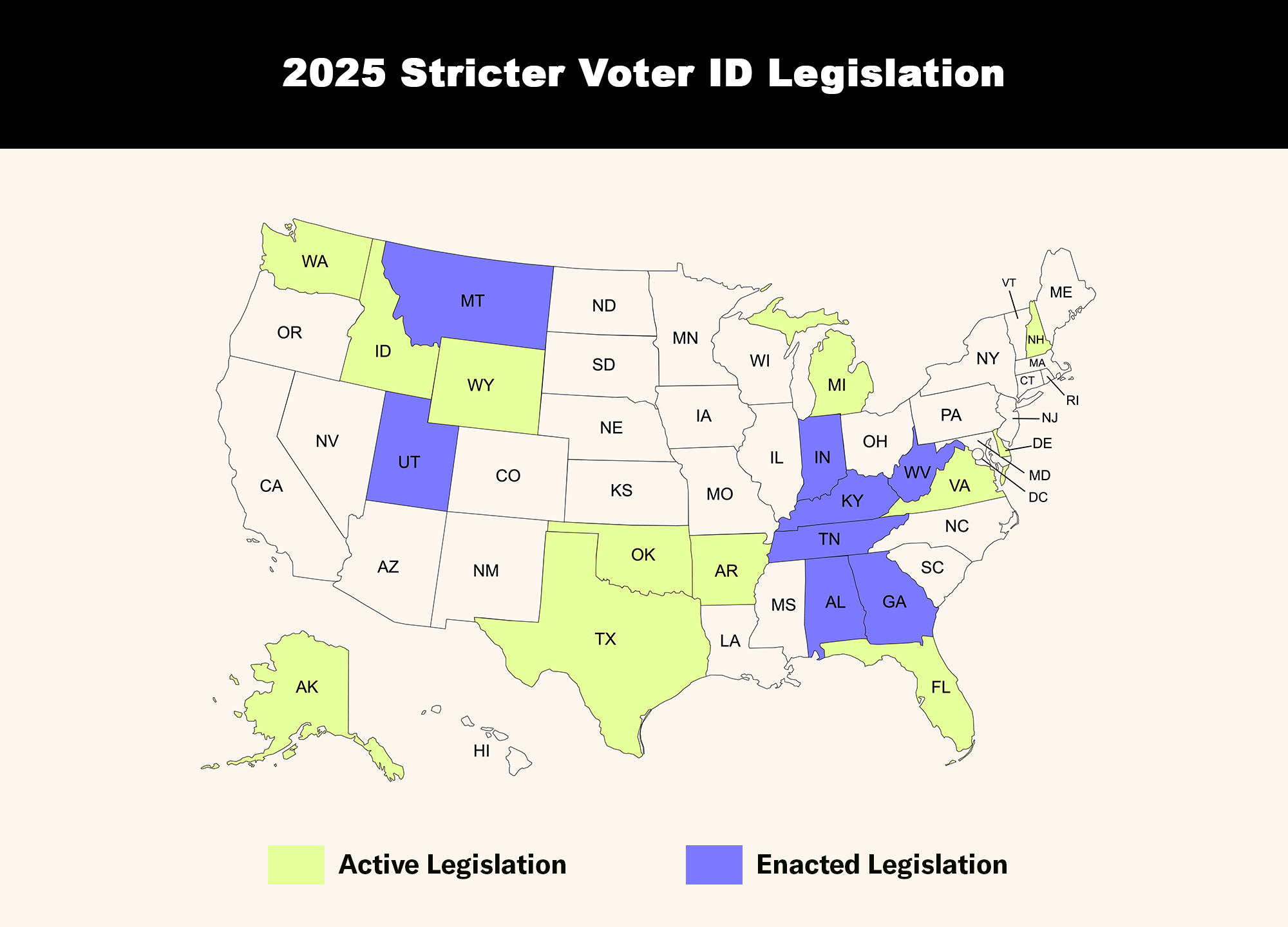
For example, Kentucky, Montana, and West Virginia eliminated non-photo ID options. Indiana prohibited the use of student IDs as voter ID. At the same time, Utah passed a law that both restricts the list of acceptable IDs for in-person voting and requires mail voters to provide a driver’s license or Social Security number. Additionally, Wisconsin voters approved an amendment to the state constitution to enshrine the state’s existing photo ID requirement in the Wisconsin Constitution. This change ties the hands of the legislature and the judiciary, preventing future modifications to the types of IDs accepted.
But There Were Bright Spots – Even in a Turbulent Year
Despite these restrictive efforts, 2025 wasn’t entirely without progress. Below are some bright spots from the last year:
Ensuring Mail Ballots Count in Pennsylvania
In Pennsylvania, a years-long legal battle over the treatment of certain categories of mail ballots was resolved in favor of voters. In March, U.S. District Judge Susan Paradise Baxter ruled that Pennsylvania’s policy of tossing out mail ballots received on time in envelopes that were undated or misdated by the voter violates the U.S. Constitution. The Third Circuit Court of Appeals upheld this decision. Thousands of legitimate mail ballots were rejected in recent years due to missing or incorrect dates printed on return envelopes. this error category accounted for 23% of mail ballot rejections in the 2024 presidential election.
In September, the Pennsylvania Supreme Court ruled that it was unconstitutional for county election officials to reject mail ballots due to technical errors without notifying the voter. The Court also ruled that voters whose mail ballots are rejected must be allowed to contest the disqualification or to cast a provisional ballot in person. Notably, Pennsylvania is among the minority of states that do not allow mail voters whose ballots are flagged for rejection due to technical issues to correct the error and have their ballots counted, as not all counties allow voters to fix issues with their return envelope signatures.
Mainers Reject Voting Restrictions in Referendum
Maine voters handily rejected a ballot measure that would have sharply restricted voting by mail and in person. Over 63% of voters voted “no” on a proposal that would have taken away voters’ ability to sign up to receive mail ballots for each election, limited drop box availability, and shortened the early voting period. The measure would also have imposed strict photo ID requirements for in-person and mail voting, without accessible alternatives for eligible voters who lack such ID.
Notably, Maine became the second state in recent years to reject a ballot measure seeking to impose strict ID requirements. This follows Arizona voters’ rejection of a similar measure in 2022. While some voter ID laws may be popular, the public recognizes the importance of ensuring backup options are in place for eligible voters who lack a qualifying ID.
Voting Rights Restoration
In Tennessee, lawmakers passed bipartisan legislation that decoupled voting rights restoration from the restoration of gun rights. Judges now have increased discretion to restore voting rights to citizens with past felony convictions who have completed their sentences. Virginia lawmakers advanced a proposed constitutional amendment to restore voting rights for Americans with past felony convictions. Virginia is currently one of only four states that permanently disenfranchises citizens for any felony conviction. If the proposal passes the legislature again next year, it will go before voters in November 2026.
Colorado Voting Rights Act
Colorado took proactive steps to secure the freedom to vote for its residents by passing its own Voting Rights Act. This law establishes new protections for people of color and other protected classes and requires accommodations for people with disabilities. The measure also ensures incarcerated voters have the right to vote while in custody. Additionally, it improves voter access on tribal lands in the state. Colorado follows a broader trend — six states have enacted Voting Rights Acts since 2021. These protections could become even more essential if the Supreme Court significantly weakens the federal Voting Rights Act next year.
Expanded Cure Processes in Texas and Wisconsin
This year, Texas passed a law establishing a clear statewide standard for “curing” mail ballots flagged for potential rejection. In November, the Wisconsin Assembly also passed a bill to standardize mail ballot curing practices across counties. The Wisconsin Senate will likely take up the bill in the new year.
Providing clear, uniform statewide rules for eligible voters to correct clerical errors on their mail ballots helps avoid confusion. It can also preempt post-election ballot-count challenges.
Early Voting Expansion
Lawmakers in Arkansas, New Jersey, and Texas enacted new laws expanding early voting access. Improvements to early voting have become a trend in recent years: 29 states have passed laws expanding early voting since 2021.
Looking Ahead: Key Areas to Watch
American elections are based on a simple premise: every legal vote is counted, and voters choose their representatives. While this has long been the case, we’ve seen a surge in federal interference, lawsuits, and state-level actions that could fundamentally alter how Americans vote and who is represented. We’ve also witnessed a reprise of unfounded claims of voter fraud, setting the stage for a contested election in 2026. Below are other key trends to watch:
Supreme Court Decisions
The U.S. Supreme Court is hearing, or could soon hear, several important cases that could reshape how Americans vote and who is represented. Cases such as Watson v. Republican National Committee could have sweeping implications for mail and military voters. Louisiana v. Callais and Turtle Mountain v. Howe threaten decades of Voting Rights Act enforcement. For more Supreme Court cases that could reshape how Americans vote and who is represented, see our analysis.
Redistricting Chaos
Under pressure — or in reaction to — Trump, six states have already redrawn their congressional maps for the 2026 midterms. These revisions are more substantial than any others occurring in an election cycle not immediately following a census since 1983-84. Additional states are expected to follow suit before the November midterms. More than a third of districts nationwide could be redrawn. Such eleventh-hour redistricting risks disenfranchising voters while creating administrative chaos for election officials and state election systems.
Interstate Data-Sharing Agreements
Since several states left the Electronic Registration Information Center (ERIC) due to baseless conspiracy theories, election officials have felt the consequences. ERIC is a bipartisan, multistate collaboration that shares information and maintains accurate voter rolls. In an effort to keep voter rolls updated without the data-sharing tool, states have begun to form new bilateral agreements. In 2025, five states enacted legislation to establish interstate data sharing outside ERIC. Ten states passed legislation to identify purported noncitizens on voter lists.
Federal Overreach
In addition to the president’s executive order, federal agencies have interfered with how states run their elections. The Department of Justice (DOJ) has demanded comprehensive voter data in nearly every state. When states have refused to comply with these requests, the DOJ has sued, filing lawsuits in 18 states and counting. Additionally, the DOJ deployed election monitors to polling sites in California and New Jersey and appointed election deniers to lead investigations into purported election irregularities.
The Department of Homeland Security (DHS) also expanded the scope of its SAVE database — originally intended for states to verify benefits eligibility — to confirm voters’ citizenship. Thirteen secretaries of state raised concerns about this use of the SAVE database. The officials cite concerns about data accuracy, voter privacy, and broader intrusions into state-run elections. The SAVE database has incorrectly flagged U.S. citizens for potential removal from voter rolls, while administrators in Texas have raised serious concerns around the reliability of its data.
States Have a Crucial Role to Play in Protecting Elections
Against this backdrop, we cannot take free and fair elections for granted. Our recent report, “Four Essential Steps States Can Take to Safeguard Our Elections,” outlines essential steps state policymakers should adopt to ensure future elections remain accountable to the public, trusted by voters, and free from political manipulation:
- Maintain accurate and up‑to‑date voter registration lists.
- Deliver preliminary election results in a timely manner.
- Test and verify election results for accuracy.
- Ensure verified results are certified on time.
The bottom line: There is no doubt that elections will take place in 2026. But it’s up to states to decide just how free and fair they will be.
Date last updated: January 7, 2025
Subscribe to our newsletters.
Get the latest in election law and policy analysis — delivered straight to your inbox.