An Emerging Trend: Mid-Decade Redistricting
Last updated: February 12, 2026
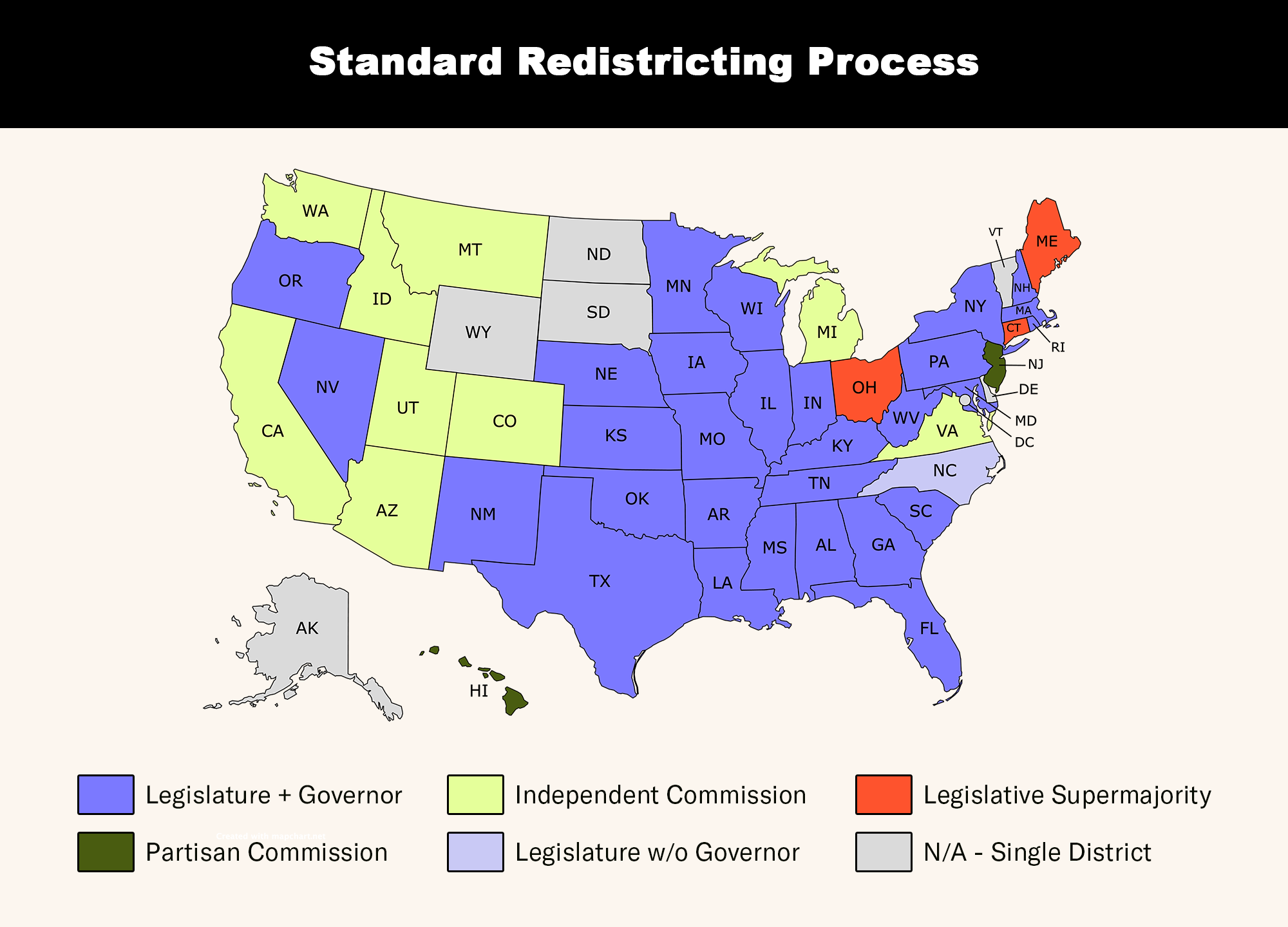
Following a census, states employ various redistricting processes. In most states, legislators adopt congressional maps through the legislative process: both chambers of the legislature pass a bill, and the governor signs it into law. Other states require a supermajority of the legislature to adopt a new map or allow the legislature to adopt maps without the governor’s signature. Some states have delegated redistricting to commissions that are either independent or political. Many states also have backstop processes, such as delegating redistricting to the judiciary, that assign responsibility for drawing maps if the standard process fails to adopt a map.
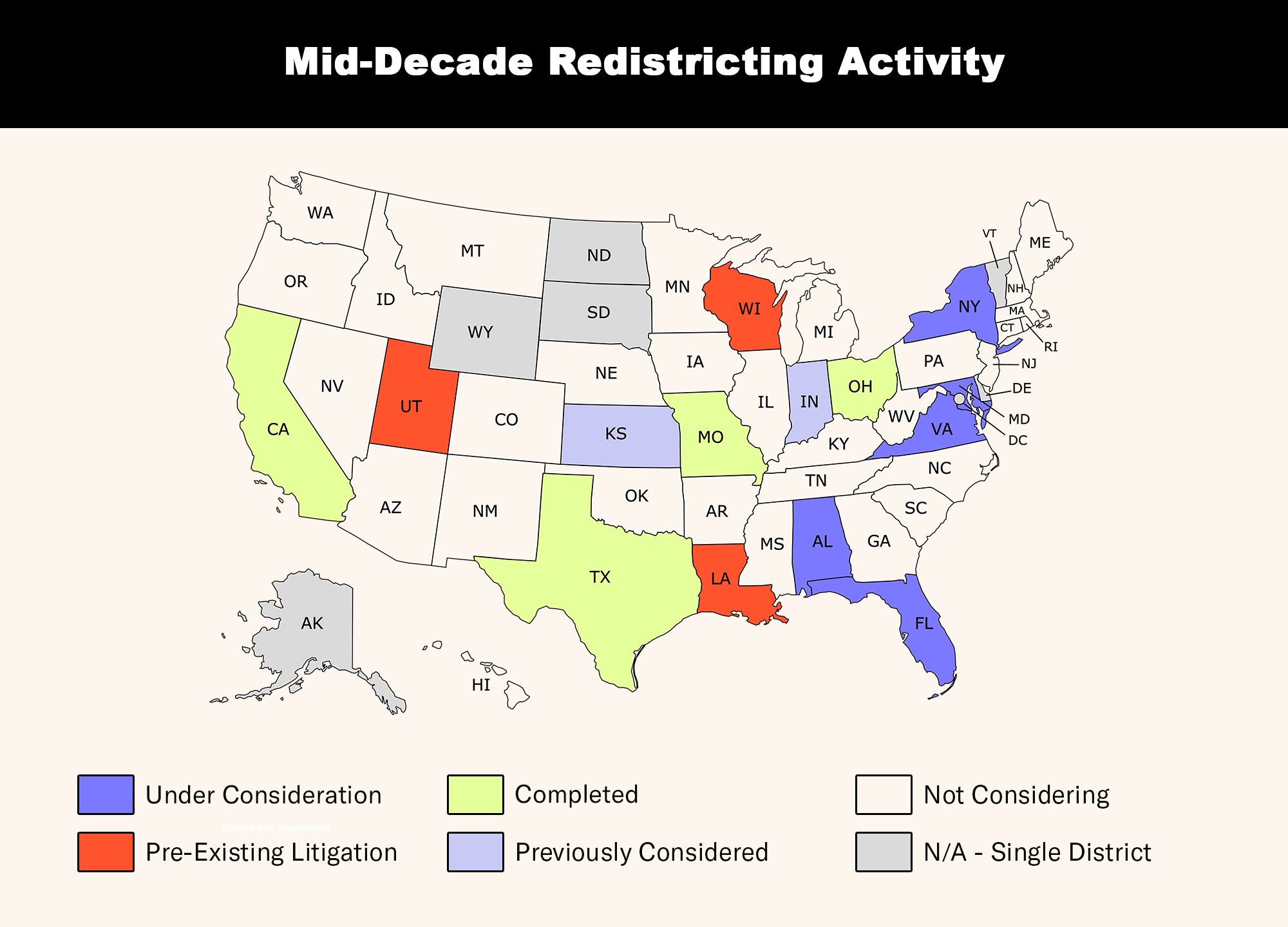
As shown in the map below, over the last two years, several states have considered or enacted new maps in the middle of the decade, between censuses. President Donald Trump has often prompted this unprecedented activity. Several states, such as California and Texas, have already completed redistricting. Some states, such as Maryland and Virginia, are actively considering new maps. Others have faced ongoing litigation since the start of the decade that continues to move through the court system and may result in new maps being drawn before November’s general elections. This litigation predates the president’s current redistricting push.
Note: This map and the following narrative summaries focus on states that may have new maps for the 2026 midterm elections. Other states, such as Colorado and New Jersey, require longer timelines, but may introduce redrawn maps before the 2028 midterms.
States that may have new district maps for the 2026 midterm elections:
Alabama
In 2024, a court-appointed special master redrew Alabama’s maps to comply with the U.S. Supreme Court’s decision in Allen v. Milligan. In 2026, the state Senate has advanced legislation that would allow special primaries to be held later in 2026 if the Supreme Court issues a decision in Louisiana v. Callais that opens the door to further redistricting.
California
In November 2025, voters approved Proposition 50, a redistricting measure backed by Gov. Gavin Newsom. This ballot measure established congressional districts for the 2026, 2028, and 2030 elections. The new maps are now subject to multiple pending federal lawsuits. In January 2026, a panel of federal judges denied a request for an injunction that would have prevented the new maps from taking effect. On February 4, the U.S. Supreme Court denied the plaintiffs’ application for a writ of injunction enjoining the maps.
Florida
Gov. Ron DeSantis issued a proclamation convening a special session to address congressional redistricting, scheduled for the week of April 20, 2026. House leaders have established a Select Committee on Redistricting, whereas Senate leaders have not. Florida’s congressional primary is scheduled for August 18.
Indiana
President Donald Trump called on Indiana to redraw its congressional map and threatened primary campaigns against Republican legislators who did not support the effort. Ultimately, in December 2025, the legislature failed to pass legislation to redraw the state’s congressional districts. New maps passed the House on a 57-41 vote but were rejected by the Senate in a bipartisan 31-19 floor vote.
Kansas
In January 2026, House Speaker Dan Hawkins stated that he would not bring redistricting legislation to a vote in the upcoming session. Hawkins attributed his decision to the lack of sufficient votes to override Gov. Laura Kelly’s expected veto of any redistricting measure.
Louisiana
Louisiana’s legislature enacted a new congressional map in 2024 in response to a federal district court ruling. That map is currently the subject of a case, Louisiana v. Callais, before the U.S. Supreme Court. The court’s ruling could result in new lines being drawn this year.
Maryland
In November 2025, Gov. Wes Moore convened the Governor’s Redistricting Advisory Commission, which recommended that the state legislature change the existing map. In January 2026, legislators introduced a bill to implement the commission’s recommendations. The bill would require legislative approval to take effect. The House has passed the legislation, while Senate President Bill Ferguson opposes the effort.
Missouri
In September 2025, during a special session, the legislature enacted a congressional redistricting plan, which Gov. Mike Kehoe signed into law. The map faces a veto referendum set for the November 2026 election. Multiple lawsuits are pending, including Maggard v. Missouri, which seeks to suspend use of the new map until the outcome of the referendum is known.
New York
In January 2026, a state court struck down New York’s 11th Congressional District, reopening the map-drawing process. The district is one of the state’s only Republican-controlled House seats. This ruling has since been appealed, and litigation is ongoing.
Ohio
In January 2022, the Ohio Supreme Court struck down a map passed by the legislature for unlawful gerrymandering. Subsequently, the redistricting commission adopted a new temporary map, which was effective through the 2024 election cycle. In October 2025, the redistricting commission passed a bipartisan congressional map that is effective through the remainder of this decade.
Texas
In August 2025, the Texas legislature passed revised maps, which Gov. Greg Abbott signed into law. A federal district court in El Paso ruled that the redrawn map was an unconstitutional racial gerrymander. Still, the U.S. Supreme Court stayed the decision, permitting the maps to be used for the 2026 elections.
Utah
In 2018, Utah voters enacted Proposition 4, creating an independent redistricting commission. A bill passed in 2020 that reversed the proposition’s ban on partisan gerrymandering has been the subject of litigation. In 2024, the Utah Supreme Court ruled that the legislature had unlawfully amended Proposition 4 and ordered new maps be drawn. These maps will be in place for the 2026 election. However, there are ongoing efforts to repeal Proposition 4 and expand the Supreme Court to overturn the anti-gerrymandering decision.
Virginia
In October 2025, the Virginia legislature passed a proposed constitutional amendment to permit redistricting. The legislature passed the proposal again in early January when it convened for a new session. The timeline for the measure to go before the public for a vote has been put on hold after a Virginia circuit court temporarily blocked it, agreeing with plaintiffs that the legislature failed to follow proper procedure. The Virginia Supreme Court has agreed to hear the case.
Wisconsin
Wisconsin has two ongoing state court lawsuits over congressional districts drawn by the legislature in 2021. The lawsuits accuse the Republican-majority legislature of partisan gerrymandering and seek new, fairer maps. The litigation, however, is unlikely to be resolved before the 2026 midterm elections.
Subscribe to our newsletters.
Sign up here to get updates from Voting Rights Lab delivered straight to your inbox.