The Markup: Judge rejects DOJ attempt to access Oregon voter rolls
We are tracking 1,263 total bills prefiled or introduced this session across 42 states and Washington, D.C. Our analysis finds that 612 bills would improve voter access or election administration, while 278 would restrict it.
This week’s Markup features election policy updates in Arizona, California, Florida, Georgia, Oregon, and Virginia. Wyoming is kicking off its legislative session this week.
Jump to section:
Improving Voter Access or Election Administration
Virginia House and Senate pass bills to expand voter access.
Both legislative chambers in Virginia passed bills last week that would improve and protect voter access. S.B. 438 would guarantee early voting on Sundays statewide. Under current law, counties may choose whether to offer Sunday early voting. S.B. 52 would require that officials complete any systematic review of the voter rolls to identify potential noncitizens at least 90 days before an election. H.B. 1014 would strengthen voting protections for individuals under guardianship. The bill requires that an individual be specifically found to lack the capacity to understand the act of voting before they can be disenfranchised due to “mental incapacity.” These bills now go to the opposite chambers for consideration.
Restricting Voter Access or Election Administration
Florida proof of citizenship bills clear first committees with revisions.
Committees in both chambers of the Florida legislature held their first hearings on bills that would impose proof of citizenship requirements on new and current registrants. An updated version of H.B. 991 adds new voter ID restrictions on top of the proof of citizenship requirements already in the bill. The Senate committee advanced a version of S.B. 1334 that removed language regarding pre-certification audits while retaining the proof of citizenship requirements.
Mississippi advances bill to eliminate mail ballot return grace period.
The Mississippi Senate passed H.B. 908. The bill would eliminate Mississippi’s five-day grace period for mail ballots postmarked by Election Day but received after. Mail ballots would have to be received by the day before the election. Currently, Louisiana is the only state that requires mail ballots to be received before Election Day. The bill now goes to the House for consideration.
The U.S. Supreme Court is considering this term in Watson v. Republican National Committee – a case arising out of Mississippi – whether states may accept ballots received after Election Day. Mississippi is currently among 14 states and D.C. that counts such ballots as long as they have a timely postmark.
On Our Radar
Supreme Court greenlights California’s 2026 congressional map; Maryland House passes redistricting plan; Virginia dispute moves to state supreme court.
The U.S. Supreme Court declined to block California from using its newly enacted congressional map in the 2026 elections. The court allowed the state to proceed under revised congressional district lines that favor Democrats while litigation continues. Maryland’s House passed a redistricting bill, which faces uncertainty in the Senate amid opposition from the Senate President. The Virginia Court of Appeals requested that the Virginia Supreme Court take up a legal challenge to Democrats’ efforts to draw new congressional districts. The case is on a tight timeline: The proposed amendment would go before voters on April 21.
Judge rejects DOJ’s attempt to access Oregon voter rolls.
A federal judge in Oregon released a written opinion rejecting the federal government’s attempt to obtain Oregon’s voter rolls. The opinion characterizes the administration’s actions outside the legal case as “chilling,” including the attorney general’s letter to Minnesota’s governor, which demanded voter data in exchange for removing Immigration and Customs Enforcement agents from the state. The Department of Justice is currently suing nearly half the country to obtain private voter information.
Arizona enacts bipartisan legislation to change the state’s primary date.
Arizona legislators and Gov. Katie Hobbs found common ground and enacted legislation that will move up the state’s primary by two weeks – from the first Tuesday in August to the second-to-last Tuesday in July. This change will make it easier for election officials to meet federal deadlines. Legislators reached a deal after the bill’s sponsors agreed to remove a provision that would have shortened the mail ballot cure period.
Fulton County judge dismisses lawsuit seeking 2020 ballots; Fulton County files lawsuit demanding return of election records seized during FBI raid.
A Fulton County Superior Court judge dismissed a lawsuit from a group of election skeptics filed in December 2020 seeking election materials from 2020’s general election. The judge ruled the lawsuit “presented zero factual or legal questions” regarding the Georgia county’s liability. Meanwhile, Fulton County is going to court to have election records seized during the January FBI raid on its facilities returned. Over the weekend, a federal judge ordered the Trump administration to produce the affidavit that led to the search warrant by Tuesday, February 10.
Subscribe to The Markup
The Markup is Voting Rights Lab’s regular analysis of the latest election policy issues and trends. Sign up here to get these updates delivered straight to your inbox.
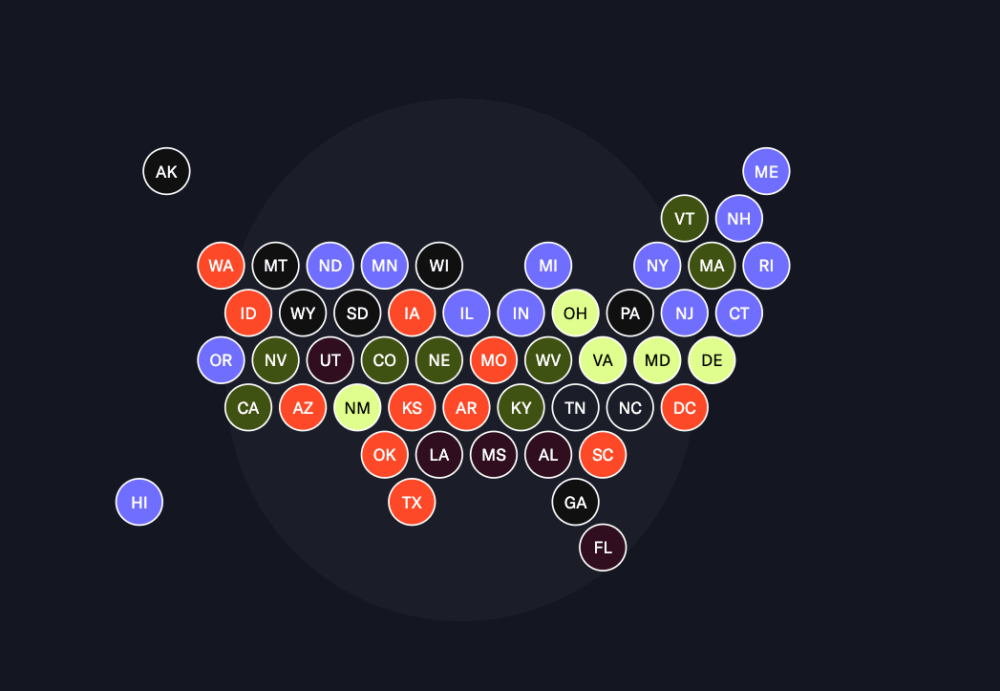
Election Policy Tracker
We are committed to providing unique, state-focused insights from a national perspective. Explore our Election Policy Tracker for real-time updates and analysis and learn more about our work to ensure free and fair elections.