The Markup: GOP lawmakers look to revive SAVE Act
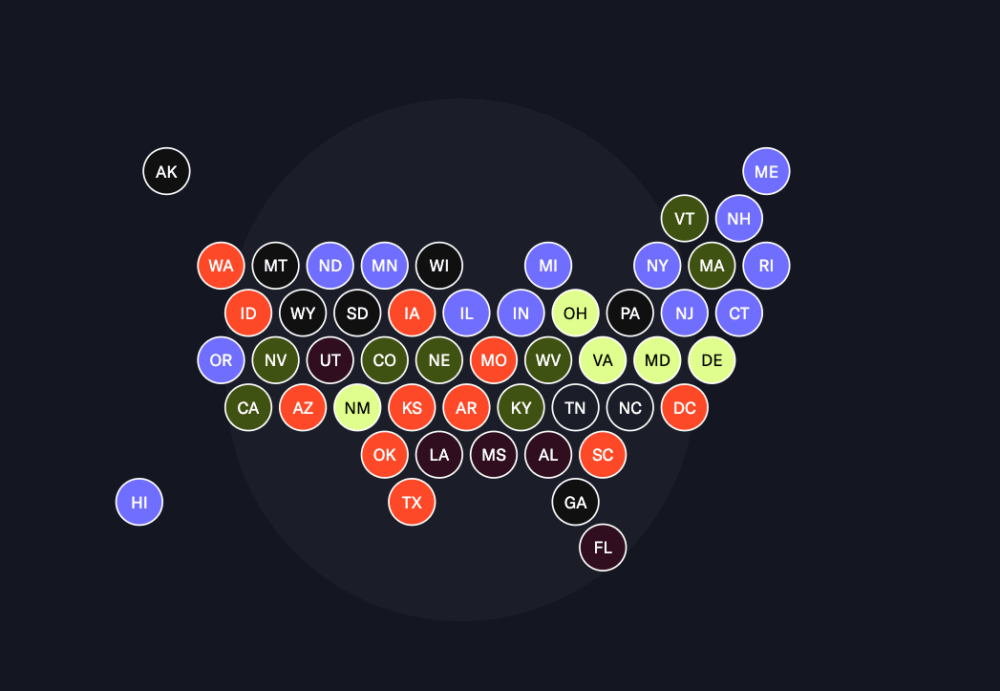
We are tracking 1,044 bills prefiled or introduced this session across 38 states and Washington, D.C. Our analysis finds that 513 bills improve voter access or election administration, while 237 restrict it. This week’s Markup features policy updates in Arizona, Georgia, Louisiana, New Hampshire, New York, Texas, Utah, and Virginia.
Jump to section:
Improving Voter Access or Election Administration
Federal court strikes down Virginia’s felony disenfranchisement policy.
A federal district court ruled that Virginia’s broad disenfranchisement of citizens with past felony convictions violates the Virginia Readmission Act. This federal law — enacted in 1870 — prohibits the state from depriving citizens of the right to vote except for convictions of felonies that existed at the time.
Under the court’s ruling, Virginia may not disenfranchise citizens for convictions of crimes, such as drug offenses, that were not felonies in 1870. According to the plaintiffs, 264,292 Virginians were disenfranchised under the state’s policy.
Restricting Voter Access or Election Administration
Arizona committees pass ballot initiatives that would limit popular voting methods.
The Arizona legislature advanced two ballot proposals that would significantly restrict in-person early voting and mail voting. S.C.R. 1001 and H.C.R. 2001 would move up the early ballot return deadline from Election Day to the Friday before, curtail the use of countywide vote centers, and impose burdensome address confirmation requirements on members of the state’s permanent mail voter list.
These bills now advance to their respective chambers’ rules committees for consideration. If passed by the legislature, the measure will go directly to voters in November and will not be subject to Gov. Katie Hobbs’s veto.
Utah House committees advance proof of citizenship bill.
The Utah House committees on rules and government operations advanced H.B. 209 along party lines. This bill would require residents to provide officials with documentary proof of citizenship, such as a passport or birth certificate, to register to vote. Individuals who have previously provided such documentation to the DMV could provide their driver’s license number to fulfill the requirement. A recent review of Utah’s more than 2.1 million registered voters found only one noncitizen on the rolls — and this person had never voted. The bill now goes to the full House for consideration, likely this week. Currently, 14 states are considering bills that would impose proof of citizenship requirements for voter registration.
On Our Radar
GOP lawmakers look to revive the SAVE Act.
Congressional Republicans have indicated an interest in bolstering the Safeguard American Voter Eligibility Act – commonly referred to as the SAVE Act. This legislation, which has passed the House twice in recent years, would require voters to provide state officials with proof of citizenship, such as a passport or birth certificate, to register to vote in federal elections. Proposed amendments would also impose a national photo ID requirement for voting. Senate Democrats are committed to blocking the bill.
New Hampshire House committee to consider multiple bills restricting voter registration this week.
The New Hampshire House Election Law Committee will hear multiple bills this week, including H.B. 1382 (requiring citizens overseas to submit documentary proof of citizenship when registering to vote using the Federal Postcard Application); H.B. 1520 (establishing new requirements to establish residency for voting purposes); and C.A.C.R. 21 (amending the state constitution’s residency voting requirements). This committee will also vote on H.B. 1342, which would make additional information about mail voters available for public inspection while protecting some information about military voters from disclosure.
New York court strikes down congressional map; Maryland commission moves forward with new one.
A New York court struck down one of the state’s congressional districts, reopening the map-drawing process. Meanwhile, a Maryland commission recommended a new redistricting plan, and the state House is expected to take it up quickly. The Senate president has said he will not bring the plan to a vote.
Georgia secretary of state proposes requiring REAL ID to vote; court tosses DOJ lawsuit seeking voter rolls.
Secretary of State Brad Raffensperger proposed requiring Georgia voters to present a REAL ID to vote. REAL ID requires residents to provide proof of U.S. citizenship or other lawful presence. Under current law, voters can provide any valid driver’s license, a U.S. passport, or other forms of photo ID.Additionally, a federal court dismissed a lawsuit brought by the U.S. Department of Justice (DOJ) against Raffensperger. The DOJ has filed lawsuits against 24 states and D.C. to date, seeking unredacted voter registration records.
U.S. House committee requests voter list maintenance information from 10 states.
Rep. Bryan Steil, chair of the U.S. House Administration Committee, sent letters to 10 states seeking information on how they conduct list maintenance and verify voters’ citizenship. Each letter posed a series of questions to state election officials and set a February 5 deadline to respond.
Winter storm disrupts early voting in Texas, Louisiana, and New York.
Freezing temperatures and ice over the weekend led to the suspension of early voting in ongoing elections in Texas, Louisiana, and New York. In Texas, officials suspended early voting for a special legislative election in Tarrant and Collin counties and for the Harris County special election for the 18th Congressional District, which has been vacant for nearly 11 months. Advocates have filed suit seeking to extend early voting in Harris County past Tuesday’s deadline to account for these closures.
In Louisiana, state officials suspended early voting on Monday in all parishes holding special legislative elections on February 7. In New York City, officials suspended early voting on Sunday and Monday for special legislative elections for three state legislative seats. Officials extended early voting hours later in the week.
Subscribe to The Markup
The Markup is Voting Rights Lab’s regular analysis of the latest election policy issues and trends.
Election Policy Tracker
We are committed to providing unique, state-focused insights from a national perspective. Explore our Election Policy Tracker for real-time updates and analysis and learn more about our work to ensure free and fair elections.