The Markup: Florida legislature passes proof of citizenship bill
Welcome to the Markup, Voting Rights Lab’s weekly digest of election law and policy updates.
We are tracking 1,520 bills prefiled or introduced this session across 44 states and D.C. Our analysis finds that 700 bills would improve voter access or election administration, while 318 bills would restrict them. This week’s Markup features policy updates in Arizona, Florida, Hawaii, Mississippi, New Hampshire, New York, Oklahoma, Tennessee, and Virginia.
Jump to section:
Improving Voter Access or Election Administration
Arizona Senate passes bill to improve signature verification.
The Arizona Senate gave bipartisan approval to S.B. 1634. The bill would require the Motor Vehicle Division to share registered voters’ pen-and-paper signatures with the secretary of state — rather than signatures made with a stylus on a digital trackpad. This change aims to improve signature verification and prevent mail ballot rejections due to perceived mismatches. The bill now goes to the House for consideration.
Virginia legislature sends bills protecting voter registrations to the governor.
H.B. 972 would prohibit voter registration cancellations based solely on the Department of Homeland Security’s unreliable Systematic Alien Verification for Entitlements (SAVE) program. The bill would also put in place additional guardrails on the use of data from state agencies and other states to protect against erroneous cancellations of voters’ registrations. H.B. 640 would shift responsibility for adjudicating voter registration challenges from a general registrar to an appropriate circuit court. It would also prohibit the filing of challenges within 60 days of an election. The bills now go to Gov. Abigail Spanberger for her signature.
Hawaii House passes bill expanding the number of agencies offering automatic voter registration.
The Hawaii House of Representatives passed H.B. 322. This bill would expand automatic voter registration (currently available only at the DMV in Hawaii) to additional agencies. It would also limit automatic voter registration to individuals who provide proof of citizenship during the course of their business with the agency. The bill now goes to the Senate for consideration.
Tennessee Senate passes bill easing financial requirements for voting rights restoration.
The Tennessee House passed S.B. 336. This bill would repeal the requirement that individuals pay all court fees before regaining their voting eligibility. The bill would also restore voting rights to citizens who comply with child support orders for the previous 12 months (including a payment plan), even if they have not met their full obligations. The measure now goes to Gov. Bill Lee to sign.
Oklahoma Senate advances proposal to expand early voting.
The Oklahoma Senate passed S.B. 1362. This bill would establish in-person early voting on the Saturday before every election from 8 a.m. to 6 p.m. Current law requires in-person early voting on Saturdays before some elections, but only until 2 p.m. The bill now moves to the House for consideration.
New York Senate passes bill authorizing countywide vote centers.
The Senate passed S.B. 569. The bill would allow local boards of elections to operate countywide vote centers on Election Day in addition to precinct-based polling places. The State Board of Elections would have to approve these changes. The bill now moves to the Assembly for consideration.
Restricting Voter Access or Election Administration
Florida legislature passes proof of citizenship bill.
The Florida House and Senate passed H.B. 991. This bill would require proof of U.S. citizenship, such as a passport or birth certificate, for voter registration. A driver’s license number would be sufficient for individuals for whom the Department of Highway Safety and Motor Vehicles already has proof of citizenship on file. Additionally, the legislation would eliminate currently accepted forms of voter ID, such as student IDs and public assistance IDs. If enacted, these provisions would take effect on January 1, 2027, after this year’s midterms. The bill now goes to Gov. Ron DeSantis for his signature.
New Hampshire legislature sends bill barring student IDs for voting to governor, rejects several other restrictive proposals.
The Senate passed H.B. 323. The bill would bar student IDs from serving as acceptable voter IDs, making the state’s strict photo ID requirement for in-person voting additionally burdensome. Student voting has been a legislative target across the country in recent years. The bill now goes to Gov. Kelly Ayotte for her signature. Meanwhile, several restrictive bills failed to advance. These proposals include H.B. 1382 (requires proof of citizenship for certain overseas voters), H.B. 1342 (makes certain confidential voter information publicly available), and H.B. 1520 (establishing New Hampshire citizenship and requiring all voter registration applicants to provide a New Hampshire citizenship card. Residents could obtain a citizenship card by presenting birth records or by pledging allegiance to the state of New Hampshire.
Mississippi secretary of state uses unverified credit data to remove voters from rolls.
Mississippi Secretary of State Michael Watson placed 50,000 voters on the inactive voter list last July after using Experian credit data to check voter residences. In some counties, as many as one in five registered voters is now inactive. Other states and jurisdictions that use Experian credit data to check voter registrations include Orange County, California; Louisiana; West Virginia; Maryland; Montana; Iowa; and Arkansas.
Arizona House and Senate set to hold hearings on ballot measures restricting early voting and vote centers.
This week, the Arizona Senate Judiciary and Elections Committee will hold hearings on multiple ballot measures. H.C.R. 2016 would ban vote centers and end early in-person voting. H.C.R. 2001 would move up the early ballot return deadline from Election Day to the Friday before. It would also impose burdensome requirements to confirm voter addresses for members of the state’s permanent mail voter list. The House Federalism, Military Affairs, and Elections committee will hear S.C.R. 1001, which closely mirrors H.C.R. 2001. If the committees pass any of these ballot measures, then they will go to the floor of their respective chambers for a final vote. If approved, these measures will be on the November ballot for voters to decide. Gov. Katie Hobbs cannot veto ballot measures.
On Our Radar
U.S. Senate prepares to debate SAVE America Act this week.
The U.S. Senate plans to debate a bill this week that would require a valid U.S. passport or birth certificate to register to vote. The SAVE America Act would also narrow the types of acceptable photo ID for in-person voting, require a photocopy of an ID to vote by mail, and require states to share their voter rolls with the Department of Homeland Security. Senators are expected to bring up amendments that would further restrict mail voting, among other topics. Democrats are expected to filibuster the legislation. While the federal bill lacks a clear path to passage, 16 states are weighing similar proof of citizenship bills this year.
Poll reveals declining public confidence in elections.
A Marist poll found that only 66% of American voters are confident that this November’s election will be fair and accurate, down from 76% in October 2024. The poll also found that 58% of voters believe it is likely they will be turned away at their polling place, and that opinions are evenly split on whether voter fraud will occur. A majority opposed deploying the National Guard to polling places.
Arizona Senate complies with FBI subpoena, turns over 2020 election audit information.
Arizona Senate President Warren Petersen shared records with the FBI – including ballot images – from his chamber’s audit of the 2020 election results in Maricopa County. That audit upheld the county’s initial election results, finding no substantial evidence of fraud. Secretary of State Adrian Fontes has raised concerns that the records contained private voter data and may be used to relitigate the 2020 election.
Election Policy Tracker
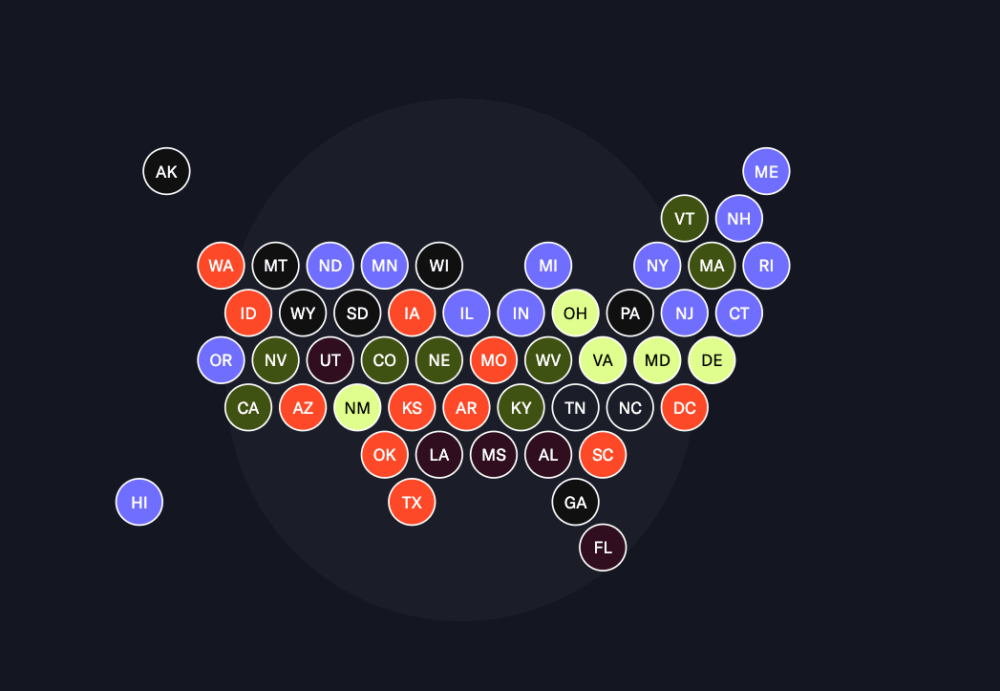
We are committed to providing unique, state-focused insights from a national perspective. Explore our Election Policy Tracker for real-time updates and analysis and learn more about our work to ensure free and fair elections.
Subscribe to The Markup
The Markup is Voting Rights Lab’s regular analysis of the latest election policy issues and trends. Sign up here to get these updates delivered straight to your inbox.