The Markup: U.S. House passes proof of citizenship, voter ID bill.
We are tracking 1,342 bills prefiled or introduced this session across 42 states and Washington, D.C. Our analysis finds that 644 bills would improve voter access or election administration, while 289 would restrict them. This week’s Markup features policy updates in Arizona, Maryland, Michigan, Mississippi, Montana, New Hampshire, North Carolina, Pennsylvania, Texas, Virginia, and West Virginia.
ICYMI: We’ve launched a new resource to track mid-decade redistricting efforts across the country. We’ll update this page periodically as this story unfolds in the run-up to the November 2026 midterm elections.
Jump to section:
Improving Voter Access or Election Administration
Maryland Senate advances bill to strengthen voting rights protections.
The Maryland Senate passed a new state Voting Rights Act (S.B. 255). This bill is designed to safeguard against vote dilution and create clearer standards that allow voters to challenge discriminatory election practices. The bill now moves to the House for consideration.
Virginia legislature advances bills to strengthen cure processes and protect voter registrations.
The Virginia House and Senate passed 13 bills, sending them to the opposite chamber for consideration. H.B. 774 would establish a process for voters to cure provisional ballots to ensure they are counted and give voters more time to correct envelope errors on mail ballots. H.B. 28 would require that officials complete any systematic review of the voter rolls to identify potential noncitizens at least 90 days before an election. The Senate has passed a similar bill. S.B. 34 would strengthen voting rights protections for individuals under guardianship. The bill requires that an individual be specifically found to lack the capacity to understand the act of voting before they can be disenfranchised due to “mental incapacity.” The House has passed a similar bill.
Montana court blocks new voter residency requirement targeting students.
A Montana state court blocked a law enacted last year that stripped voting rights from temporary residents. The law required individuals who moved to the state for college or professional training to declare their intention to make Montana their home afterward to register to vote. The Montana Public Interest Group challenged the new law in court, arguing it imposes an unconstitutional residency requirement that disenfranchises students.
Restricting Voter Access or Election Administration
U.S. House passes proof of citizenship, voter ID bill.
The House passed the SAVE America Act (H.R. 7296), which would require proof of citizenship to register to vote in federal elections and a photo ID to vote. This is the latest in a series of House bills seeking to impose federal control over election policy. Senate Democrats have vowed to block the legislation, arguing it would disrupt election administration and disenfranchise eligible voters across the country. Senate Majority Leader John Thune has promised a vote, but appears unwilling to circumvent the filibuster to advance the bill.
Mississippi House passes bill requiring some citizens to show proof of citizenship.
The House passed H.B. 1253, which requires individuals registering to vote (who were not citizens when they obtained a Mississippi driver’s license) to provide proof of citizenship. This requirement applies even if citizenship can be confirmed through the Department of Homeland Security’s SAVE database. The bill would also establish regular checks of the existing voter list against the SAVE database. The bill now goes to the Senate for consideration.
Texas mail voting restrictions upheld by Fifth Circuit panel.
The Fifth Circuit Court of Appeals overturned a district court ruling striking down a provision of S.B. 1 (2021). The provision in question seeks to ban alleged “ballot harvesting” by prohibiting payment for certain interactions with voters in the presence of a ballot. The lower court had found the prohibition unconstitutionally vague. Plaintiffs may seek a rehearing before the full circuit court or appeal to the U.S. Supreme Court.
Arizona House passes constitutional amendment to restrict early voting.
Arizona lawmakers advanced a proposal to move the mail ballot (“early ballot”) return deadline earlier — from Election Day to the Friday before Election Day. The proposal also adds burdensome address-confirmation requirements for voters on the permanent mail voter list, a change that would effectively eliminate the permanent list. If the Senate approves the measure, the amendment will then go before Arizona voters in November. The constitutional amendment process allows the legislature to bypass the ability of Gov. Katie Hobbs to veto legislation.
West Virginia House passes bill to restrict mail ballot return.
The West Virginia House passed H.B. 4600, a bill that would eliminate the state’s grace period for mail ballots returned after Election Day. Under current law, state officials count such ballots if they are postmarked on or before Election Day and received by the start of the canvass. The bill now goes to the Senate for consideration. The U.S. Supreme Court is considering in Watson v. Republican National Committee whether states may accept ballots received after Election Day. West Virginia is currently among 14 states and D.C. that count such ballots as long as they have a timely postmark.
On Our Radar
New Hampshire court begins trial over proof of citizenship requirement.
A federal court in New Hampshire began a two-week trial over the state’s proof of citizenship requirement. The law is set to take effect in state and federal elections for the first time this year. It requires voters to provide proof of age, U.S. citizenship, and residence to register. Plaintiffs argue that this requirement violates the U.S. Constitution.
North Carolina appeals court begins trial over partisan power grab.
A three-judge North Carolina Court of Appeals panel heard arguments last week regarding S.B. 382. Enacted in December 2024 over the veto of outgoing Gov. Roy Cooper, the law removed the authority of the governor (a Democrat) to appoint members of the state board of elections and chairs of county boards. It transferred the authority to appoint members to the state’s auditor (a Republican). The state Supreme Court is expected to have final say on the issue.
Pennsylvania ruling barring officials from throwing out undated and misdated mail ballots appealed to U.S. Supreme Court.
The Republican National Committee petitioned the Supreme Court to reverse last year’s Third Circuit decision that barred counties from rejecting mail ballots with undated or misdated return envelopes. The Court is expected to consider whether to hear the case in the coming months.
Michigan judge dismisses DOJ voter roll lawsuit; West Virginia secretary of state declines to turn over private voter information.
A federal judge in Michigan dismissed a lawsuit filed by the U.S. Department of Justice (DOJ) against the state. The lawsuit sought to compel Michigan officials to provide an unredacted copy of their voter list, which contains confidential personal information. This is the third lawsuit of its kind to be dismissed. Additionally, West Virginia Secretary of State Kris Warner refused to comply with a similar DOJ request to share private voter information.
Growing adoption of digital IDs raises questions about voter ID.
Seven new states announced plans to add digital versions of their driver’s licenses and state ID cards to Apple Wallet, joining 13 other states. The growing adoption of digital identification cards raises questions for states that require voters to present an ID at the polls. States such as Georgia and Tennessee have prohibited the use of digital IDs for voter ID purposes.
Subscribe to The Markup
The Markup is Voting Rights Lab’s regular analysis of the latest election policy issues and trends. Sign up here to get these updates delivered straight to your inbox.
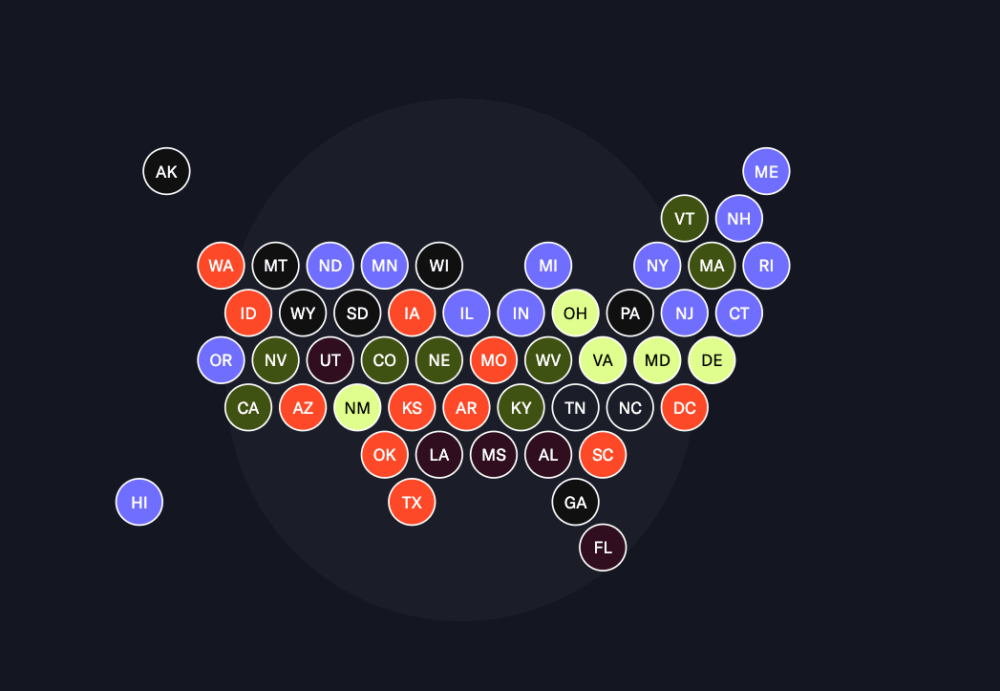
Election Policy Tracker
We are committed to providing unique, state-focused insights from a national perspective. Explore our Election Policy Tracker for real-time updates and analysis and learn more about our work to ensure free and fair elections.